- A switch controls on/off. A dimmer adjusts light level, and the light’s electronics must work with that control method.
- “LED”, “dimmable” and a similar-looking wall control do not prove a compatible pair. Identify the actual models and their instructions.
- Flicker or an unusual noise needs assessment. A compatibility explanation cannot rule out an electrical fault or clear the installation.
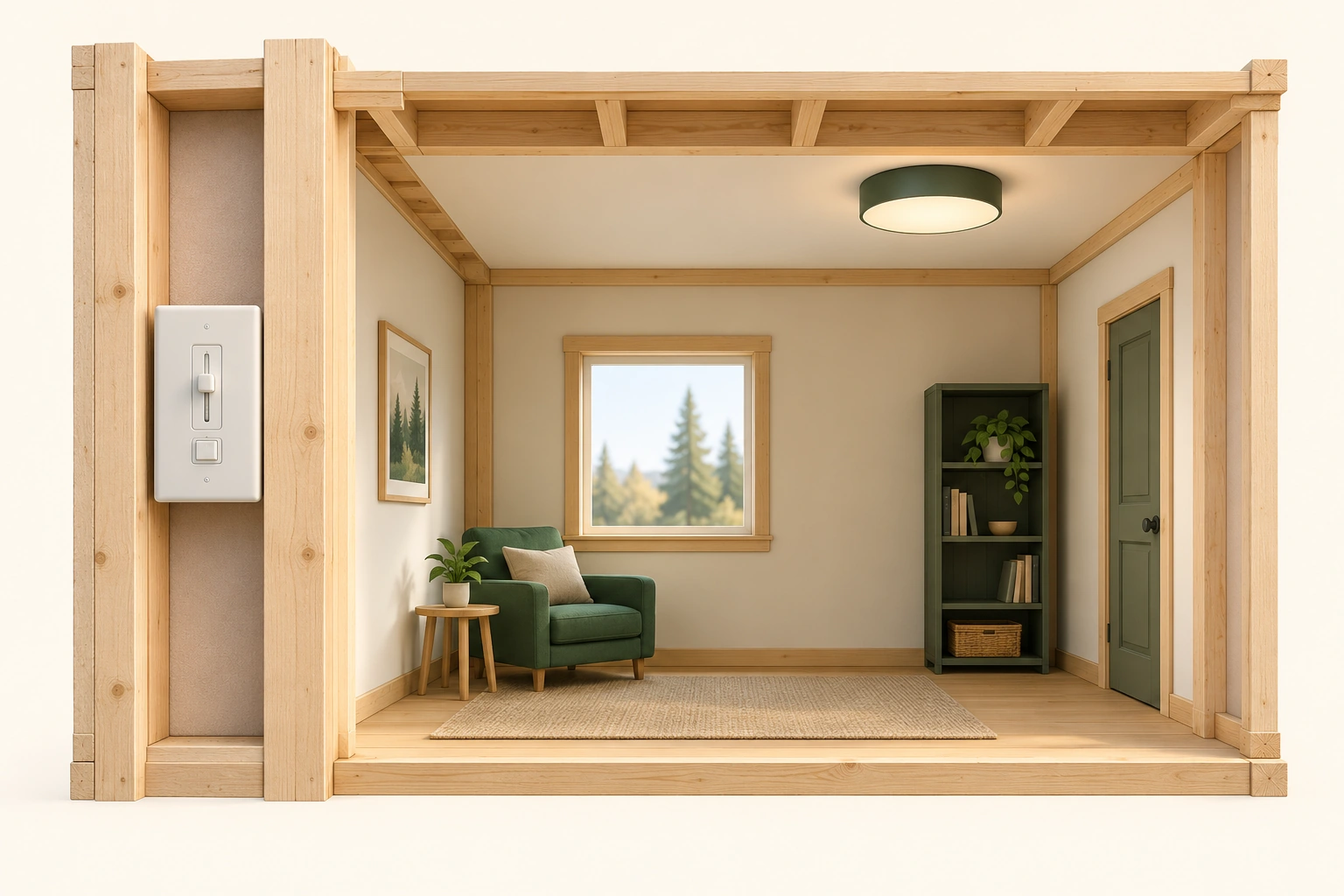
A switch gives on/off control; a compatible dimmer adds brightness adjustment. The ceiling fitting holds or contains the light source. This room cutaway places the control at the left and the light above the room, without showing their wiring.
About this illustration
No installed model, hidden connection, control method, matched pair, electrical condition, measured light output or safe access is established. This is a conceptual teaching model, not an assessment of your home.
6 picture lessons appear beside the questions in this guide. Use them to understand the explanation, then consider what it means for your home.
What happens between the wall control and the light?
Start with three familiar jobs. Electrical power is supplied to the lighting. The control requests on/off or a light level. The lamp or lighting fixture produces the light. A fixture is the fitting that holds or contains the light source; a lamp can mean a replaceable bulb in product documents.
With LED lighting, electronics are part of the story. An LED lamp contains electronic components. In another arrangement, a separate power supply feeds the lighting, as in the named DALS example below. The electronics and control must suit one another. The appearance of a bulb, ceiling fitting or wall plate cannot identify that relationship.
This explains why two questions differ: “Can the light turn on?” and “Does this light work properly with this dimming control?” A successful start answers neither the whole dimming question nor the condition of the wiring. Keep ordinary control, light production and electrical protection separate when reading a proposal.
Flickering, surging or unexpectedly dimming lights need qualified assessment: Ontario ESA warns about loose connections and shock or fire hazards. Do not remove covers or repeatedly demonstrate the problem. For smoke or fire, get out, stay out and call emergency services from outside. For active sparks, keep clear and seek emergency help.
The wall control and the light have different jobs
A switch gives on/off control; a compatible dimmer adds brightness adjustment. The ceiling fitting holds or contains the light source. This room cutaway places the control at the left and the light above the room, without showing their wiring.
Numbers identify the parts explained below.
- Wall control
A switch gives on/off control. A compatible dimmer also adjusts brightness; the model documents identify its method.
- Light fitting
Holds or contains the light source. The illustrated glow is not an operating measurement.
- Model documents
Name the actual light and wall control, then check which equipment they are designed to work with.
What does this illustration leave out?
No installed model, hidden connection, control method, matched pair, electrical condition, measured light output or safe access is established. Read the part names and their jobs below the picture.
Which actual light and wall-control models are documented, and what identifies their intended relationship?
Explore this with HomeAI ↗Opens an editable question. Nothing is sent until you choose to send it.What is the difference between a switch and a dimmer?
An ordinary light switch gives on/off control. A dimmer adds adjustable light level: you can request less or more light from equipment designed for that control. The wall device may combine a separate on/off action with a slider, dial or another level control. Similar-looking buttons can have different functions.
A dimmer is not simply a smaller version of the circuit breaker. The breaker belongs to the electrical protection system; the wall control belongs to ordinary lighting use. Turning a light off at its usual control is not an electrical-isolation procedure and does not make opening the fixture, control or wiring safe.
Control from two doorways adds another question. A three-way arrangement provides control from two locations. Depending on the documented products, one location may adjust the level while another provides on/off, or a matched multi-location family may offer different functions. The number of wall plates does not establish the arrangement.
Record the controls you already know about and ask which products belong together. Do not uncover devices to identify their connections or assume another dimmer can be added at the second doorway. Ask the electrician to describe the intended everyday functions at each location, using the applicable model instructions.
What extra job does a dimmer do?
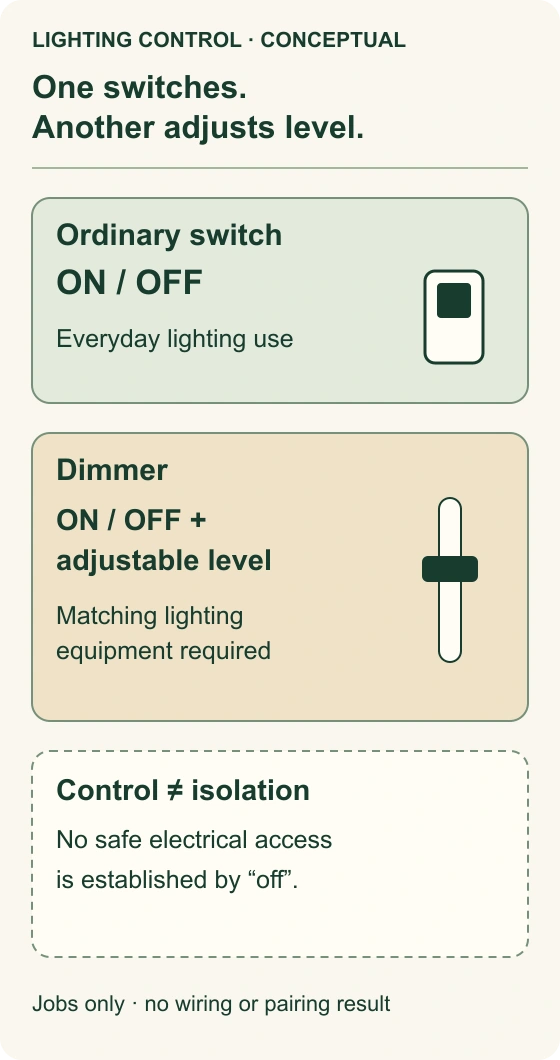
A switch provides on/off. A compatible dimmer also requests an adjustable light level. The panels compare everyday jobs; they do not show electrical connections.
Numbers identify the parts explained below.
- Switch
Gives ordinary on/off control.
- Dimmer
Adds an adjustable-level request when the identified lighting supports its method.
- Electrical access
Turning the light off at its usual control does not make opening equipment safe.
What does this illustration leave out?
No installed control, compatible product, isolation, circuit condition or safe electrical access is established. Read the complete switch and dimmer comparison below.
Which everyday functions does each documented control provide, and which light supports its method?
Explore this with HomeAI ↗Opens an editable question. Nothing is sent until you choose to send it.Read the complete diagram
Read the complete switch and dimmer comparison
- Ordinary switch
- Gives on/off control for everyday lighting use.
- Dimmer
- Adds an adjustable-level request when the documented lighting supports that control method. A similar slider or dial does not identify the method.
- The light’s response
- Depends on the actual lamp or fixture electronics and its documented relationship with the control. No level, percentage or smooth response is assumed here.
- Electrical isolation
- Has a separate purpose from ordinary lighting control. A light switched off at its usual control does not make opening the control, light or wiring safe.
These parallel panels compare component jobs. They are not a wiring route, switching procedure or proof that a light and dimmer are compatible.
What remains unknown: No installed control, compatible product, isolation, circuit condition or safe electrical access is established.
A useful question: Which everyday functions does each documented control provide, and which light supports its method?
Three different jobs: control, light and protection
- Ordinary switchGives ordinary on/off control; it does not provide an electrical-isolation procedure.
- DimmerRequests an adjustable level using a method that the identified lighting must support.
- LED electronics or documented power supplyManage the light’s electrical input; the actual architecture and matching requirements depend on the product.
- Electrical protectionHas a separate job from ordinary level control. Use the existing protection guide and qualified assessment for that question.
General jobs, not a wiring diagram or a finding about your installation.
Further reading: Leviton · Residential dimmers and compatibility questions; DALS · Named external LED power-supply example; Ontario ESA · Homeowner electrical safety handbook.
What does an LED driver or power supply do?
A driver or power supply manages the electrical power used by a particular LED lighting system. It has a different job from the wall control that requests a light level. The LED elements make light; the supply arrangement and control determine how that documented system receives and responds to power.
For a concrete example, DALS describes DR2496DIM as an external power supply for named lighting applications and identifies its dimming methods. This shows why a small enclosure can matter even when it does not make light. It is one documented architecture, not a universal diagram of every bulb or recessed fixture.
Other lighting has electronics within the lamp or fixture. Do not assume every unit has the same internal parts, a separately replaceable driver or the same output. A diagram helps name the jobs; the actual manufacturer documents and a qualified assessment establish what is installed and which components can be serviced.
If a proposal says “replace the driver”, ask what exact unit is being replaced, what finding supports that work, and which light and control it must match. A replacement box with similar dimensions is not enough. Leave component access, electrical measurements and selection of replacements to the qualified provider.
Why can an LED light need a separate power-supply box?
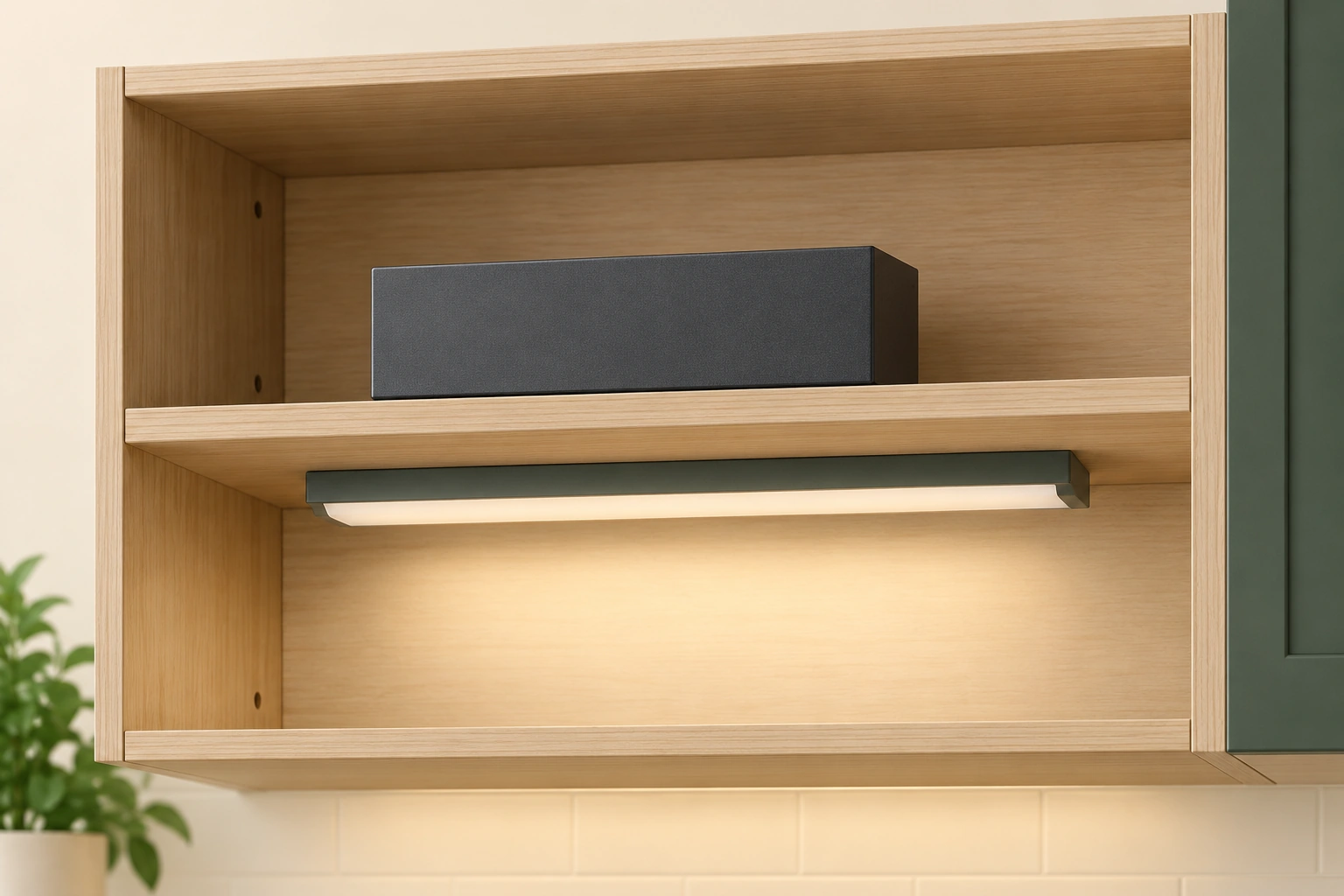
For some LED lighting, a separate power supply manages the power reaching the light. The box above and light bar below illustrate those two jobs; no connecting wires are drawn.
Numbers identify the parts explained below.
- Power-supply box
Manages the power reaching some LED lights. The box is generic, so it identifies no actual model or output.
- Separate light
The bar produces light. Its appearance does not tell you which power supply or control it needs.
- Check the arrangement
Some lights have their electronics inside the lamp or fitting. The model documents explain which arrangement applies.
What does this illustration leave out?
No specific DALS product, actual output, connection, control method, installation, replacement part, serviceability or measured light output is established. Read the part names and their jobs below the picture.
Which power-supply arrangement do the actual model documents describe?
Explore this with HomeAI ↗Opens an editable question. Nothing is sent until you choose to send it.Why is “dimmable LED” not the whole answer?
“Dimmable” tells you a product has a documented dimming capability. It does not say that every dimmer, control method or installation will work with it. Leviton explicitly notes that not all LED bulbs dim smoothly with every Leviton dimmer. The light and the control are a pair to identify.
Keep the complete model information, not just the brand and “LED” description. Ask for the light’s intended control method, the control’s supported light types, and any manufacturer pairing information for those exact products. A compatibility list is more useful than a general statement that a dimmer is suitable for LEDs.
The application matters too: which lights share the control, how many are connected, whether another control location is involved, and which fixture or power supply is present. Product instructions may contain limits for that arrangement. Those details are for the electrician to verify; an online wattage calculation does not approve the installation.
Treat a tool result as a bounded document. Record the selected models, the date and any stated test conditions or exclusions. We have read the compatibility-tool gateway, but have not queried or accepted a particular pair. Neither the gateway nor a product logo is an assessment of your home’s existing connections.
Which evidence answers the compatibility question?
- “Dimmable” on the lightA documented capability; it does not identify a suitable control for every arrangement.
- An exact manufacturer pairing recordInformation about selected models and stated conditions. Keep the result, date and exclusions; no actual pair was queried for this guide.
- A qualified installed-system assessmentFindings about the locations and equipment actually examined. Its exclusions and date still matter.
- An invoice or authority recordThe recorded work or authority scope. Neither silently supplies the other assessments.
Product documents, work records and assessed current condition answer separate questions.
Further reading: Leviton · Residential dimmers and compatibility questions; Leviton · LED dimmer compatibility tool gateway; Electrical Safety Authority — notifications and inspections.
Do all dimmers send the same kind of command?
No. A familiar wall control can work through different methods. In phase-cut dimming, the control changes the pattern of electrical power delivered to the lighting. “Forward phase” and “reverse phase” name different versions. The light’s documented electronics must be suitable for the method; the names are not a homeowner wiring recipe.
A named Leviton 0–10 V example separates two jobs: switching the light’s power and sending a brightness-control signal to its driver. Think of available power and the requested light level as separate functions. That conceptual distinction does not identify the wires, installed voltage or safe access in your home.
These examples explain why two products called “dimmers” are not automatically interchangeable. A slider on the front cannot tell you which method the device uses. Similarly, “low voltage” in a description does not make opening a device or touching its wiring safe. Use exact documentation and qualified electrical work.
Before approving a lighting proposal, ask: “Which control method does this light require, and what shows that this control supports it?” Request that explanation in ordinary language alongside the model numbers. No waveform, wiring diagram or claimed universal compatibility is needed for you to ask a useful question.
Similar controls can use different methods
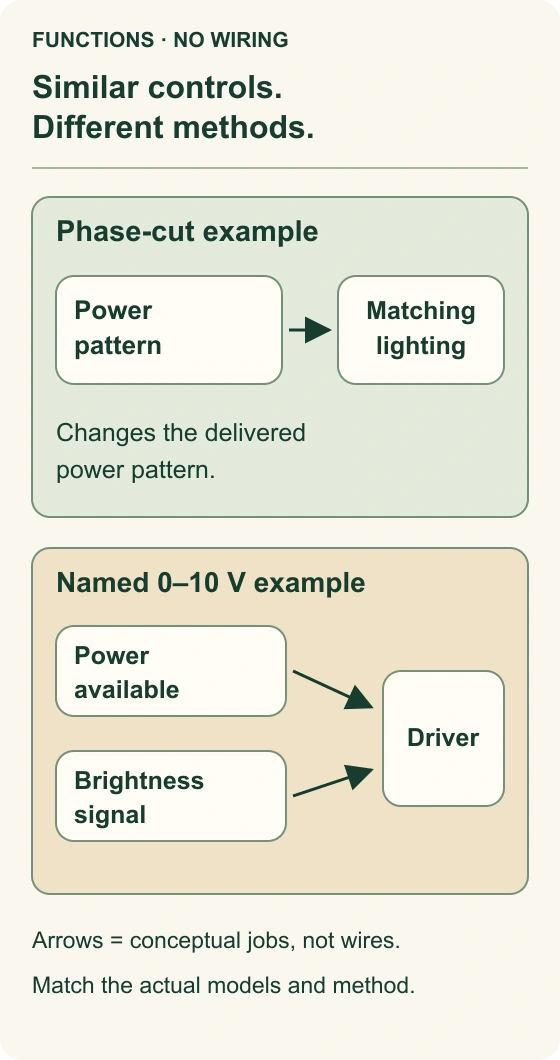
Phase-cut changes the delivered power pattern. The named Leviton 0–10 V example separates a power-switching job from a brightness signal. Similar-looking controls are not automatically interchangeable.
Numbers identify the parts explained below.
- Phase-cut example
Changes the power pattern delivered to lighting designed for that method.
- Named 0–10 V example
Power switching and a separate brightness signal serve different functions.
- Actual documents
The identified light, driver and control instructions establish the method and matching requirements.
What does this illustration leave out?
No wire, colour identity, physical route, measured waveform, installed voltage, control setting, matched pair or safe access is established. Read the complete function comparison below. The arrows are jobs, not wires.
Which control method does this light require, and what documentation shows that the proposed control supports it?
Explore this with HomeAI ↗Opens an editable question. Nothing is sent until you choose to send it.Read the complete diagram
Read the two conceptual control methods
- Phase-cut example
- The control changes the pattern of electrical power delivered to lighting designed for its method. Forward and reverse phase are different versions; no waveform is drawn or measured here.
- Power-switching job in the named example
- Leviton’s IP710/DS710 0–10 V explanation distinguishes switching power from requesting brightness. This conceptual job diagram identifies no conductor or physical route.
- Separate brightness signal
- The named 0–10 V example sends a brightness signal to the driver. “0–10 V” names that documented control family; it is not a measurement of the installed system or an assurance of safe electrical access.
- Equipment matching
- Ask which method the exact light or driver requires, and what documentation shows that the exact control supports it. Similar control faces do not establish interchangeability.
Every arrow represents a conceptual function. The diagram supplies no wiring, numerical waveform, setting, universal voltage, product selection, installation or owner test.
What remains unknown: No wire, colour identity, physical route, measured waveform, installed voltage, control setting, matched pair or safe access is established.
A useful question: Which control method does this light require, and what documentation shows that the proposed control supports it?
Why can app-dimmable lights need an ordinary wall switch?
A connected light can handle its own brightness command through its electronics and app. Its wall switch can have a separate job: making power available. For the documented DALS Connect family, the manufacturer says its lights work with a standard switch and should not be used with a wall dimmer.
This is a useful counterexample to “if it dims, add a dimmer”. In that family, app-controlled brightness does not establish permission to put another dimming method ahead of the light. When the ordinary switch removes power, that family’s connected control is unavailable. This is not a rule for every smart-lighting brand.
For the actual equipment, ask which functions depend on power, a compatible controller, a network or an account. Keep those questions separate: a light that can still be switched normally may have different remote-control capabilities. A manufacturer example does not establish the network, accessories or account access present in your home.
At handover, request the correct product instructions and authorized transfer of the necessary controls or accounts. Do not reset, pair or change network settings as an experiment to identify equipment. An electrician and the manufacturer’s support can clarify the installed arrangement; the owner can keep the resulting documents together.
Power availability and brightness are separate jobs
For the documented DALS Connect family, an ordinary switch makes power available and the app requests brightness. DALS says not to use a wall dimmer for this family. Other products require their own instructions.
Numbers identify the parts explained below.
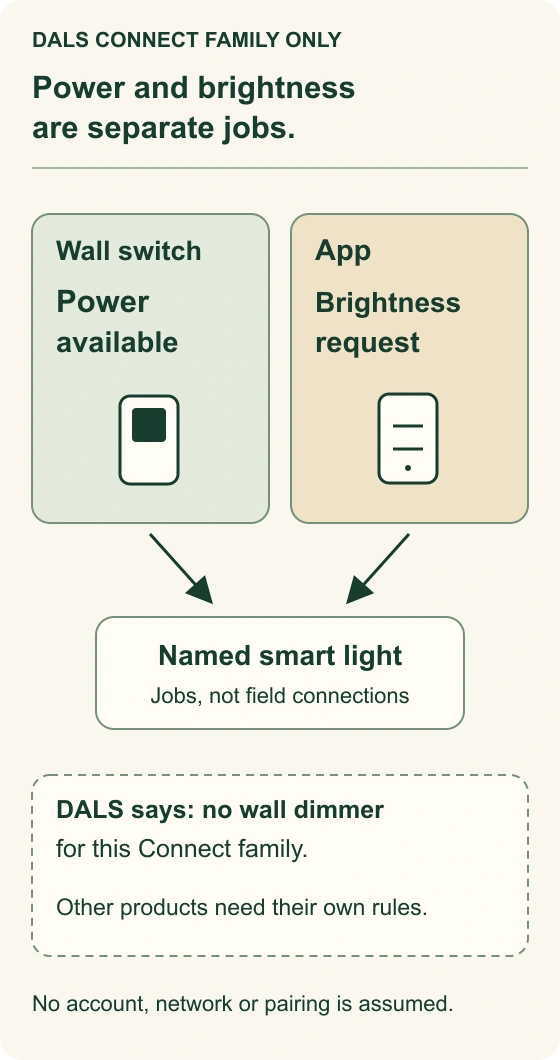
- Wall switch
Ordinary switched power is a separate job from the app brightness command.
- App
Requests brightness through the named family’s connected features; actual access remains a separate question.
- Model-specific limit
The no-wall-dimmer instruction belongs to this DALS Connect family, not every connected light.
What does this illustration leave out?
No actual product, power state, account, network, installed accessory, pairing, outage operation or universal smart-lighting compatibility is established. Read the complete named-family explanation below.
Which functions depend on power, a controller, a network or an account for the actual installed products?
Explore this with HomeAI ↗Opens an editable question. Nothing is sent until you choose to send it.Read the complete diagram
Read the DALS Connect-family example
- Ordinary wall switch
- Makes power available for the documented family. This everyday role does not provide an electrical-isolation procedure.
- App brightness request
- The app controls brightness through the family’s connected features. A brightness request is distinct from the job of providing power.
- Specific manufacturer instruction
- DALS says this Connect family works with a standard switch and should not be used with a wall dimmer. This is not a compatibility rule for every smart-lighting product.
- Actual household questions
- Identify the installed products and instructions. Ask which functions depend on power, a compatible controller, a network or an account; no present network, login, accessory or pairing is assumed.
Removing power at the ordinary switch makes this family’s connected control unavailable. This explains a documented role distinction, not an instruction to reproduce a problem, reset, pair or change a network.
What remains unknown: No actual product, power state, account, network, installed accessory, pairing, outage operation or universal smart-lighting compatibility is established.
A useful question: Which functions depend on power, a controller, a network or an account for the actual installed products?
What can flicker or an unusual noise mean?
A lamp/control mismatch can affect dimming, so pairing is one reasonable question. It is not the only one. ESA also identifies dimming, surging or flickering as possible signs of a loose connection in a lighting circuit, fixture or electrical service. One symptom cannot distinguish those explanations safely.
Noise has several possible contributors too. LEDVANCE describes electronic components, the lamp holder or fixture, dimmer and other equipment as possible influences on audible noise. That is a supplementary manufacturer explanation from a UK page, not a finding about your lamp or a promise that buzzing is harmless.
Tell the electrician what you already noticed: the room, which lights, whether a change followed recorded work, and the approximate date. Include observations from normal use only. A concern at one fixture does not clear the rest of the installation; a concern in several rooms does not identify a particular service fault.
Do not adjust a suspect dimmer, change lamps, open covers or switch other loads to reproduce the event. For smoke or fire, get out, stay out and call emergency services from outside. Keep clear of active sparks or wet electrical areas and contact the utility or emergency services. Do not touch equipment or attempt switching.
How can you make a useful lighting record safely?
Start with documents you already have: product packaging, the supplied fixture manual, invoices and previous assessment reports. Add a simple room list naming the light and usual control locations. Photograph an already accessible external label only when it does not require climbing, dismantling or approaching damaged equipment. Leave concealed identities unknown.
Keep observations and documents in separate fields. “Bedroom ceiling light flickered during normal use” describes an observation. “Invoice lists a lamp replacement” describes recorded work. “Electrician found a loose connection at the stated location” would be a finding only when an actual report says that. Do not turn the first two into the third.
Useful fields include the exact light and control models, known fixture or power-supply model, documented dimming method, number of lights sharing the control, other control locations, and the date/source of each detail. Mark anything supplied verbally as reported. A partly completed record is more honest than a filled-in guess.
There is no need to remove a wall plate, climb to a recessed light, measure voltage or explore wiring to complete the record. Send the unknowns to the electrician. Ask them to identify what can be established from documents and what requires examination, then request a written account of the scope and findings.
What do the numbers and labels actually tell you?
A watt measures electrical power; lumens describe light output. Those are different quantities. A brightness-equivalence description compares the offered light with a reference lamp; it does not replace the product’s actual electrical-input information. Colour appearance and brightness preferences are also different from the control method and electrical condition.
When reading a proposal, keep each number with its job. The light’s stated input, a control’s documented supported load, and a count of connected lights are separate entries. The qualified provider must check the applicable product instructions and the installed arrangement. No generic total settles all load types or control requirements.
A certification or evaluation question is also different from a dimming-performance question. Ask the electrical authority or qualified provider which approval and installation requirements apply locally. A similar mark in an illustration, a marketing logo or a shopping listing cannot authenticate your product or the work in your home.
If an assessment includes measurements, request the location, method, conditions and comparison used. A check of one documented pairing or operating condition cannot certify every light, concealed connection or future replacement. The useful result answers a defined question and states what remains unexamined, rather than simply saying “LED compatible”.
What should an electrician’s proposal and report explain?
A useful proposal names the problem being investigated and the equipment involved. Ask whether it covers product identification, compatibility documents, fixture/control condition, affected connections, other control locations or a wider supply concern. These are possible assessment tasks, not promises that every concern needs every test.
Ask the provider to explain why a suggested component is appropriate for the actual light, control method and installation. If work is proposed, request its scope, the applicable local authority process and completion records. Keep replacement work and the evidence that explains the original concern as separate items.
Ontario is one regional example: ESA describes licensed electrical contracting businesses, electrical notifications and a review process distinct from a building permit. Its risk-based process can vary. Do not assume that every accepted file means every device received an on-site examination, or transfer Ontario terminology to another province or territory.
Elsewhere in Canada, confirm the contractor’s required qualifications and the electrical authority’s current requirements for your project. In a condominium or other shared property, also confirm authorization for work affecting shared services. An AI explanation or HAUSE referral cannot establish a provider’s licence, availability, assessment findings or approval.
Fictional example: did new LEDs prove the old dimmer was suitable?
Fictional example: Amira’s kitchen has four lights on one older wall control. An invoice records four LED lamp replacements, but does not identify the control model or a pairing check. Packaging says the lamps are dimmable. She later notices flicker during normal use and contacts an appropriately qualified electrical provider.
The invented record has four lamp positions, four recorded replacements and zero recorded control-model or pairing findings. Those are document counts, not electrical ratings, measured performance or proof that nothing was checked. The invoice’s silence leaves the assessment unknown. Amira does not recreate the flicker or change components to investigate.
A pairing concern is possible, but so is an electrical fault. The provider’s actual scope and findings would determine the next step. If a later fictional report identifies a connection issue and states that only the kitchen lighting was examined, retain both statements. A particular finding does not establish a whole-home clearance.
The useful outcome is a better record: identified light/control models, the assessed issue, dated work, applicable completion evidence and any exclusions. This scenario invents no approved pair, repair result, current product, cost or real customer case. The same questions help at new-home handover when the controls and manuals are unfamiliar.
Count Amira’s records, not assurances
All counts and events are invented: four positions, four recorded replacements and zero recorded control-model or pairing findings. The missing entries leave questions open; they do not identify the cause of flicker.
Numbers identify the parts explained below.
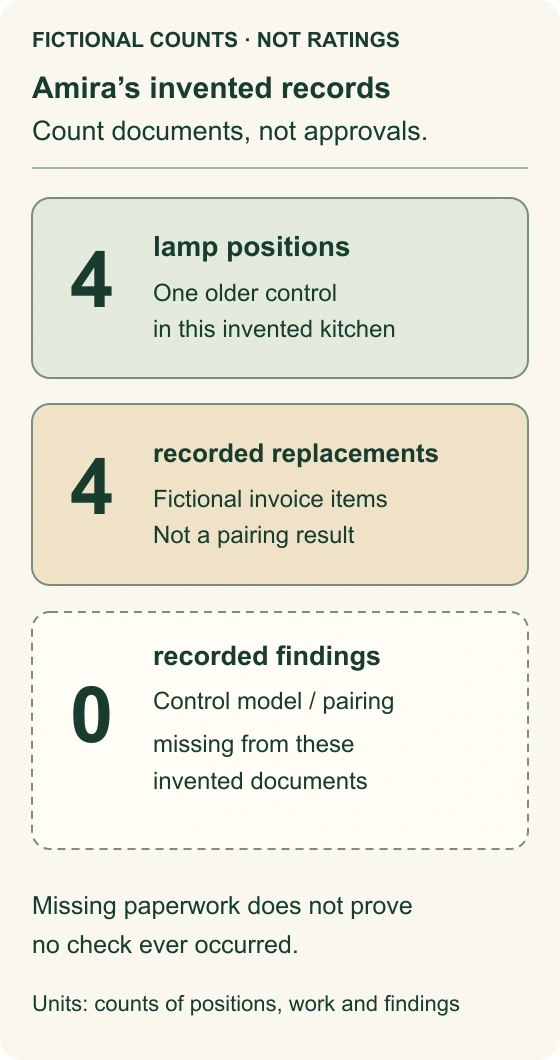
- 4 positions
Invented scope: four kitchen lamp positions share one older control.
- 4 replacements
The fictional invoice records four LED replacements; it does not establish the control model or pairing.
- 0 recorded findings
The supplied fictional records contain no control-model or pairing findings. Missing documentation does not prove no assessment happened.
What does this illustration leave out?
No measured load, real model, accepted pair, finding that no check occurred, repair result, cost, installed approval or whole-home safety conclusion is supplied. Read all the invented counts and their limits below.
Which model and pairing information is missing, and what did the actual qualified assessment cover?
Explore this with HomeAI ↗Opens an editable question. Nothing is sent until you choose to send it.Read the complete diagram
Read every invented count in Amira’s kitchen
- 4 lamp positions
- Invented scope of this example: four kitchen positions share one older wall control. The unit is a count of positions, not watts or lumens.
- 4 recorded LED replacements
- The fictional invoice lists four replacements. This is a count of recorded work items, not an accepted light/control pairing or performance result.
- 0 recorded control-model or pairing findings
- These entries are missing from the supplied invented records. Zero is the count of recorded findings here; it does not prove no check occurred or that no compatible pair exists.
- Concern and alternative explanations
- Flicker was noticed during normal use, with no owner experiment. A pairing concern and an electrical fault remain possible until appropriately qualified assessment provides actual findings.
- Scope stays attached to a later report
- If a later report examines only the kitchen, keep that exclusion. A kitchen finding does not establish whole-home clearance.
All names, counts and events are fictional. No electrical rating, cost, actual product, approval, completed repair, current installation or real customer case is supplied.
What remains unknown: No measured load, real model, accepted pair, finding that no check occurred, repair result, cost, installed approval or whole-home safety conclusion is supplied.
A useful question: Which model and pairing information is missing, and what did the actual qualified assessment cover?
Amira’s fictional kitchen: count records, not assurances
- Four lamp positionsInvented scope of the kitchen example; not a measured electrical load.
- Four recorded LED replacementsThe fictional invoice describes work, not an accepted lamp/control pair.
- Zero recorded control-model or pairing findingsMissing from the invented documents; this does not prove no check ever occurred.
- Later assessment, if obtainedRetain the actual findings and exclusions. Kitchen findings do not clear every room.
All counts and events are invented. No rating, cost, test outcome or property approval is supplied.
Further reading: Leviton · Residential dimmers and compatibility questions; Leviton · LED dimmer compatibility tool gateway; Ontario ESA · Homeowner electrical safety handbook.
Which information should stay with the home?
Keep a room-based lighting schedule with the actual fixture, replaceable lamp, control and any documented external power supply. Add applicable manuals and manufacturer pairing information with dates. If later work changes one part, update the entry rather than assuming the original product relationship still applies.
Keep the professional report beside the work invoice and any applicable authority record. A report explains observations and findings; an invoice records the supplied work; an authority record has its stated project scope. None automatically substitutes for the others or establishes that present condition will remain unchanged.
For a new build, ask which controls and fixtures were installed, how multi-location or connected features are intended to work, and what check was recorded. A room demonstration can explain ordinary use, but it does not independently assess concealed connections or guarantee every later lamp will suit the control.
HomeAI can help organize these questions and explain the component jobs. Ask any proposed HAUSE provider about their actual electrical qualifications, product familiarity, service area and assessment scope. A referral description is not an inspection or an invented credential. Preserve the resulting evidence so the next owner understands the lighting too.
Practice the distinction.
Amira’s fictional lighting record
Four kitchen lamp replacements are recorded; the older control’s identity and pairing assessment are not. All names, counts and events are invented.
Reported observations
- Four positions share the recorded kitchen control.
- The invoice lists four dimmable LED replacements.
- Flicker was noticed during normal use; no owner experiment or measurement was performed.
Compare the explanations
Expand each possibility to see the evidence needed to distinguish it. Similar symptoms can have different mechanisms.
The lamp/control pairing needs identification
The dimmable label does not establish this particular pair. The old control model and applicable documents are unknown.
Exact model identities, applicable manufacturer pairing information and the provider’s assessment scope.
An electrical fault remains possible
Flicker can also involve a connection problem. Appearance, one room or no additional symptoms cannot choose the cause.
Appropriate qualified assessment and a report of the actual findings and exclusions.
A useful next question
Send the ordinary-use concern and existing documents to an appropriately qualified electrical provider. Ask what needs assessment; do not recreate the event.
This invented record supplies no compatibility result, electrical rating, quote, installed approval or whole-home safety conclusion.
Know what the words mean.
- Lamp and fixture
- A lamp can mean the light source or replaceable bulb. The fixture is the fitting that holds or contains the light source.
- Dimmer
- An ordinary lighting control that allows an adjustable light level when the documented lighting equipment supports its method.
- Driver or power supply
- Electronics that manage power for the documented LED lighting system. The actual location, output and serviceability depend on the equipment.
- Phase-cut dimming
- A control method that changes the electrical power pattern delivered to compatible lighting. The term supplies no installation instructions.
- 0–10 V control
- A named control family can use a separate brightness signal as well as a power-switching job. Exact equipment instructions establish the actual arrangement.
- Compatibility
- Whether identified products are designed to work together under their documented conditions. It is different from approval or an assessment of present connections.
- Three-way control
- An arrangement for controlling lights from two locations. Which location can dim depends on the documented devices.
- Watts and lumens
- Watts describe electrical power. Lumens describe light output. Neither quantity alone establishes control compatibility or safety.
Questions to bring
to the conversation.
- Record only safely available product documents and observations from ordinary use; leave concealed identities unknown.
- Ask which exact light, control and power-supply models are involved and which control method is documented.
- Request the actual assessment scope, findings, proposed work and applicable regional completion records.
- Keep compatibility, product approval and present installation condition as separate questions; do not perform owner wiring or fault tests.
Separate a showing observation, an existing record and a new professional assessment. Unknown means a question remains; it does not automatically mean a defect.
Use the evidence planner ↗Go to the source.
Original HomeAI explanation informed by these public references. Sources support the underlying guidance; they have not reviewed or endorsed HomeAI. Diagrams are conceptual, and calculator outputs depend on your inputs.
Canadian lighting education, Ontario ESA safety/record examples and Calgary fire-response guidance are supplemented by named Leviton and DALS family explanations. One UK LEDVANCE body supplies limited electronics/noise context; its historical standards discussion is not adopted. No current Canadian code, particular compatible pair, installed condition or product approval is established. NRCan’s historically framed lighting page is not used for current market, savings or lifetime numbers.
Publication & source review
First published .
Sources reviewed .
- NRCan · Home lighting design guide
Where this reference applies
Jurisdiction: Federal Canadian consumer education; historically framed lighting guide
Edition: Issued January 30, 2014; webpage modified March 19, 2026. The later page date does not make its older lamp-market descriptions current.
Source reviewed: 2026-10-06 · America/Edmonton
Reading scope: Complete 274-line main HTML body personally read. Linked PDF and source photographs not independently read or inspected.
Lighting tasks, light-output versus electrical-input terms and ordinary switch/dimmer jobs. No current savings, lamp lifetime, market prevalence, product approval, room-installation rule or owner installation recipe.
- Leviton · Residential dimmers and compatibility questions
Where this reference applies
Jurisdiction: Manufacturer residential families; no Canadian installation acceptance inferred
Edition: CMS publication metadata August 10, 2026; not an instruction-sheet edition.
Source reviewed: 2026-10-06 · America/Edmonton
Reading scope: Complete 143-line main HTML body personally read. Linked buying guides, videos and compatibility results not counted as read.
Switch/dimmer roles, multi-location questions, named LED pairing and the limit that not every LED dims smoothly with every control. No wiring, fin removal, derating recipe, load threshold or universal suitability.
- Leviton · LED dimmer compatibility tool gateway
Where this reference applies
Jurisdiction: Manufacturer pairing information
Edition: CMS publication metadata January 13, 2026.
Source reviewed: 2026-10-06 · America/Edmonton
Reading scope: Complete 11-line main HTML body personally read. No lamp/control pairing was queried or accepted.
Purpose of model-specific pairing information. A gateway is not a test result, certified installation or guarantee of field behaviour.
- Leviton · Forward and reverse phase dimming
Where this reference applies
Jurisdiction: Manufacturer conceptual FAQ; named residential controls
Edition: CMS publication metadata January 29, 2026.
Source reviewed: 2026-10-06 · America/Edmonton
Reading scope: Complete five-line main body personally read. Linked detailed application note remains unread.
Phase-cut changes the electrical power pattern delivered to the load. No leading/trailing waveform, wiring detail, universal neutral requirement or product-selection recipe.
- Leviton · How named 0–10 V dimmers work
Where this reference applies
Jurisdiction: Manufacturer named IP710 and DS710 family examples
Edition: CMS publication metadata January 29, 2026.
Source reviewed: 2026-10-06 · America/Edmonton
Reading scope: Complete ten-line main body personally read. Linked product or power-pack instructions not implied read.
Separate power-switching and brightness-signal jobs. No wire colours, installation, power-pack selection, capacity or low-voltage safety assurance.
- DALS · Named external LED power-supply example
Where this reference applies
Jurisdiction: Manufacturer with Canadian office; DR2496DIM example only
Edition: No substantive publisher date established; copyright year is not publication evidence.
Source reviewed: 2026-10-06 · America/Edmonton
Reading scope: Complete rendered main product body personally read through the web tool. Ordinary direct GET returned 403 and is retained separately. Linked catalogue sheet and source photographs not independently read/inspected.
A named external power supply and its specified dimming-method relationship. No universal LED voltage, rating, load range, replacement procedure, Canadian approval or availability claim.
- DALS · Connect-family smart-lighting FAQ
Where this reference applies
Jurisdiction: DALS Connect manufacturer family; not all connected lighting
Edition: No substantive publisher date established; copyright year is not publication evidence.
Source reviewed: 2026-10-06 · America/Edmonton
Reading scope: Complete rendered main FAQ body personally read through the web tool. Ordinary direct GET returned 403 and is retained separately. Linked manuals/apps not read.
This named family uses app dimming and ordinary switched power; manufacturer says not to use a wall dimmer. No reset, pairing, wiring, network limits, security or universal smart-lighting compatibility.
- LEDVANCE · Electronics and dimmer matching
Where this reference applies
Jurisdiction: United Kingdom manufacturer body; supplementary component explanation, not Canadian approval or standard
Edition: No substantive page date established. Historical forward-looking standards language is withheld; linked lists have their own dates and remain unread.
Source reviewed: 2026-10-06 · America/Edmonton
Reading scope: Complete 109-line rendered page body personally read, including all substantive dimming/electronics/noise paragraphs. Linked compatibility PDFs and standards not read.
LED lamps contain electronics; lamp/control matching and several possible contributors to audible noise. No current standard absence, EN/CE adoption, Canadian model compatibility or finding that a noise is harmless.
- Ontario ESA · Homeowner electrical safety handbook
Where this reference applies
Jurisdiction: Ontario electrical safety regulator; hazard guidance with local contracting terminology
Edition: Twelve-page currently accessible Inside Your Home handbook; no substantive issue date established from the complete extracted body.
Source reviewed: 2026-10-06 · America/Edmonton
Reading scope: Complete text across all 12 PDF pages personally read through the web tool. Source figure pixels and linked regulations not independently inspected/read.
Flickering/dimming/surging can involve a loose connection and needs qualified assessment; repeated trips and electrical hazards are not pairing clearance. Ontario contractor and record terminology remains local. No owner tests, repair steps, notification deadline or universal inspection rule.
- City of Calgary · What to do during a fire
Where this reference applies
Jurisdiction: Calgary, Alberta; municipal emergency education
Edition: No substantive publication or revision date established; footer year is not a publication date.
Source reviewed: 2026-10-06 · America/Edmonton
Reading scope: Complete current returned web body personally read, including the full substantive preparation, during-fire and after-fire sections. Linked escape-plan, alarm and insurance materials are not counted as read.
Smoke or fire: get everyone out immediately, call emergency services from a safe location outside and do not re-enter. No owner electrical switching, firefighting procedure, national building rule or linked document claim.
- Electrical Safety Authority — notifications and inspections
- Electrical Safety Authority · Protection and damaged equipment
Have a question about your home?
Start with the symptom, timing and what you have observed.
Ask HomeAI