Jump to a question in this guide
- What makes a portable electric heater warm the room?
- How do radiant, convection and fan heaters differ?
- What do the thermostat and safety controls actually do?
- Why do clear space and the whole cord route matter?
- Why is an outlet that accepts the plug not a complete supply assessment?
- Does a different heater shape guarantee lower energy cost?
- What should I record when a heater trips or a room stays cold?
- Why is cycling time different from time spent in the room?
- What should the model, approval and recall record contain?
- Who resolves the underlying heating and safety questions?
- How would a fictional household respond to a heater stopping?
- Resistance heat, air movement and radiant delivery are connected but different jobs.
- A thermostat is not permission to crowd, cover or leave equipment outside its instructions.
- Use suitable direct wall supply; no extension or power strip.
- Keep appliance, building supply and persistent cold-room questions separate.
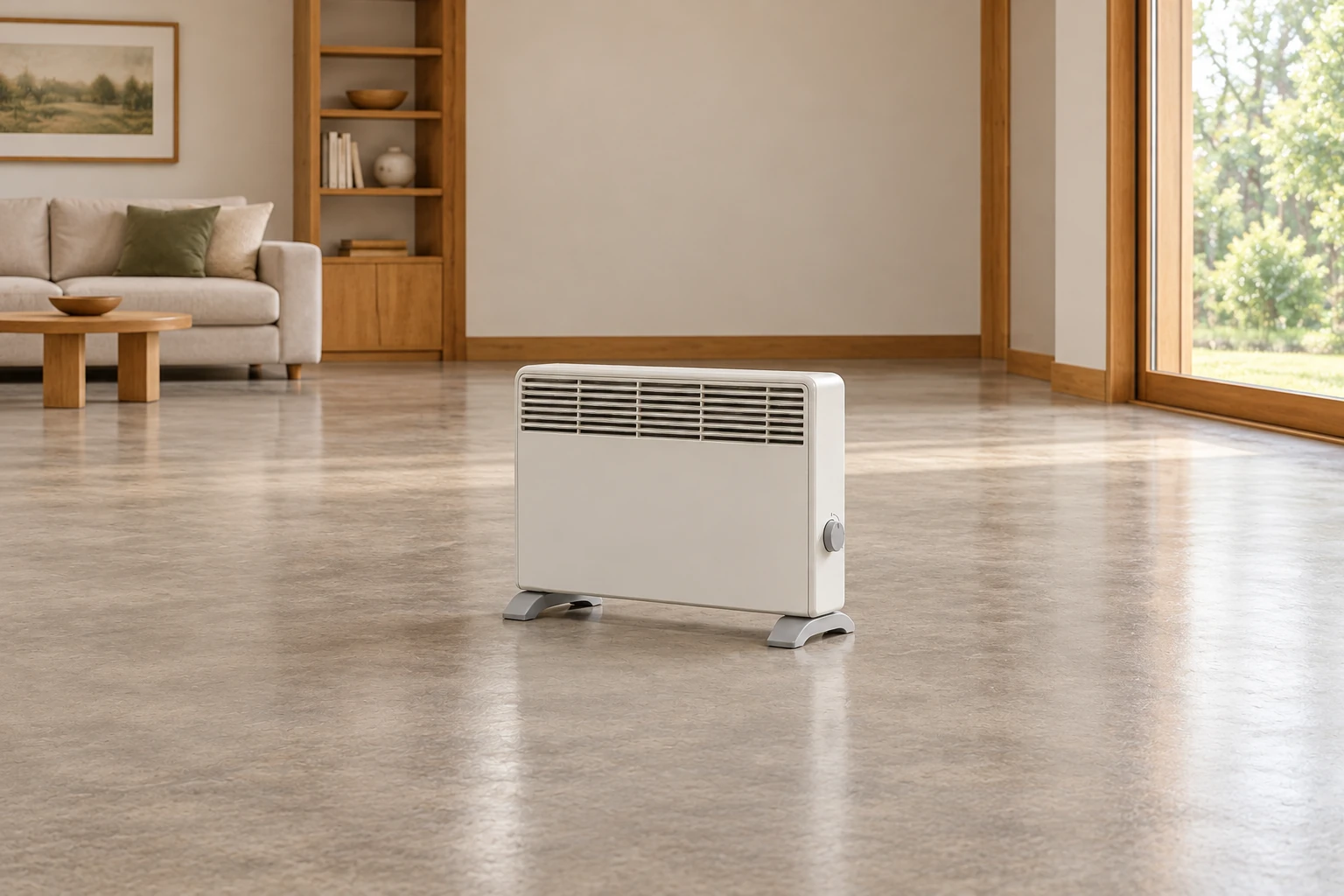
The closed heater sits on bare floor with furniture well back in the conceptual room. Heat delivery, changing surroundings and the actual supply remain connected use questions.
About this illustration
No measured clearance, approved placement, cord/outlet condition, protective feature or operating result. This is a conceptual teaching model, not an assessment of your home.
6 picture lessons appear beside the questions in this guide. Use them to understand the explanation, then consider what it means for your home.
What makes a portable electric heater warm the room?
A portable electric heater takes electrical energy through its intended supply and turns it into heat in a resistance element. The appliance then transfers heat to surrounding air and surfaces. Its casing, grille, controls and any fan arrange that delivery. The plug is part of the supply route; the thermostat controls operation; neither is evidence that the room’s permanent heating need has been resolved.
Portable means the product is intended for use in more than one location under its instructions. It does not mean any outlet, room or surface is suitable. Identify the actual model and intended environment before use. This guide concerns portable electric heaters; fuel-burning heaters, permanently connected baseboards and portable air conditioners with heating functions need their own documentation.
The room picture places a closed heater in a clear floor area. Its spacing is illustrative, not a measured product clearance. ESA advises separation from combustible materials and directs users to a wall outlet without an extension or power strip. Follow the exact product’s instructions and obtain qualified advice when supply or placement is uncertain.
The complete native journey follows electrical input, heat production, delivery to air/surfaces and control response. It shows no exposed element or wiring. Understanding these jobs explains why covering a heater or crowding its airflow can change conditions, and why a lit indicator cannot certify the appliance and supply route.
A portable heater can address a limited supplementary comfort goal while a cold room’s underlying cause remains a separate question. Record the intended use: a short occupied period in an office is different from relying on a portable appliance to replace missing permanent heat. Ask the relevant building/heating professional about persistent inadequate heating rather than adding equipment indefinitely.
Portable heat needs a continuing placement and supply plan
The closed heater sits on bare floor with furniture well back in the conceptual room. Heat delivery, changing surroundings and the actual supply remain connected use questions.
Numbers identify the parts explained below.
- Closed heater
The resistance element supplies heat within the actual design.
- Open floor area
Illustrates why nearby objects and traffic matter without defining a universal safe zone.
- Background room
The persistent heating need and household use require their own plan.
What does this illustration leave out?
No measured clearance, approved placement, cord/outlet condition, protective feature or operating result. This illustration explains an idea. It is not an installation guide.
Can the actual instructions, suitable direct supply and required clear placement all be maintained?
Explore this with HomeAI ↗Opens an editable question. Nothing is sent until you choose to send it.How do radiant, convection and fan heaters differ?
Radiant heating transfers energy toward surrounding surfaces and people. Convection transfers heat through air moving around warmer parts. A fan-forced heater uses a fan to move air through its designed path. Real appliances can combine these processes; the categories explain the dominant delivery arrangement rather than promising one perfectly isolated heat mechanism.
A radiator-style portable heater warms its enclosed body before that body delivers heat to the room. A fan heater directs a moving warm stream. A radiant panel can make the exposure to its warm surface especially relevant. These differences can affect how warmth is experienced without proving a different amount of electrical heat from the same defined input.
The three closed product examples are separate concepts, not tested products. They intentionally show no invented oil passages, fan internals or glowing exposed elements. The native comparison describes the heat route in words. An appearance resembling a radiator does not establish the actual fluid, construction, safety functions or suitability of an unknown appliance.
NRCan explains resistance heating at the point of use. This does not mean that every portable shape gives identical comfort, surface conditions, sound or control behaviour. It also does not establish that a resistance heater is the most efficient whole-home option compared with a suitable heat pump. Keep energy conversion and use-matched comfort as different questions.
Choose an assessment question before comparing claims. Do you need warmth at a particular occupied location, a quieter operating arrangement or a remedy for a persistently cold room? The actual product instructions, suitable supply and safe placement remain necessary in every case. This guide offers no ranking, purchase recommendation or universal output requirement.
Closed heater shapes organize delivery differently
Separate fan-heater, radiator-style and guarded-panel concepts illustrate different delivery arrangements. The native figure explains radiant and convective paths without inventing internals.
Numbers identify the parts explained below.
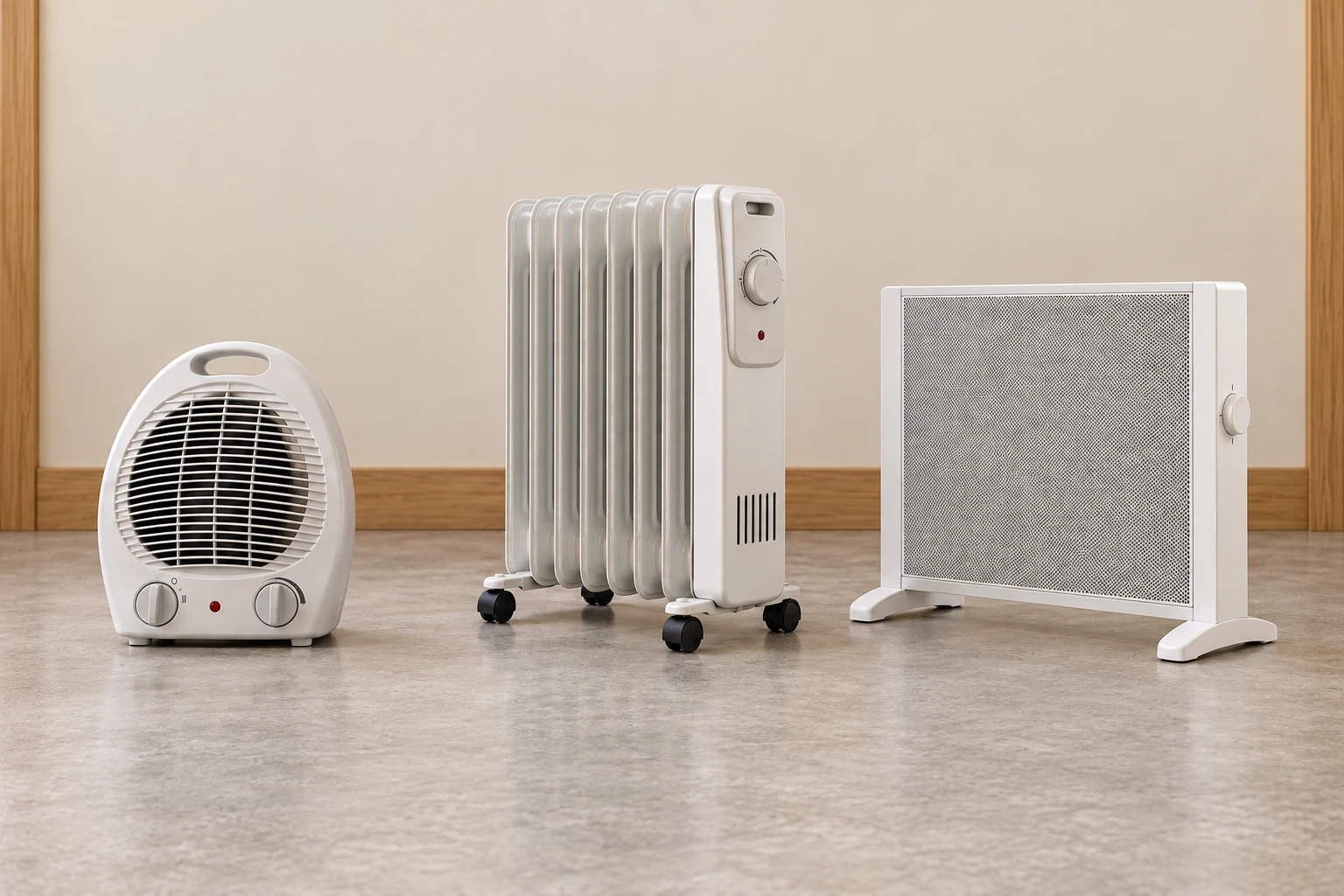
- Fan-heater concept
A fan can drive its designed air path.
- Radiator-style concept
A warm enclosed body exchanges heat with the room.
- Guarded-panel concept
Radiant and convective processes can be combined in an actual product.
What does this illustration leave out?
No exact product identity, approval, internal fluid, measured output, equal comfort or safe operating placement. This illustration explains an idea. It is not an installation guide.
Which actual delivery arrangement and instructions fit the intended occupied use?
Explore this with HomeAI ↗Opens an editable question. Nothing is sent until you choose to send it.Heat can reach the room by different routes
Radiant transfer reaches surrounding surfaces and people; convection carries heat through moving air; a fan drives its designed stream. Actual appliances can combine these processes.
Numbers identify the parts explained below.
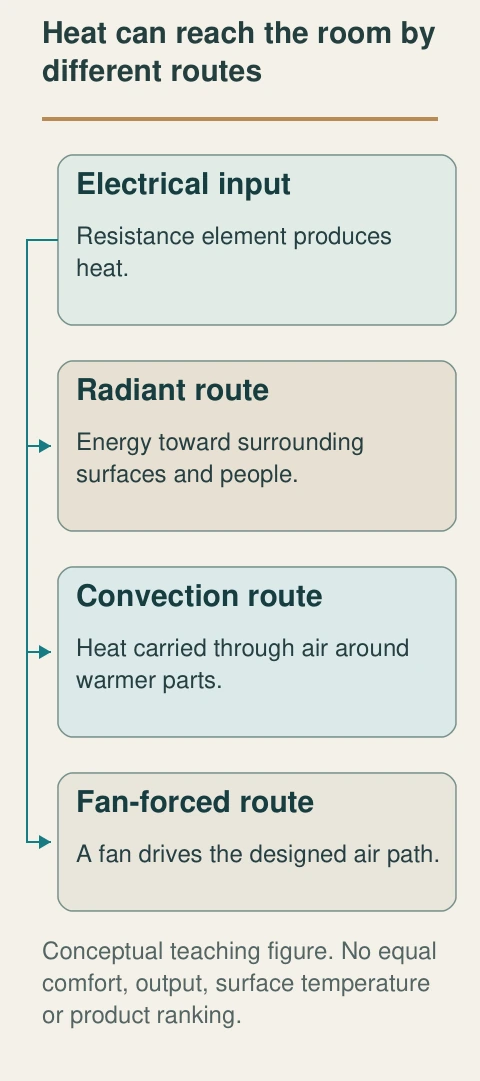
- Electrical input
Resistance element produces heat.
- Radiant route
Energy toward surrounding surfaces and people.
- Convection route
Heat carried through air around warmer parts.
- Fan-forced route
A fan drives the designed air path.
What does this illustration leave out?
No equal comfort, output, surface temperature or product ranking. This illustration explains an idea. It is not an installation guide.
Which delivery arrangement serves the intended occupied use under the actual instructions?
Explore this with HomeAI ↗Opens an editable question. Nothing is sent until you choose to send it.Different delivery, same distinction between input and comfort
- RadiantHeat transfer toward surrounding surfaces and people.
- ConvectionHeat carried by moving air around warm parts.
- Fan-forcedA fan drives the designed warm-air path.
Conceptual categories; actual appliances can combine them.
Further reading: Natural Resources Canada · Electric heaters; Health Canada · Danger to human health or safety assessment for portable electric heaters.
Read the complete figure
Heat can reach the room by different routes
Radiant transfer reaches surrounding surfaces and people; convection carries heat through moving air; a fan drives its designed stream. Actual appliances can combine these processes.
- Electrical input
- Resistance element produces heat.
- Radiant route
- Energy toward surrounding surfaces and people.
- Convection route
- Heat carried through air around warmer parts.
- Fan-forced route
- A fan drives the designed air path.
What remains unknown: No equal comfort, output, surface temperature or product ranking.
A useful question: Which delivery arrangement serves the intended occupied use under the actual instructions?
What do the thermostat and safety controls actually do?
A thermostat responds to a temperature-related condition and controls heat production according to the actual design. A dial position may be a relative setting rather than a calibrated room-temperature promise. A heater’s sensor location and surrounding conditions can differ from the occupied spot. Ask the applicable manual what the control indicates and how ordinary use is intended.
Over-temperature protection and a tip-over function, where actually present, have different jobs from comfort control. Their existence should be established from the product documentation, not inferred from a stable base or a button. A protective function is not permission to cover the appliance, crowd it or leave it operating outside its instructions.
Health Canada’s assessment discusses hazards under foreseeable abnormal conditions. Those laboratory and standards-related tests are not owner demonstrations. Do not overturn an operating heater, obstruct a grille, drape fabric over it or bypass a switch to find out whether protection works. A component failure can have consequences beyond what a short informal experiment reveals.
The control close-up keeps the casing closed and omits invented numbers or warning codes. It teaches that the user control and the heat-delivery body have different jobs. If a control behaves unexpectedly, stop relying on the appliance and obtain appropriate manufacturer or qualified service advice. Do not treat repeated resets as successful troubleshooting.
Keep the exact model, manual and any actual service findings with the record. A feature on a newer version does not establish the same feature on an older unit bearing a similar name. If remote operation, timers or restart functions exist, their suitability and limits need the actual instructions; this guide does not authorize unattended operation through an added smart plug.
The ordinary dial is not a safety permission
The closed heater’s unnumbered dial illustrates ordinary temperature-related control. Its base and grille do not identify protective functions or certify the supply.
Numbers identify the parts explained below.
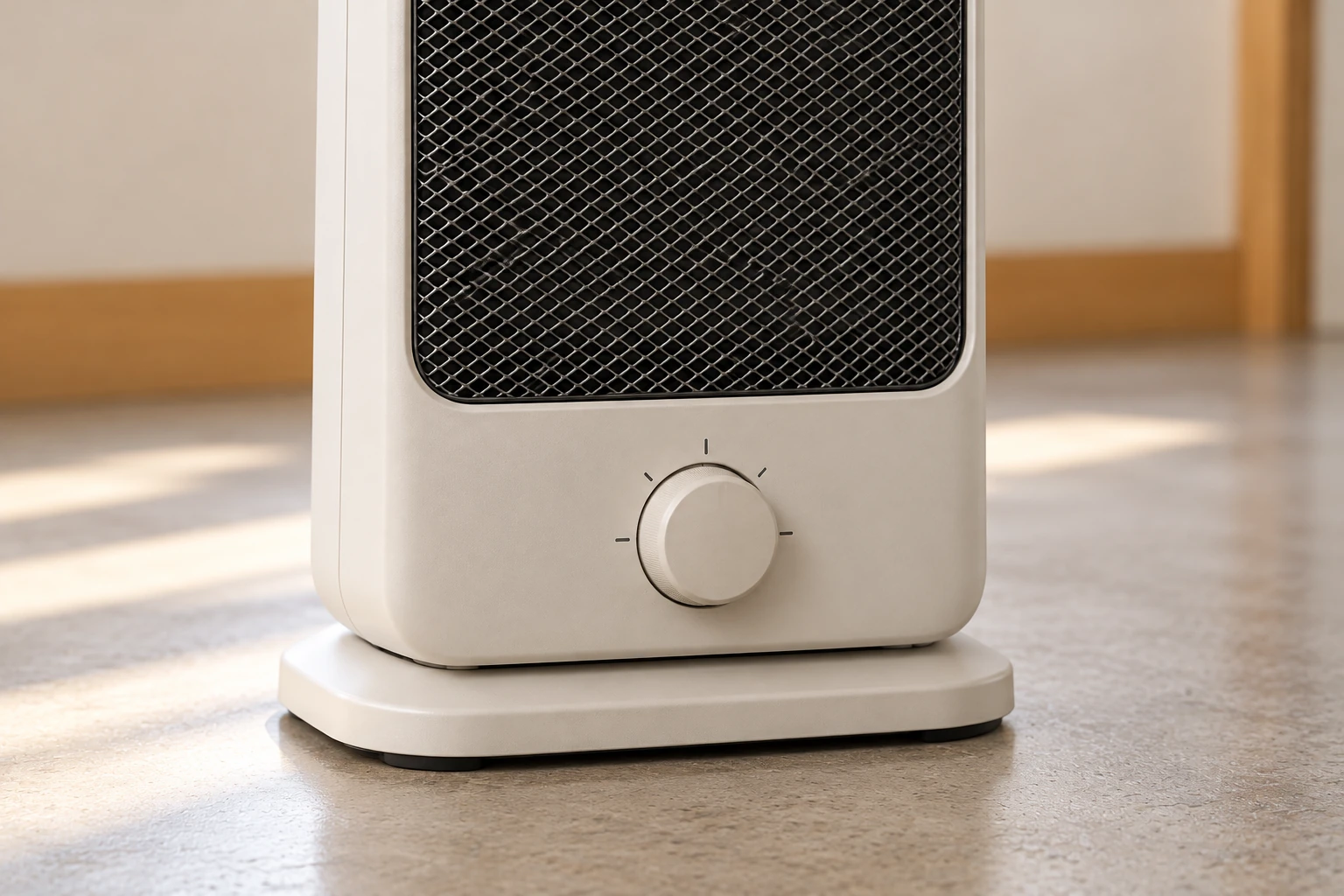
- Ordinary dial
Its meaning follows the exact model’s instructions.
- Closed housing
Internal functions are not established by external appearance.
- Base and grille
Their appearance does not replace placement and qualified fault assessment.
What does this illustration leave out?
No calibrated temperature, tip-over feature, over-temperature result, internal access or operating proof. This illustration explains an idea. It is not an installation guide.
Which functions are actually documented, and what should the household do when operation changes?
Explore this with HomeAI ↗Opens an editable question. Nothing is sent until you choose to send it.Controls are not interchangeable permissions
- ThermostatOrdinary temperature-related operation.
- Over-temperature functionA defined abnormal-condition response where documented.
- Tip-over functionA different model-specific response where documented.
- Household usePlacement, attendance and suitable supply still follow actual instructions.
No protective-function experiment or bypass.
Further reading: Health Canada · Danger to human health or safety assessment for portable electric heaters; Electrical Safety Authority · Indoor Safety / Portable Space Heaters.
Why do clear space and the whole cord route matter?
Heat must leave the appliance through the surfaces and airflow its design uses. Nearby fabric, furniture or other objects can both receive heat and restrict its intended delivery. Health Canada identifies overheating and nearby-material hazards. The placement question therefore includes what can move, fall or be placed nearby during ordinary household life, not only a clear photograph taken at setup.
ESA advises keeping portable heaters away from combustible materials, traffic and doorways and keeping cords out from under rugs or furniture. Follow the actual manufacturer’s clearance and location instructions as well. This guide supplies no universal measured safe zone for every product, and its conceptual room picture cannot certify an existing arrangement.
Consider a curtain that moves, bedding that falls or storage placed beside the heater later. A location can change after the original setup. Keep children, pets and people who may not readily move away from hot equipment in the household plan. Suitable supervision and use must follow the actual product and circumstances rather than a portal’s generic furniture layout.
The cord route also affects household access. Do not cover a cord to hide a trip hazard or route it through a doorway where it can be damaged. If no suitable direct supply and placement can be achieved together, arrange another appropriate solution. Adding an extension or power bar to make the room look tidy is not the answer.
Use the heater only for its intended purpose. It is not a clothes dryer, a surface for towels or a way to dry a flooded area. Wet conditions introduce separate electrical concerns. For damaged equipment, smoke, burning smell or another apparent immediate hazard, stay clear and obtain appropriate urgent help. Evidence gathering should never keep someone beside a developing fire.
Why is an outlet that accepts the plug not a complete supply assessment?
The plug fitting physically into an outlet answers a narrow compatibility observation. It does not establish the condition of the contacts, the whole circuit, other connected loads or the suitability of the supply for the actual appliance. The nameplate and manufacturer instructions belong with a qualified electrical assessment when those questions are uncertain.
ESA directs portable heaters to a wall outlet without an extension cord or power strip and warns against overloading. Do not infer that two nearby outlets are separate circuits or that a panel directory is complete. The existing electrical-protection guide explains why a breaker trip names an event rather than the cause. This article gives no owner circuit-capacity calculation or load experiment.
A loose plug, damaged cord, discoloured outlet, unusual warmth, buzzing or burning smell should not become a reason to keep operating while collecting more data. Stop relying on the equipment and arrange appropriate qualified help; use emergency services for an immediate danger. Do not touch suspect hot or damaged parts, remove a cover or repeatedly reset a protective device.
If permanent supply work is proposed, have the qualified provider explain the actual scope, local requirements and completion evidence. A new receptacle or circuit has its own design and installation record. It does not make an unsuitable heater location acceptable or eliminate the need for the product’s operating instructions.
Keep the appliance and supply findings distinct in the file. A service centre may establish an appliance concern while an electrician assesses the building route. One provider’s invoice should not silently cover the other’s work. A clear account says what was inspected, under what conditions, what was done and what still needs another role.
Appliance, supply and placement need separate answers
A documented product identity, suitable direct wall supply and instructions-matched clear placement have different jobs. A thermostat or approval mark does not replace the other answers.
Numbers identify the parts explained below.
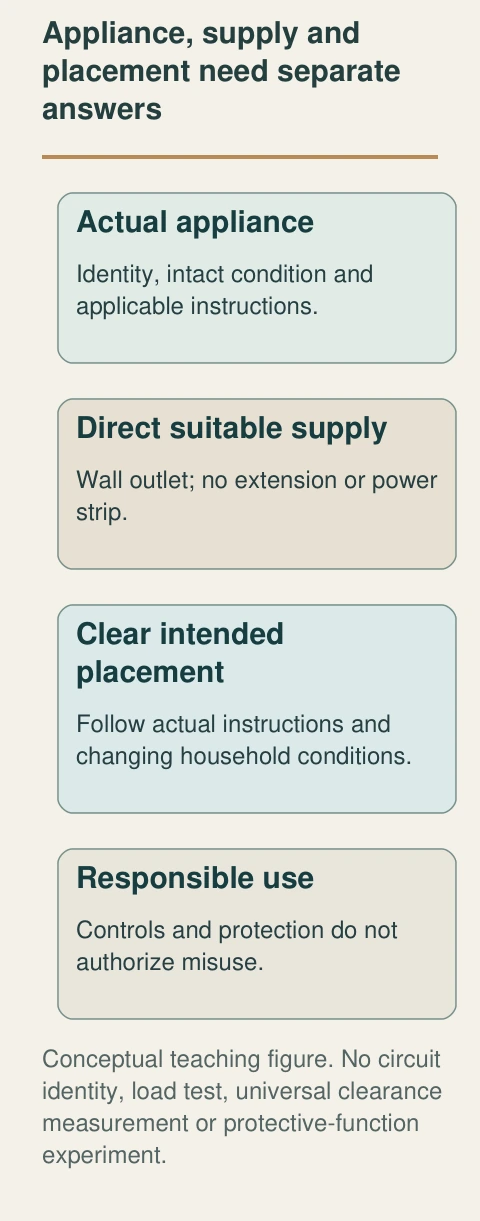
- Actual appliance
Identity, intact condition and applicable instructions.
- Direct suitable supply
Wall outlet; no extension or power strip.
- Clear intended placement
Follow actual instructions and changing household conditions.
- Responsible use
Controls and protection do not authorize misuse.
What does this illustration leave out?
No circuit identity, load test, universal clearance measurement or protective-function experiment. This illustration explains an idea. It is not an installation guide.
Which appliance, building-supply and room-use questions remain unresolved?
Explore this with HomeAI ↗Opens an editable question. Nothing is sent until you choose to send it.Read the complete figure
Appliance, supply and placement need separate answers
A documented product identity, suitable direct wall supply and instructions-matched clear placement have different jobs. A thermostat or approval mark does not replace the other answers.
- Actual appliance
- Identity, intact condition and applicable instructions.
- Direct suitable supply
- Wall outlet; no extension or power strip.
- Clear intended placement
- Follow actual instructions and changing household conditions.
- Responsible use
- Controls and protection do not authorize misuse.
What remains unknown: No circuit identity, load test, universal clearance measurement or protective-function experiment.
A useful question: Which appliance, building-supply and room-use questions remain unresolved?
Does a different heater shape guarantee lower energy cost?
Electrical power is a rate of energy use. Operating time determines the energy used over a period, and the actual tariff determines the relevant charge. A thermostat may change how long a heater operates. These relationships are different from claiming that a decorative casing creates more resistance heat from the same energy input.
The labelled arithmetic comparison in the later cycling chapter keeps power, actual on-time and energy separate. A plug rating, dial position or time spent in the room does not establish the energy used. Read the example there as stated assumptions, not as a reason to add a meter, adapter or other device to the heater’s supply route.
For a cost decision, distinguish the portable heater’s own energy from the home’s total heating energy. Heating a limited occupied area can change demand, but the outcome depends on other heating, maintained conditions, actual operating time and the local tariff. Whole-home comfort, moisture and freeze protection need a suitable building/heating plan. This guide supplies no current price or guaranteed saving.
Power and elapsed time need explicit assumptions
An invented continuous 1 kW input for 2 hours equals 2 kWh. Actual thermostatic operation may cycle; the example is a unit lesson, not a measured appliance or bill forecast.
Numbers identify the parts explained below.
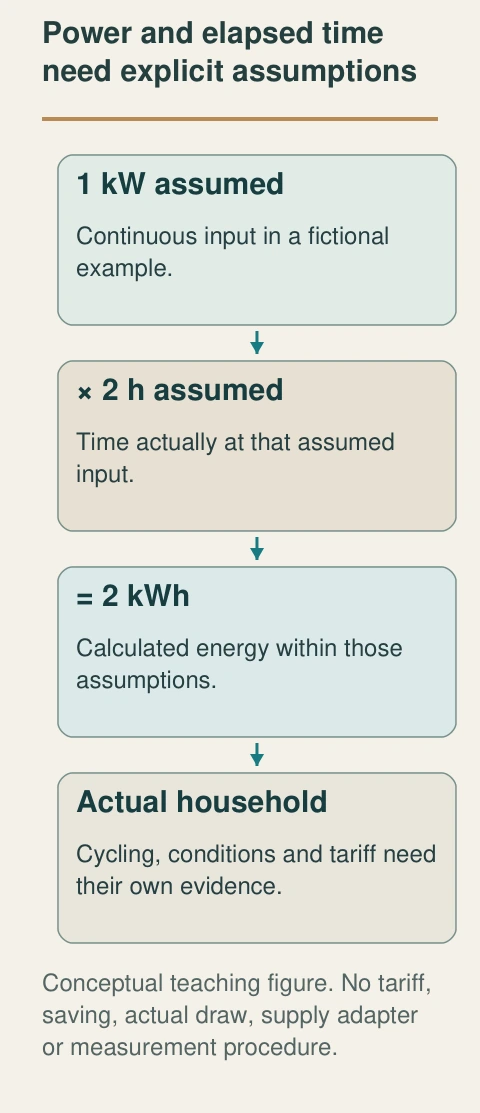
- 1 kW assumed
Continuous input in a fictional example.
- × 2 h assumed
Time actually at that assumed input.
- = 2 kWh
Calculated energy within those assumptions.
- Actual household
Cycling, conditions and tariff need their own evidence.
What does this illustration leave out?
No tariff, saving, actual draw, supply adapter or measurement procedure. This illustration explains an idea. It is not an installation guide.
What actual power, operating time and tariff evidence supports the real comparison?
Explore this with HomeAI ↗Opens an editable question. Nothing is sent until you choose to send it.Power × time gives energy only within the assumptions
- Assumed power1 kW continuous input in a fictional example.
- Assumed duration2 hours at that input.
- Calculated energy2 kWh, with no tariff or saving claim.
- Actual operationCycling, power and conditions need their own evidence.
Teaching arithmetic, not a measured appliance or permission to add a supply meter/adapter.
Further reading: Natural Resources Canada · Electric heaters.
Read the complete figure
Power and elapsed time need explicit assumptions
An invented continuous 1 kW input for 2 hours equals 2 kWh. Actual thermostatic operation may cycle; the example is a unit lesson, not a measured appliance or bill forecast.
- 1 kW assumed
- Continuous input in a fictional example.
- × 2 h assumed
- Time actually at that assumed input.
- = 2 kWh
- Calculated energy within those assumptions.
- Actual household
- Cycling, conditions and tariff need their own evidence.
What remains unknown: No tariff, saving, actual draw, supply adapter or measurement procedure.
A useful question: What actual power, operating time and tariff evidence supports the real comparison?
What should I record when a heater trips or a room stays cold?
Describe the event: the room, model, ordinary setting, approximate time, other known equipment and the exact visible behaviour. Did the heater stop, did a building protective device operate, or did the room simply remain uncomfortable? These observations ask different questions and should not all be called an overload.
Do not deliberately add loads, move the heater between suspect outlets or force repeated operation to reproduce the event. Keep it out of use when a hazard or unresolved fault is suspected and obtain appropriate service. A successful restart does not establish that the appliance, outlet and circuit are safe under every condition.
For a comfort complaint, distinguish the occupied location from the heater’s immediate warm stream. The room may have heat-loss, air-leakage or distribution questions beyond portable output. Record known changes such as a new room use or altered permanent-heating operation without diagnosing the wall or adding multiple portable units.
Supply the actual manual and service history to the relevant provider. Ask which appliance and building questions the appointment can cover. A report should state methods, conditions and limits, including an intermittent event that was not reproduced. Not reproduced is useful information, but it should not erase the dated household account.
Keep recommendations and completed tasks separate. If the provider advises replacement, ask which finding supports it and how the proposed arrangement fits the actual need and supply. If further electrical assessment is needed, name its owner and next action. A portal task marked complete is not a professional safety finding.
Why is cycling time different from time spent in the room?
A thermostat may stop and start heat production while the appliance remains selected for use. Time spent in the room is therefore not necessarily the heater’s actual on-time. A dial position does not identify a duty cycle, which is the share of a period spent operating in the defined way. The exact product and conditions determine the actual behaviour.
Consider an invented arithmetic comparison using an assumed 1 kW input. Four hours at that continuous input would equal 4 kWh. If the same defined input occurred for only two of those four hours, it would equal 2 kWh. These examples isolate operating time; they are not measured heater results, a predicted thermostat pattern or a recommendation to seek a particular cycling rate.
A room’s heat loss and other heat sources can change how much supplementary heat is needed. Two days with the same dial setting may have different conditions. Do not infer a fault or a saving from the clock alone. Ask the relevant provider to connect actual operation and the room’s need if a cost or performance question matters.
This calculation does not authorize a plug-in meter, extension, smart outlet or other added supply device. The direct suitable wall-supply boundary remains. An energy estimate and an electrical safety assessment have different purposes; a plausible number cannot certify the outlet or the appliance.
It also does not authorize unattended or overnight use. Operating responsibility follows the actual product instructions and appropriate household safety advice. A thermostat and protective function do not replace attendance or suitable placement. The household should be able to stop relying on the portable appliance when the intended use cannot be maintained responsibly.
For a real comparison, retain the exact appliance identity, intended occupied period, operating assumptions and actual local tariff. State whether the estimate concerns the heater alone or the entire heating arrangement. A portable appliance may add energy while another system continues unchanged; a claimed whole-house saving needs more evidence than a reduced dial setting elsewhere.
The useful lesson is that power, operation, delivered comfort and cost are separate quantities connected by stated assumptions. Keeping them separate supports an honest decision. It avoids both a magical efficiency claim and the opposite assumption that different controls and household use can never change total energy demand.
What should the model, approval and recall record contain?
Retain the actual model, serial or date identity where safely available, manufacturer instructions and purchase/service documents. ESA advises a recognized Canadian approval mark from an accredited certification agency. A mark is product evidence within its purpose; it does not assess a damaged used unit, its household placement or the condition of the outlet.
A recall match requires the notice’s exact identity and scope. A familiar brand name alone cannot establish that a unit is affected or cleared. This guide has not conducted a recall clearance for the reader’s appliance. Use current official manufacturer/Health Canada information for the actual model and follow an applicable notice’s instructions.
Health Canada’s assessment is a regulatory hazard document updated November 2024. It describes a defined portable-electric scope and references safety standards. This article does not claim to have independently read those paid standards, establish legal compliance or calculate an individual household’s fire probability from reported incidents.
An older government fire booklet contains extension-cord wording that differs from the current ESA portable-heater instruction. That older wording is not adopted. The guide uses the current direct-wall boundary and the exact product instructions, while preserving the source-history distinction rather than silently blending contradictory procedures.
When transferring the appliance or a home record, retain identity and unresolved concerns. Do not advertise it as inspected merely because it has an old label or warmed a room once. A qualified service finding has its own date, scope and conditions. The file should make those limits easy for the next household to see.
Who resolves the underlying heating and safety questions?
An appliance provider addresses the heater within its qualifications and manufacturer scope. A qualified electrical contractor addresses the building supply and protection. A heating/building professional addresses persistent inadequate heat and alternatives. A landlord, owner or building manager may need to coordinate the permanent-system issue in a shared or rented building.
Ask each provider to explain the actual next decision in plain language. Is the concern a damaged appliance, uncertain supply, unsuitable placement or a room whose heat loss exceeds its intended heating arrangement? These can interact, but naming them prevents a new portable heater from becoming the default response to every cold-room complaint.
A professional proposal should identify the supported finding, relevant work and deliverables. For a permanent alternative, ask how capacity, distribution, controls and local requirements are addressed. This guide does not prescribe a circuit, installed heater or whole-house design. A portable comfort lesson is not construction approval.
After actual work, retain the completed record and normal-operation instructions. Ask which functions were demonstrated and what further observation is appropriate. Continue to follow the heater’s rules for placement and attendance; an electrical repair does not authorize a new unsafe use or added remote-control accessory.
Review the household plan when room use, furnishings or permanent heat changes. Keep prior incidents and findings instead of overwriting them with a reassuring new label. The useful outcome is clear responsibility for the appliance, supply and room need, with remaining uncertainty assigned to a person who can address it.
How would a fictional household respond to a heater stopping?
In this invented case, Taylor uses a portable electric heater in a home office. It stops during ordinary use, and another appliance was known to be operating nearby. Taylor does not know whether the outlets share a circuit. The first account therefore records a stopped heater and known context, not a diagnosed circuit overload.
Taylor stops relying on the heater, keeps the area clear and arranges the appropriate qualified advice. The model, manual and observed event are supplied without opening the appliance, moving it through outlets or repeatedly resetting protection. Any apparent immediate hazard receives an urgent response rather than an experiment.
To make the record boundary concrete, suppose an invented appliance-service report identifies a heater control concern and explicitly excludes the building circuit. Taylor can understand the appliance recommendation from that report. The adjacent outlet and connected-load questions remain unassessed until an appropriately qualified electrical provider addresses them. The fictional report is not evidence of a real fault, safe circuit or completed repair.
The office’s cold condition remains a separate heating question. If the permanent system needs assessment, Taylor obtains that scope rather than adding a second portable unit. A proposed remedy is evaluated against the actual room use, suitable supply and operating responsibilities. No price or guaranteed saving is invented.
After any real work, the household would retain completed documents and the actual handover. A warmer afternoon would be recorded with its conditions, not treated as proof that every safety question was resolved. The lesson is to connect observations to the right qualified scope and keep appliance, electrical and comfort conclusions distinct.
Keep learning about the connected parts
- Why does a breaker trip? Understand GFCI and AFCI protection
- How a heat pump moves heat: the cycle, rooms and energy numbers
- Why one room won’t warm up
- Build a home-care record that the next person can understand
Canadian context and authorities · Visual atlas · Learning labs
Practice the distinction.
Taylor records a stop without naming an overload
Fictional case: an office heater stops while another nearby appliance is known to operate; circuit identity is unknown.
Reported observations
- A heater stops during ordinary use; a nearby appliance is operating, but shared circuit identity is unknown.
- A fictional appliance-service report identifies a control concern within its scope and excludes the building circuit.
- Taylor avoids repeated resets or outlet experiments; circuit and cold-room questions remain with their relevant providers.
Compare the explanations
Expand each possibility to see the evidence needed to distinguish it. Similar symptoms can have different mechanisms.
Appliance or control concern
The actual heater needs its own qualified scope.
Model-specific service findings with conditions and limits.
Supply or connected loads
Nearby outlets do not establish circuit identity.
Qualified electrical assessment of the actual route.
A useful next question
Use the appliance report only for its stated appliance scope. Obtain the separate electrical or building-heating assessment needed for the remaining supply and cold-room questions.
No real overload, electrical reading, repair price, successful result or saving is supplied.
Know what the words mean.
- Radiant heat
- Energy transferred toward surrounding surfaces and people from a warmer surface.
- Convection
- Heat transfer through moving air around warmer parts.
- Power
- The rate of energy use, commonly expressed in watts or kilowatts.
- Energy
- The amount used over a period, commonly expressed in kilowatt-hours for household electricity.
- Protective function
- A model-specific response to a defined abnormal condition, distinct from ordinary comfort control.
Questions to bring
to the conversation.
- Which model and intended environment apply?
- What can move or fall into the heater’s required clear area?
- Is a suitable direct supply available without improvisation?
- What exact event occurred, and which provider can assess it?
- Does the underlying room-heating problem need its own plan?
Separate a showing observation, an existing record and a new professional assessment. Unknown means a question remains; it does not automatically mean a defect.
Use the evidence planner ↗Go to the source.
Original HomeAI explanation informed by these public references. Sources support the underlying guidance; they have not reviewed or endorsed HomeAI. Diagrams are conceptual, and calculator outputs depend on your inputs.
Complete current NRCan heater, ESA indoor-safety and Health CanadaNovember 2024assessment bodies read October 13, 2026. Older DND 2018extension-cord wording read but excluded in favour of current ESA direct-wall instruction; no blended procedure. No owner circuit/load test, repeated reset, opening, bypass, tip-over/blockage experiment, electrical repair, product recommendation, current recall clearance, legal approval or financial saving. Fictional1 kW × 2 h calculation states its assumptions. Author draft is separate from independent acceptance and publication.
Publication & source review
First published .
Sources reviewed .
Have a question about your home?
Start with the symptom, timing and what you have observed.
Ask HomeAI