- Identify electric resistance versus water-fed heat from the actual equipment and records; a long cover cannot decide it.
- The element makes heat, room air carries it and a matched thermostat controls input; those are separate jobs.
- Connect power, operating time and the applicable bill without turning a showing or an assumed calculation into a seasonal cost forecast.
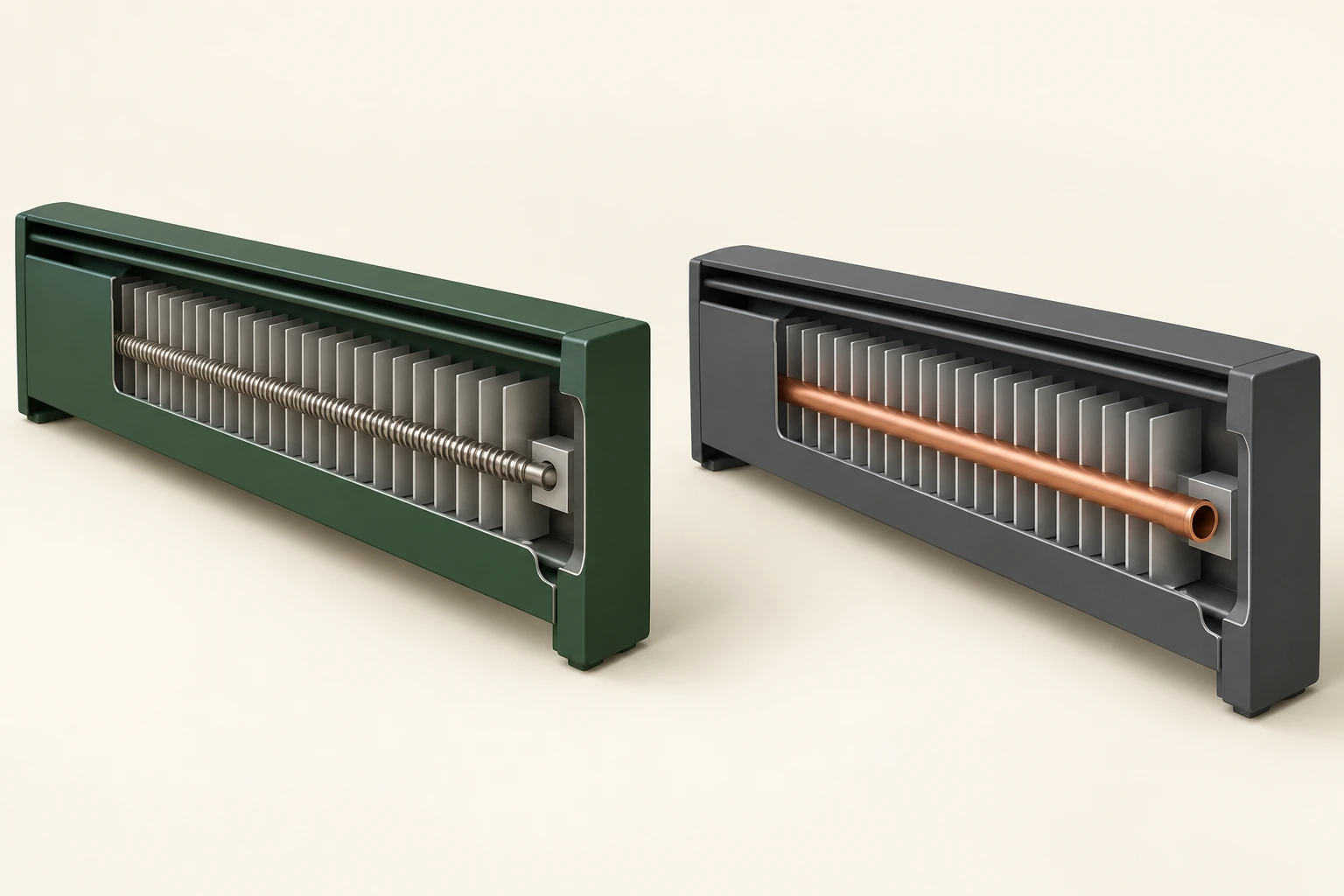
Both examples show a cover and metal fins. The left illustrates an electric heating element; the right illustrates a water pipe bringing heat from another source. Their similar outside shape is why the real equipment and records matter.
About this illustration
The artwork cannot identify a home’s heater, authenticate either construction or material, show a complete circuit or water route, or establish condition and safe installation. This is a conceptual teaching model, not an assessment of your home.
6 picture lessons appear beside the questions in this guide. Use them to understand the explanation, then consider what it means for your home.
Is this electric heat or hot-water heat?
A long heater near the floor is a useful starting point, but its cover does not tell you what makes the heat. An electric resistance baseboard uses electricity in a heating element. A water-fed baseboard receives heat through water from a separate heating source. Similar room furniture can hide very different systems.
Before choosing an ordinary purchase question, deal with immediate danger. For smoke or fire, get everyone out, stay out and call emergency services from a safe place outside. Keep away from wet electrical areas; contact the utility or emergency services for appropriate help. Do not open a cover or operate electrical equipment to investigate.
For a routine enquiry, ask for the heater model, the actual heating type and the relevant records. With permission, photograph accessible identification from a normal safe position. If it cannot be read safely, ask the seller or qualified provider to obtain it. Appearance, paint colour and a room label cannot confirm the hidden arrangement.
Map which rooms have which heat source. A home may combine electric baseboards, water-fed emitters or a heat pump, so one identified bedroom heater does not describe the whole house. Link each room to the seller’s account and supplied documents, then ask a qualified provider to resolve any uncertain identity.
Similar covers can hide different heat sources
Both examples show a cover and metal fins. The left illustrates an electric heating element; the right illustrates a water pipe bringing heat from another source. Their similar outside shape is why the real equipment and records matter.
Numbers identify the parts explained below.
- Electric example
An element makes heat at the heater. The illustrated coil-like form is conceptual, not a particular product’s verified construction.
- Water-fed example
A hollow pipe represents water bringing heat from a separate source. The picture shows no boiler or joined water circuit.
- Fins and cover
Similar outside parts do not establish which heat source a real heater uses; ask for its model and connected arrangement.
What does this illustration leave out?
The artwork cannot identify a home’s heater, authenticate either construction or material, show a complete circuit or water route, or establish condition and safe installation. Read the part names and their jobs below the picture.
Which actual model and connected heat source does the provider identify?
Explore this with HomeAI ↗Opens an editable question. Nothing is sent until you choose to send it.Similar room heaters can receive heat in different ways
- Electric resistance baseboardAn electrical element makes heat at the heater · Identify the actual heater and its electrical control.
- Water-fed baseboardWater brings heat from a separate source · Identify the water circuit and connected source; use the hydronic guide.
- Heat pumpA different heating arrangement that moves heat · Identify the equipment and rooms it serves; use the heat-pump guides.
Function comparison only; covers, colour and room photographs cannot identify an installed heating type or compare actual cost.
Further reading: Natural Resources Canada · Electric heaters; BC Hydro · Baseboard heaters; Natural Resources Canada · Keeping the Heat In, section 9: operating your house.
How does an electric baseboard warm the room?
The resistance element converts electrical energy into heat. In a common finned design, metal fins around the element help transfer that warmth to nearby air. The Stelpro Brava product is one named example of an element-and-fin arrangement; it does not identify the construction of every heater you will encounter.
BC Hydro describes natural convection: cooler room air enters below the heater, warms as it passes the heated parts and rises into the room. That moving air carries heat. The heater does not need a central furnace blower to perform this job, and a separate ventilation system still has its own purpose.
The outer cover encloses the heater; its openings let room air pass through the intended arrangement. Treat the cover and surrounding surfaces as potentially hot. Do not touch the element, reach through openings or remove parts to see how heat is produced. Ask for the applicable manual and qualified assessment when parts appear damaged.
Keep heat production and room response as separate questions. A heater can supply heat while a particular seat feels cold because of a cold window, uneven air movement or heat escaping through the room’s enclosure. Ask what was observed and what was actually assessed, rather than deciding that the element must be faulty.
The element makes heat; moving room air carries it
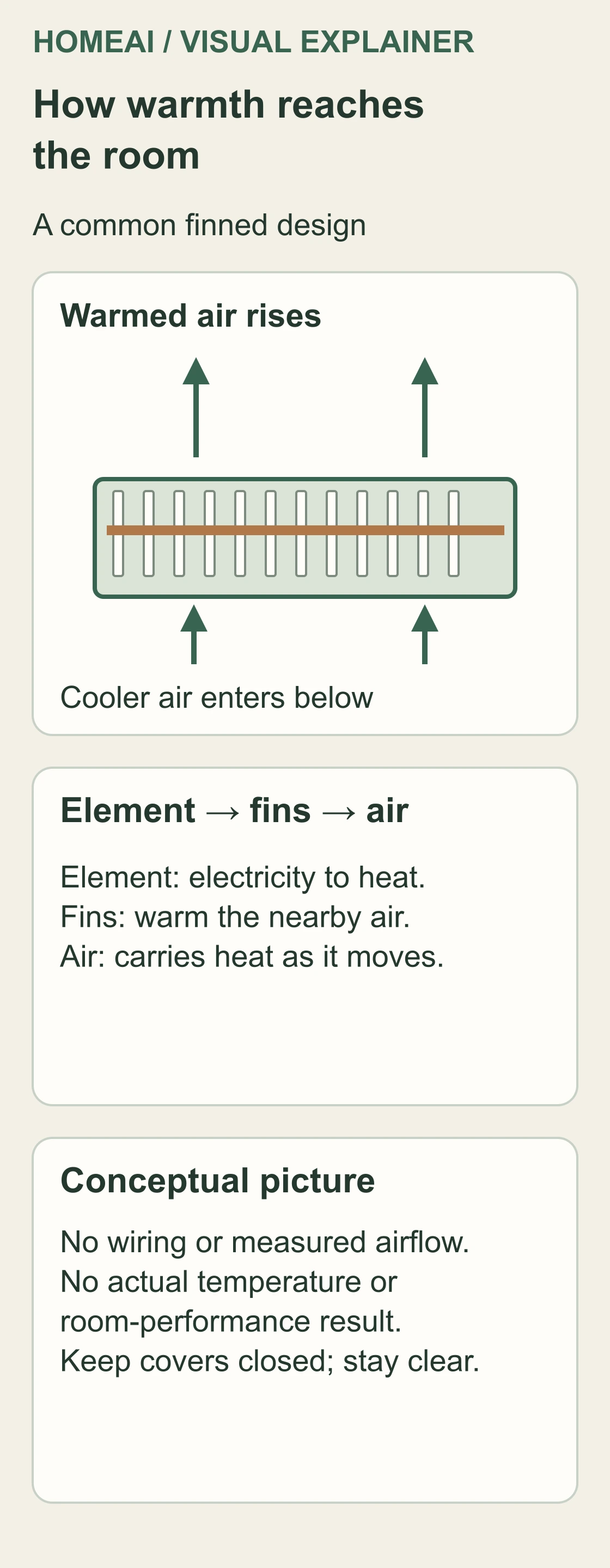
The element converts electrical energy into heat. Fins help transfer warmth to nearby air. Cooler room air passes the heated parts and warmed air rises; this common baseboard job does not need a central furnace blower.
Numbers identify the parts explained below.
- Heating element
Converts electrical energy into heat; its exact construction belongs to the model.
- Fins
Help transfer heat to nearby air in this conceptual finned design.
- Room air
Cooler air enters below and warmed air rises. Arrows show the natural-convection concept, not measured movement.
What does this illustration leave out?
No installed model, full circuit, actual air speed, temperature, capacity, safe installation or room-performance result is supplied. Read the complete element, fins and air explanation below.
Which parts and intended air passages does the actual heater manual identify?
Explore this with HomeAI ↗Opens an editable question. Nothing is sent until you choose to send it.Read the complete diagram
Read the element, fins and moving-air jobs
- Resistance element
- Converts electrical energy into heat at the heater. The actual model documents identify its construction.
- Fins
- In a finned design, metal surfaces help transfer warmth to surrounding air; the Brava product is one named example.
- Cooler room air
- Enters below the common natural-convection heater and passes its heated parts. No speed or flow rate is given.
- Warmed room air
- Rises and carries heat into the room. This job is separate from bringing outdoor ventilation air into the home.
- Cover and openings
- Enclose the heater and allow the intended room-air passage. Do not remove covers, touch hot surfaces or reach between fins to inspect them.
All arrows describe conceptual heat and air jobs. This is neither a field wiring route nor evidence of a real room’s comfort, measured heat output or safe arrangement.
What remains unknown: No installed model, full circuit, actual air speed, temperature, capacity, safe installation or room-performance result is supplied.
A useful question: Which parts and intended air passages does the actual heater manual identify?
Why do air movement and the room layout matter?
A convection heater needs its intended air openings and surrounding space. Furniture, stored objects and window coverings can interfere with that movement or conflict with the model’s safety instructions. At a showing, note the arrangement from a safe distance and ask the seller or qualified provider to address a concern; do not rearrange items around a hot heater.
There is no universal clearance distance in this guide. Match the actual heater, cover, nearby materials and furnishings to its own instructions. A spacious illustration cannot approve a room layout, and a photograph cannot measure concealed separation or show whether every air passage is unobstructed.
A cold window can also cool adjacent air, which then moves downwards. NRCan explains that this kind of convection can be mistaken for an air leak. Air leakage through an opening is a different mechanism. A draught-like sensation alone does not tell you which one is occurring, or establish the right repair.
Describe where the discomfort occurs and the conditions when it was noticed. Ask whether the unresolved question concerns the heater, its control, room-air movement or the building enclosure. Treat a later window, insulation or room-layout change as relevant history, rather than assuming a thermostat replacement will answer every comfort question.
The heater needs its intended room-air space
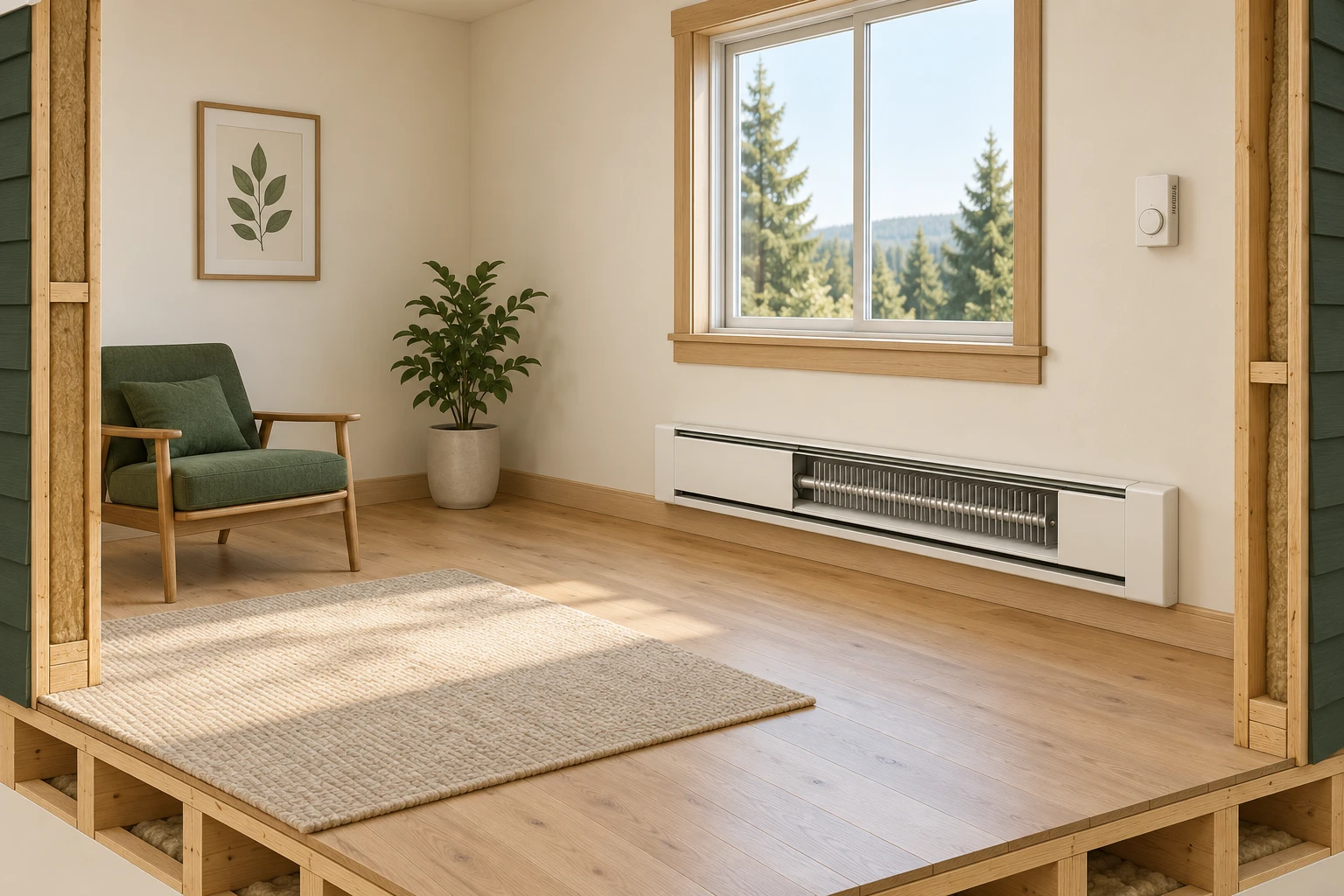
The heater sits low on the wall with openings and nearby floor space visible. The separate wall control represents temperature control. The chair and plant are shown apart from the heater; no clearance distance is specified.
Numbers identify the parts explained below.
- Heater openings
Allow room air through the intended arrangement. Do not reach into or remove parts of a real heater.
- Wall control
Represents a room-temperature control; the picture does not show which equipment it serves.
- Room arrangement
Furniture and window coverings need comparison with the actual model’s instructions; the illustration supplies no clearance measurement.
What does this illustration leave out?
The scene does not verify airflow, room temperature, actual equipment identity, electrical connections, measured separation or suitability of a room layout. Read the part names and their jobs below the picture.
Does the qualified provider find an unobstructed arrangement that matches this model’s instructions?
Explore this with HomeAI ↗Opens an editable question. Nothing is sent until you choose to send it.What does the thermostat actually control?
A thermostat senses temperature at its sensing location and controls heat input according to its settings and design. The requested temperature is a target; it is not a measurement of every corner of the room. Identify which heater or heaters the control serves before treating a wall display as a description of the entire home.
Some heaters have a built-in control, while others use a separate wall control. The Brava product describes model-specific options. A separate wall thermostat does not prove that all heaters in view are connected to it, and several controls do not prove independent circuits. Have the provider identify the present arrangement.
A display can show different quantities. The named STZW402+ manual distinguishes room temperature, a requested temperature and an optional externally supplied outdoor temperature. Another model can use different symbols or behaviour. Ask for the matching instructions rather than diagnosing the heater from a number or icon.
A timer, app or schedule concerns how a control is used; compatibility concerns whether the control is suitable for the actual equipment and installation. These are separate questions. Record reported holds, schedules and room response for the established thermostat guide, while asking an electrician to resolve the electrical matching question.
Can any smart thermostat replace the existing one?
No. Many electric baseboards use a line-voltage thermostat that controls power supplied to the heater. That is different from a low-voltage control signal used by many other heating arrangements. A familiar screen, wireless connection or “smart” label does not establish which electrical job a product performs.
The complete arrangement matters. The Brava product also lists an optional low-voltage relay kit: another component can separate a control signal from heater power. This is a named-product example, not evidence that your home contains that option. Do not assume every electric baseboard connects directly to the same kind of wall control.
The STZW402+ manual supplies another useful boundary. It names baseboards and convectors and excludes certain other heater or load types. Its ratings and exclusions belong to that specific control. A generic comparison, online compatibility slogan or photograph cannot approve it for the heater and wiring at this address.
Before a proposed change, give a qualified electrician the exact heater and thermostat identities, relevant manuals and intended use. Ask them to establish the control arrangement, electrical ratings and actual wiring requirements. This guide supplies no conductor-colour diagnosis, cover-removal task, wiring diagram or owner replacement procedure.
Match the thermostat’s electrical job
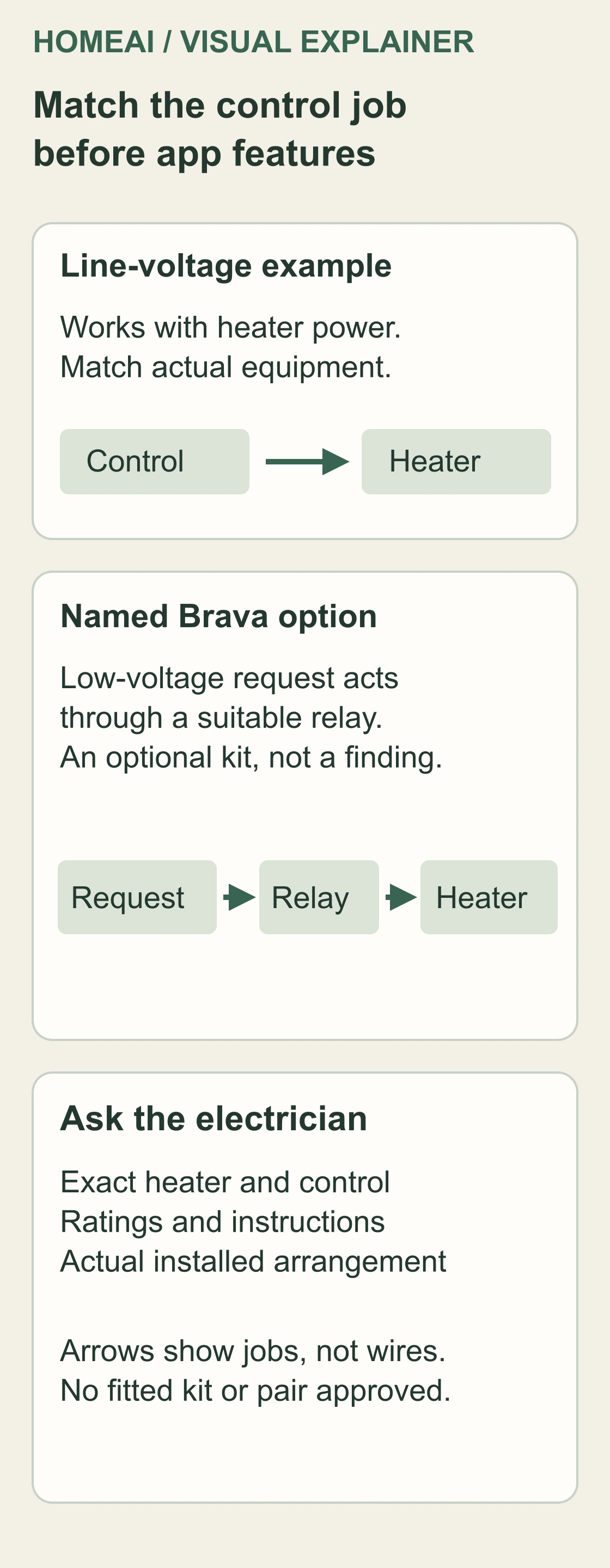
Many baseboards use a line-voltage control. A named Brava optional kit illustrates another arrangement with a low-voltage control signal and relay. An app feature does not decide this electrical match.
Numbers identify the parts explained below.
- Line-voltage example
The control works with power supplied to a suitable heater. Its ratings and actual installation must match.
- Relay example
A low-voltage request can act through a suitable relay; Brava’s optional kit is a named example, not a finding in this home.
- Actual matching
The electrician checks the exact heater, control, applicable instructions and actual electrical arrangement.
What does this illustration leave out?
No installed relay, heater/control approval, voltage measurement, load calculation, conductor identity, wiring method, owner test or safe access is established. Read the complete conceptual control comparison below. Arrows are jobs, not wires.
What establishes the intended control arrangement and exact heater/control match at this address?
Explore this with HomeAI ↗Opens an editable question. Nothing is sent until you choose to send it.Read the complete diagram
Read the two control arrangements before choosing app features
- Line-voltage control example
- Many electric baseboards use a thermostat that works with power supplied to the heater. The actual voltage, heater load, control ratings and installation need qualified matching.
- Low-voltage signal and relay example
- A separate control signal can act through an appropriate relay. The Brava product’s optional low-voltage relay kit illustrates that choice for the named product; it does not prove a relay is fitted in the home.
- Named control limitations
- The STZW402+ manual names baseboards and convectors and excludes some other heaters or load types. Its support and ratings belong to that model; no particular installed pair is approved here.
- Wireless or smart feature
- An additional communication feature does not determine the control’s electrical job, equipment support or wiring requirements.
- Qualified assessment
- Have an electrician identify the actual heater, control, intended arrangement and applicable instructions. No cover removal, conductor-colour diagnosis, wiring diagram or owner replacement procedure is supplied.
The arrows are a comparison of functions, not a physical route or installation sequence. Neither panel depicts a verified home, installed accessory, measured voltage or accepted pair.
What remains unknown: No installed relay, heater/control approval, voltage measurement, load calculation, conductor identity, wiring method, owner test or safe access is established.
A useful question: What establishes the intended control arrangement and exact heater/control match at this address?
Match the control’s electrical job before its app features
- Heater powerThe electrical input that produces resistance heat · An electrician matches actual voltage, load, equipment and installation.
- Control signalA request that can act through an appropriate relay · The Brava’s optional low-voltage kit is a named example, not an installed finding.
- Wireless featureAn additional way to communicate with a supported control · A network name or smart label does not approve a heater/control pair.
No wiring instructions or particular compatibility verdict. Named manuals establish only their own scope, not the home’s arrangement.
Further reading: BC Hydro · Smart thermostats; Stelpro · Brava B electric baseboard; Stelpro · STZW402+ electronic-thermostat owner manual.
What can comfort at a showing tell me?
A showing tells you how particular rooms felt at that time. Outside weather, sun, occupancy, recent operation and the seller’s settings can affect that experience. Record the circumstances and any existing temperature record with its units and location. One pleasant visit cannot demonstrate comfort through a Canadian heating season.
Cold near a window could involve the window surface, air leakage or room-air movement. A room that does not reach its requested temperature could raise questions about heat loss, available heat, the control or the equipment. These are possible explanations to investigate, not diagnoses made from a brief walk-through.
Ask about the reported pattern: which room, which conditions, when it started and which assessment followed. A qualified provider can define an appropriate equipment or room-performance enquiry. Keep its findings attached to the conditions and access used; a different season or inaccessible component may remain outside that visit.
Do not conduct a stress test, deliberately obstruct an opening, turn settings to an extreme or ask the seller to demonstrate concerning equipment. If essential heating is failing in severe weather, seek timely qualified help rather than waiting for a useful log. Purchase deadlines do not replace a safe technical assessment.
Does efficient electric heat mean a low bill?
NRCan describes electric resistance heating as converting electrical energy into heat at the point of use. That conversion statement has a narrow meaning. It does not say how much heat this room needs, how long the heater operates or what the household will pay for its electricity.
Power describes the rate of energy use, commonly expressed in kilowatts, or kW. Energy describes an accumulated quantity, commonly expressed in kilowatt-hours, or kWh. A heater rating and a meter’s recorded energy answer different questions. A rating alone does not establish actual operating time or seasonal consumption.
For an assumed steady electrical input, energy equals power multiplied by elapsed time. Real thermostatic operation changes heat input over time, so a wall setting is not a measurement of energy. An electrician or appropriate assessor must define any actual measurement method and what equipment or period it covers.
Electricity price is another quantity. BC Hydro’s bill separates energy charges from basic charges and taxes; another provider or plan can use a different structure. Compare the applicable account and period. The fictional arithmetic below illustrates units only, without a current tariff, affordability verdict or winter cost forecast.
Which electricity records should I request?
Request records the seller is authorised to share, keeping account identifiers private. Ask for the billing dates, energy units and relevant bill components, together with known changes in occupancy or heating equipment. Keep the complete period beside the amount; “the winter bill” is not a defined measurement.
Find out what the meter includes. Whole-home electricity can cover lighting, hot water, appliances and other equipment as well as baseboards. A change in total use cannot be assigned to one bedroom heater without a suitable basis. Ask whether any supplied assessment measures a particular load or only the whole account.
Compare documents with the present arrangement. A bill predating a heat-pump installation, altered room use or heater replacement describes a different period. The difference may matter, but it supplies no automatic saving or defect finding. Ask what changed and what the provider can reasonably assess from the available records.
Ask your own electricity provider which tariff and account structure would apply. The BC Hydro bill is an educational example, not a Canadian price standard. Use the energy-bill guide for a deeper period and unit comparison, and the first-year budget guide for the wider household costs that this heater lesson does not calculate.
A model, work report and bill answer different questions
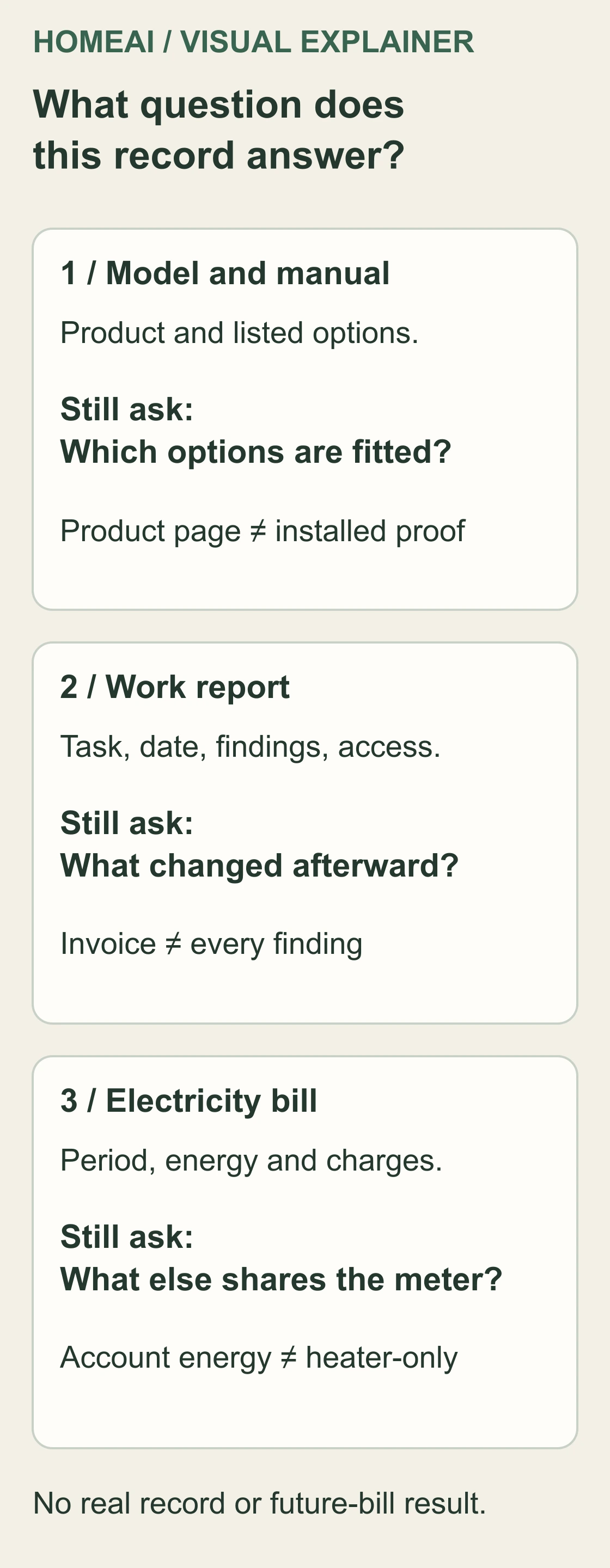
The model explains the product; the report records stated work and findings; the bill records account energy and charges. None can answer every question about the heater, room comfort and future cost.
Numbers identify the parts explained below.
- Model and manual
Identify the stated product and documented options; listed options are not proof they are fitted.
- Work report
Keep dates, task, findings and access limits. Ask which later changes or concealed parts it excludes.
- Electricity bill
Keep period, units and meter coverage. Whole-account energy is not automatically heater-only consumption.
What does this illustration leave out?
No actual product, work completion, permission, heater-specific energy measurement, seasonal comfort, current tariff or price forecast is supplied. Read every record question and its limits below.
Which remaining heater or comfort question is outside the supplied records?
Explore this with HomeAI ↗Opens an editable question. Nothing is sent until you choose to send it.Read the complete diagram
Read what each supplied record can and cannot answer
- Model and manual
- Identify the product and its documented choices. Ask whether the home actually contains each listed option; a product page alone cannot answer that.
- Work or assessment report
- Identify the date, equipment, tasks, findings, access and follow-up. Ask which present components and later changes are outside it.
- Electricity bill
- Identify account period, energy units, meter coverage and separate charges. Ask what other equipment the meter includes; whole-home electricity is not automatically baseboard-only energy.
- Comfort observation
- Keep the room, location, date and reported conditions. A short showing is not evidence of performance in different weather or an explanation of the cause.
Request records with permission and keep private account identifiers private. The BC Hydro account is a utility example, not a national rate standard, assessed property or heater-specific meter.
What remains unknown: No actual product, work completion, permission, heater-specific energy measurement, seasonal comfort, current tariff or price forecast is supplied.
A useful question: Which remaining heater or comfort question is outside the supplied records?
Ask each record a question it can answer
- Model and manualWhich product and documented options are described? · Not confirmation that this home contains every listed option.
- Installation or assessment recordWhat work or findings were recorded, and with which access? · Not every later change or concealed condition.
- Electricity billWhat account period, energy and charges are reported? · Not energy attributed to one heater, comfort or future winter cost.
Document jobs are different. Keep identity, dates, meter coverage and the provider’s actual scope attached to the record.
Further reading: Stelpro · Brava B electric baseboard; Stelpro · Brava B/AB electric-baseboard owner manual; Stelpro · STZW402+ electronic-thermostat owner manual; BC Hydro · Understand your bill; Electrical Safety Authority — notifications and inspections.
What can I safely notice, and when should I stop?
With permission, record accessible heaters, closed controls, readable model information and the room arrangement from a safe position. Note visible damage or the seller’s report in ordinary words. Do not touch hot surfaces, reach between fins, move covers, open a thermostat or access an electrical panel to identify the equipment.
Ask for the assessment associated with scorch marks, damaged covers, unusual sounds or reported repeated shutdowns. Similar observations can have different causes. A quiet heater is not proof of a safe connection, and a reported restart is not a completed repair. Keep the professional’s findings and unresolved questions together.
For smoke or fire, get out, stay out and call emergency services outside. For active sparks or suspected electrical danger, keep clear and seek appropriate utility or emergency help. Do not copy a manual’s startup-smoke reassurance or operate a switch to decide whether a concerning observation is harmless.
If water may contact a heater or other electrical equipment, keep out of the affected area. ESA’s flood guidance directs people to utility disconnection and qualified assessment before reuse; its Ontario licensing processes remain local. Do not enter the water, arrange an owner isolation test or treat a dried exterior as restored safety.
How would a fictional buyer compare power, time and price?
In this invented example, buyer Alex receives a heater description but no heater-specific energy measurement. For a classroom calculation only, assume steady input of 2 kW for 3 hours during one invented interval. Multiplying 2 kW by 3 h gives 6 kWh. These are assumptions, not observed operating conditions.
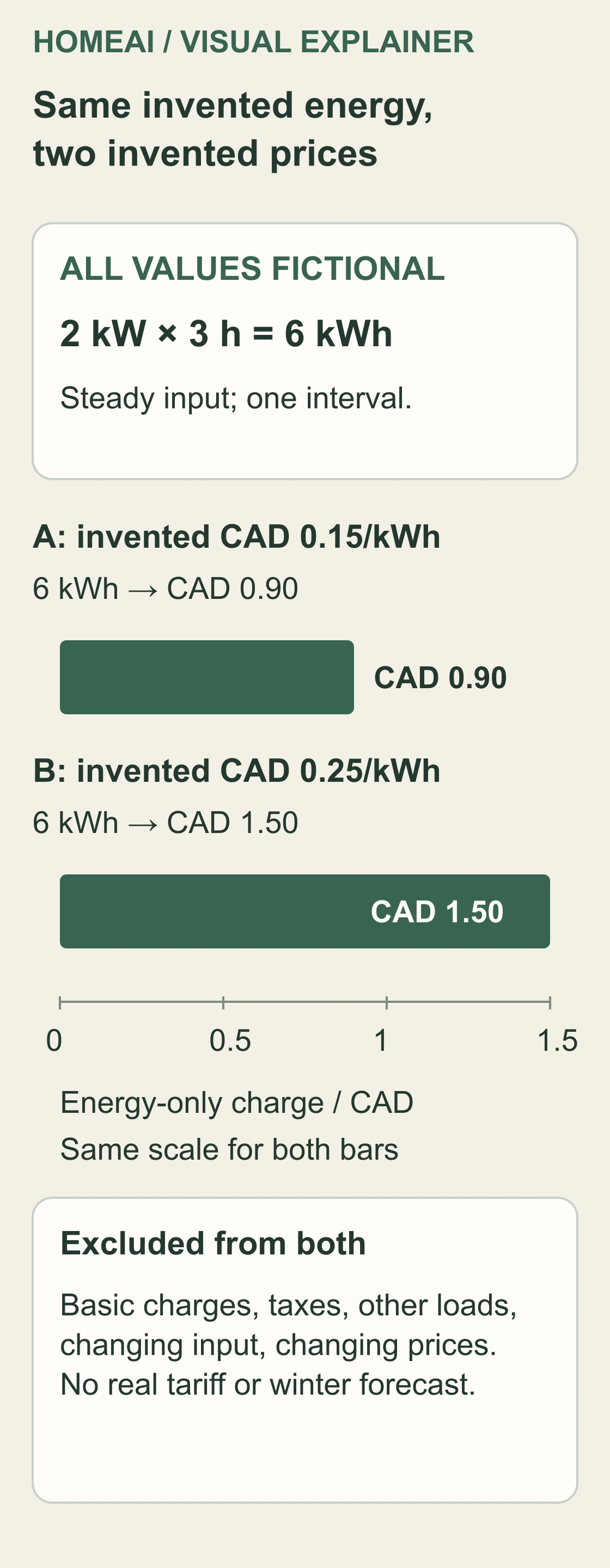
At an invented energy price of CAD 0.15 per kWh, those 6 kWh produce an energy-only charge of CAD 0.90. At a different invented price of CAD 0.25 per kWh, the same 6 kWh produce CAD 1.50. The price changes; the assumed energy does not.
The example excludes basic charges, taxes, other equipment, time-varying prices and changing heater input. It does not show room comfort, electrical suitability or a full bill. Neither invented price is a current Canadian tariff. Three assumed steady hours cannot be multiplied into a credible winter forecast.
Alex requests the actual heater and control identities, relevant installation history and authorised billing records. A qualified provider is asked to define any remaining equipment, control or room-performance assessment. The transaction advisers handle access and written commitments. No passing inspection, defect, repair cost or purchase outcome is invented.
Same invented energy, two invented prices
The invented input and duration give 6 kWh. Changing only the invented price changes the energy-only charge. The bars use CAD and compare those two classroom results, not actual Canadian tariffs or heater performance.
Numbers identify the parts explained below.
- Power × time
Invented steady input: 2 kW × 3 h = 6 kWh. A requested thermostat temperature does not establish these assumptions.
- Price A
Invented CAD 0.15/kWh × 6 kWh = CAD 0.90 energy-only charge.
- Price B
Invented CAD 0.25/kWh × 6 kWh = CAD 1.50 energy-only charge; the assumed energy is unchanged.
What does this illustration leave out?
No actual heater input, operating time, household bill, basic charges, taxes, other loads, changing input, time-varying tariff, room comfort or winter forecast is established. Read all invented quantities, units and exclusions below.
What actual billing period, meter coverage and energy evidence would be needed for a household comparison?
Explore this with HomeAI ↗Opens an editable question. Nothing is sent until you choose to send it.Read the complete diagram
Read every invented assumption and charge
- Invented electrical input
- 2 kW, assumed steady throughout one invented interval. This is not the nameplate or a measurement of a real heater.
- Invented elapsed time
- 3 h at the assumed steady input. A thermostat setting does not establish input or duration.
- Invented energy calculation
- 2 kW × 3 h = 6 kWh. The units distinguish a rate from accumulated energy.
- Invented price A
- CAD 0.15/kWh × 6 kWh = CAD 0.90, energy-only charge.
- Invented price B
- CAD 0.25/kWh × 6 kWh = CAD 1.50, energy-only charge; assumed energy remains 6 kWh.
- Excluded from both results
- Basic charges, taxes, other equipment, changing heater input and time-varying prices. No full bill, real tariff, affordability judgement, comfort finding or winter forecast is supplied.
All values are original classroom assumptions. The bars compare two calculated energy-only charges in CAD on the same scale. No current price, provider rate, meter result or actual customer case is represented.
What remains unknown: No actual heater input, operating time, household bill, basic charges, taxes, other loads, changing input, time-varying tariff, room comfort or winter forecast is established.
A useful question: What actual billing period, meter coverage and energy evidence would be needed for a household comparison?
Who should assess the unresolved questions?
Use an electrician qualified and authorised for the relevant work at the address. Ask whether the visit includes equipment identity, heater/control matching, accessible electrical condition and the reported concern. A room heat-loss or enclosure question may require another appropriate specialist; agree who will answer it and what written result is expected.
Installation and inspection records have a stated scope. Ontario’s ESA distinguishes electrical notification from a building permit and describes its own completion process. Ask the relevant local authority which records apply in this province and at the work date. Do not assign Ontario procedures across Canada or treat a certificate as every present-condition finding.
Your realtor can coordinate document requests and access; confirm any claimed HAUSE training, professional role and local availability. A referral introduces a provider. It does not establish licensing, model experience or a completed assessment. Ask who performs the technical work and which remaining question the booked visit covers.
Your insurer answers its document and coverage questions; transaction and legal advisers handle agreements and reliance. A quotation defines proposed work and price, while an assessment records observations and findings. Keep these jobs clear so a payment receipt, referral or future proposal does not become an invented technical approval.
What should I keep before possession and future changes?
Keep a room-by-room equipment list, exact heater and control identities, matching manuals, relevant installation and change records, complete reports and outstanding recommendations. Preserve each document’s dates and access limits. A labelled folder should let the next owner see which parts were assessed and which remain uncertain.
Have the qualified provider explain the normal controls and care appropriate to the actual equipment and arrangement. Keep model-specific safety instructions available. This guide supplies no universal cleaning interval, numeric clearance, wiring method or replacement schedule, and it does not recommend a particular heater or thermostat.
Before changing controls, furnishings, room use or the heating plan, share the current records and proposed change with the responsible provider. A plan to add a heat pump or another electrical load raises separate distribution and service questions. Use the established companion guides rather than assuming the existing baseboards settle that future assessment.
A useful handover lets you answer four ordinary questions: what makes the heat, how it reaches each room, what controls it and what records support the remaining decisions. Keep property-specific uncertainty visible without mistaking it for a proven defect or a reason to skip a qualified enquiry.
Keep learning about the connected parts
- Thermostat settings: read the control before comparing comfort
- Hydronic heating: record the zone before blaming the boiler
- Why is my energy bill higher? Read the quantity, dates and charges
- Can this home support your electrical plans?
Explore the whole-home map · Understand the Canadian context · Open the visual atlas · Explore the evidence labs · Build a Home Plan
Practice the distinction.
A heater rating and a winter-bill description
Fictional buyer Alex receives an equipment description and the seller’s informal winter-bill account, without a heater-specific measurement. The guide’s invented calculation assumes 2 kW steadily for 3 h, giving 6 kWh.
Reported observations
- The actual heater and control identities still need matching records.
- A whole-home bill may include equipment other than the baseboards.
- Invented CAD 0.15/kWh gives CAD 0.90 for 6 kWh; invented CAD 0.25/kWh gives CAD 1.50.
Compare the explanations
Expand each possibility to see the evidence needed to distinguish it. Similar symptoms can have different mechanisms.
The bill and heater describe different quantities
A heater’s power rating is a rate; a bill records energy over a defined account period and its charges.
Applicable billing dates, units, meter coverage and identified equipment; no assumed heater operating time.
The comfort question needs its own assessment
Room heat loss, air movement, controls and equipment can raise different questions that one bill does not resolve.
A qualified scoped enquiry into the reported pattern, with conditions and access recorded.
A useful next question
Obtain the actual files and define the remaining technical enquiry before advisers address transaction commitments.
Invented arithmetic only. Prices, steady input and duration are assumptions; basic charges, taxes, other loads, changing input and time-varying prices are excluded. No tariff, winter forecast, diagnosis, compatibility approval or actual inspection is represented.
Know what the words mean.
- Resistance element
- The heater part that converts electrical energy into heat.
- Fin
- A metal surface around an element or pipe that helps transfer heat to surrounding air.
- Convection
- Heat carried by moving air; warmed air rising through a common baseboard is one example.
- Water-fed baseboard
- A room heater receiving heat through water from another source; its long cover can resemble an electric heater.
- Line-voltage control
- A control working with the heater’s electrical power, requiring matching equipment ratings and the actual installation.
- Low-voltage control signal
- A control instruction at a different electrical level from heater power; an appropriate relay arrangement may separate those jobs.
- Relay
- A component that can let a control signal govern another electrical load; its suitability and arrangement are model-specific.
- Requested temperature
- The thermostat’s target, distinct from measured temperature throughout a room.
- Kilowatt (kW)
- A unit of power: the rate of energy use or transfer.
- Kilowatt-hour (kWh)
- A unit of accumulated energy; 1 kW sustained for 1 hour corresponds to 1 kWh.
Questions to bring
to the conversation.
- Which rooms use which identified heater models and heat sources?
- What heater and control arrangement does the qualified electrician identify?
- Which reported comfort concern involves equipment, air movement or the building enclosure?
- Which installation or change records describe the present arrangement?
- Which billing period, meter boundary and energy units accompany the seller’s account?
- Who will answer the unresolved technical question, with what access and written scope?
Separate a showing observation, an existing record and a new professional assessment. Unknown means a question remains; it does not automatically mean a defect.
Use the evidence planner ↗Go to the source.
Original HomeAI explanation informed by these public references. Sources support the underlying guidance; they have not reviewed or endorsed HomeAI. Diagrams are conceptual, and calculator outputs depend on your inputs.
Canadian federal sources explain heat and room behaviour. BC Hydro supplies British Columbia utility and bill examples; Stelpro documents only the named product and control. Ontario ESA notification rules remain Ontario-specific. City of Calgary supplies the current fire response. Source-object dates are retained separately from this fresh reading. No model pairing, national installation rule, current tariff, room-performance finding or winter-cost forecast is supplied.
Publication & source review
First published .
Sources reviewed .
- Natural Resources Canada · Electric heaters
Where this reference applies
Jurisdiction: Canada; federal consumer energy education
Edition: Live page modified January 14, 2025.
Source reviewed: 2026-10-06 · America/Edmonton
Reading scope: Complete current substantive HTML body personally read; linked regulation and equipment pages not counted as read.
Electric resistance makes heat at the point of use; heater and control types have different functions. The stated end-use energy conversion does not establish room comfort, household cost or a heat-pump comparison under actual conditions. Regulatory and programme statements are excluded.
- BC Hydro · Baseboard heaters
Where this reference applies
Jurisdiction: British Columbia; utility consumer education
Edition: No substantive publication or revision date established; footer year is not a publication date.
Source reviewed: 2026-10-06 · America/Edmonton
Reading scope: Complete current substantive baseboard body personally read, with full returned HTML/text retained. Linked advice and manuals not counted as read.
Natural-convection element/air roles, obstruction and room-control concepts. Numerical clearances, schedules, savings, cleaning procedures and intervals are excluded; the page’s separate duct advice is not assigned to a baseboard.
- BC Hydro · Smart thermostats
Where this reference applies
Jurisdiction: British Columbia; utility consumer education
Edition: No substantive publication or revision date established; footer year is not a publication date.
Source reviewed: 2026-10-06 · America/Edmonton
Reading scope: Complete current substantive smart-thermostat body personally read; linked compatibility tools, rebate pages and individual manuals not counted as read.
Heating-system type, line-voltage versus low-voltage control concepts and exact-model compatibility questions. No particular replacement recommendation, pair approval, wiring method, programme eligibility, price or savings promise.
- BC Hydro · Understand your bill
Where this reference applies
Jurisdiction: British Columbia; this utility’s account and bill example only
Edition: No substantive publication or revision date established.
Source reviewed: 2026-10-06 · America/Edmonton
Reading scope: Complete current returned substantive bill body personally read; linked rate and billing programmes not counted as read.
Billing period, energy charge and separate basic charges/taxes provide useful record categories. No current tariff, provincial price comparison, business-demand advice or household forecast is imported.
- Stelpro · Brava B electric baseboard
Where this reference applies
Jurisdiction: Named Canadian manufacturer product family; not identification of a home’s heater
Edition: No substantive publication or revision date established.
Source reviewed: 2026-10-06 · America/Edmonton
Reading scope: Complete current returned product page personally read, including descriptive, control, document and accessory sections. Only the separately retained B/AB owner manual and STZW402+ manual were additionally read.
Element and fins, built-in or wall-control options and an optional low-voltage relay kit illustrate model-specific choices. No installed option, compatibility approval, price, rating, numerical clearance or performance guarantee is inferred.
- Stelpro · Brava B/AB electric-baseboard owner manual
Where this reference applies
Jurisdiction: Named manufacturer B/AB models; regional and US provisions are not Canadian national rules
Edition: Four English pages EN1–EN4; no separately established printed revision date.
Source reviewed: 2026-10-06 · America/Edmonton
Reading scope: All four English text pages personally read. Actual EN1 safety/identity and EN3 installation/wiring pixels inspected; the latter is explicitly excluded from owner instruction.
Hot surfaces, unobstructed air openings, exact model/nameplate and qualified electrical assessment. Installation, wiring, colour, reset, cleaning, startup-smoke reassurance, interval and numerical-clearance instructions are deliberately not reproduced.
- Stelpro · STZW402+ electronic-thermostat owner manual
Where this reference applies
Jurisdiction: Named STZW402+ control and stated heater/load scope only
Edition: Printed identifier INSSTZW402+0822; that identifier is not treated as an independently established publication date.
Source reviewed: 2026-10-06 · America/Edmonton
Reading scope: Both complete English text pages and both actual page pixels personally read. Linked radio/controller documents were not read; procedures and numerical ratings are excluded.
The manual distinguishes supported baseboards/convectors, excluded heater/load types, temperature displays and optional network functions. No installed pairing, rating, wire method, setting, owner troubleshooting or outage capability is established.
- Natural Resources Canada · Keeping the Heat In — Section 2: How your house works
Where this reference applies
Jurisdiction: Canada; federal building-science/retrofit education, not adopted provincial code
Edition: Live HTML modified 2025-01-14
Source reviewed: 2026-10-04 · America/Edmonton
2.1.7 whole-house interaction; 2.3.1 distinct air/vapour/weather functions and continuous systems; 2.4 moisture transport; 2.5 local/heritage caution Limits: No universal barrier location, insulation or humidity target, moisture transport multiplier, CO installation rule, energy saving, code adoption or assembly approval.
- Natural Resources Canada · Keeping the Heat In, section 9: operating your house
Where this reference applies
Jurisdiction: Canada; general homeowner education with equipment-dependent exceptions
Publisher publication date: 2014-03-06
Publisher modification date: 2025-09-29
Sections 9.1.2–9.1.3: some hydronic systems have slower response, and generation/distribution/building loads require distinct assessment. No universal setback, savings, equipment sizing, bleeding, pressure, damper or water-temperature procedure is adopted.
- Electrical Safety Authority — notifications and inspections
- Electrical Safety Authority · Flood safety
Where this reference applies
Jurisdiction: Ontario electrical regulator; wet-electrical physical safety guidance, with Ontario licensing/notification procedures kept local
Edition: No substantive publication/update date established; copyright2026 is not a publication date.
Source reviewed: 2026-10-04 · UTC
Electricity can travel through water/wet flooring; keep out of wet electrical areas, obtain utility disconnection where appropriate and qualified assessment before reuse. No owner electrical-isolation procedure, Ontario process nationalization, numerical clearance, insurance or reconnection guarantee.
- City of Calgary · What to do during a fire
Where this reference applies
Jurisdiction: Calgary, Alberta; municipal emergency education
Edition: No substantive publication or revision date established; footer year is not a publication date.
Source reviewed: 2026-10-06 · America/Edmonton
Reading scope: Complete current returned web body personally read, including the full substantive preparation, during-fire and after-fire sections. Linked escape-plan, alarm and insurance materials are not counted as read.
Smoke or fire: get everyone out immediately, call emergency services from a safe location outside and do not re-enter. No owner electrical switching, firefighting procedure, national building rule or linked document claim.
Have a question about your home?
Start with the symptom, timing and what you have observed.
Ask HomeAI