Jump to a question in this guide
- Start with the problem and the evidence you have
- Separate investigation from the proposed repair
- Define the result and the boundaries of the work
- Check the provider for this actual scope
- Compare proposals against the same questions
- Identify approvals and connected professional responsibilities
- Understand how and where the agreement is formed
- Connect payments to defined work and current advice
- Plan site access and the household’s continuing needs
- Manage discoveries and substitutions before they spread
- Use milestones to resolve questions while work is visible
- Define completion and retain the actual handover
- A fictional owner compares a repair with an assumption
- Handle a concern with a precise record and current advice
- An observed symptom, an investigation result and a repair proposal are different commitments.
- Compare included work, interfaces, assumptions and reinstatement before comparing totals.
- Record discoveries and substitutions with their effects on scope, price and sequence.
- Completion returns to the agreed purpose and the relevant verification, instructions and outstanding items.

A localized discoloured patch appears on finished wall near an opening, with a closed folder nearby and framing exposed only at separate cut edges.
About this illustration
No active leak, mould identity, structural finding, cause or repair method. This is a conceptual teaching model, not an assessment of your home.
7 picture lessons appear beside the questions in this guide. Use them to understand the explanation, then consider what it means for your home.
Start with the problem and the evidence you have
Hiring a repair contractor begins with a problem to resolve, not simply a product to buy. A stain, repeated noise or damaged surface is an observation; its cause and the appropriate work may still be uncertain. Write down what is already known, what has been professionally assessed and what remains open. That distinction helps a provider propose the right investigation instead of pricing an assumed repair.
A repair can involve several connected systems. The visible finish may be affected by water, movement, equipment or an earlier alteration. The relevant technical guide owns those mechanisms and assessment questions. This guide owns the process that carries supported findings into comparable proposals, a defined work scope, managed changes and completion evidence. It does not diagnose the building from a symptom.
Three primary consumer sources inform the process: Alberta’s contractor overview, Canada’s Office of Consumer Affairs home-renovation guidance and Consumer Protection BC’s current door-to-door-sales page. Their jurisdictions and dates differ. The BC page explicitly distinguishes contracts made before and on or after August 1, 2026. This guide does not turn those particular rules into nationwide deposit, cancellation or contract-formation advice.
For an urgent hazardous condition, obtain appropriate emergency or technical help before pursuing a normal quotation process. A comparative-proposal exercise should not delay the relevant response. Conversely, urgency in a sales conversation does not itself establish a building emergency. Preserve the already observed facts and use the appropriate independent professional scope where the diagnosis or proposed work is uncertain.
The useful starting record contains the concern, location, history, relevant existing documents and desired functional result. It does not need an invented technical conclusion. A provider should be able to see where their assessment begins and which earlier finding they are being asked to rely on. Keep the limits explicit before a repair proposal becomes a commitment to work.
A visible stain does not establish its cause
A localized discoloured patch appears on finished wall near an opening, with a closed folder nearby and framing exposed only at separate cut edges.
Numbers identify the parts explained below.
- Patch
Observation only.
- Finished wall
Concealed conditions unknown.
- Folder
Actual findings and scope remain distinct.
What does this illustration leave out?
No active leak, mould identity, structural finding, cause or repair method. This illustration explains an idea. It is not an installation guide.
Which supported investigation finding connects this observation to proposed work?
Explore this with HomeAI ↗Opens an editable question. Nothing is sent until you choose to send it.Separate investigation from the proposed repair
Investigation seeks information needed for a decision. Repair changes the building or equipment to achieve an agreed result. They may be offered by the same provider, but their scopes are different. Ask what question the proposed investigation answers, what evidence it will provide and how that evidence will inform the next decision. A charge for investigation should not be disguised as certainty about the eventual repair.
Some findings can be made from records and ordinary access; others may require specialist work or controlled opening-up. The appropriate provider should explain the actual method and responsibilities. This guide gives no destructive inspection, electrical test, leak reproduction or structural procedure. The owner’s role is to understand the scope and limits, not to perform a diagnostic trial to make the quotation easier.
Ask how the provider distinguishes a supported cause from a plausible explanation. An estimate based on an assumption should identify it. If the work can change after concealed conditions are exposed, the proposal needs an agreed process for that uncertainty. A fixed-looking total does not remove an unstated dependency, and an allowance is not evidence that the underlying condition has been resolved.
Consider whether another professional scope is needed before selecting work. The relevant trade, designer, engineer or other specialist depends on the actual concern and local requirements. A general contractor’s ability to coordinate work is not automatically a specialist finding in every system. Ask who is responsible for each technical conclusion and how it will be documented.
Keep the investigation result separate from a sales recommendation. A useful finding states what was examined, what was found and what was not established. The proposed repair can then explain how it addresses that finding. If the recommendation reaches beyond the evidence, ask for the missing reasoning or appropriate further assessment before comparing it with a different provider’s more limited scope.
Evidence and work are separate commitments
Original native teaching figure: Evidence and work are separate commitments. Complete labels distinguish the conceptual functions; no actual property finding.
Numbers identify the parts explained below.
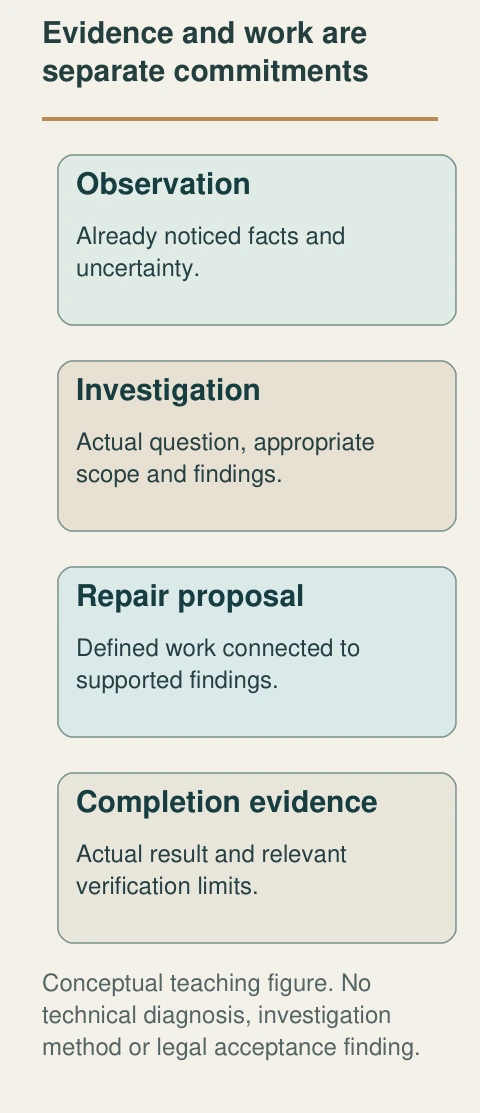
- Observation
Already noticed facts and uncertainty.
- Investigation
Actual question, appropriate scope and findings.
- Repair proposal
Defined work connected to supported findings.
- Completion evidence
Actual result and relevant verification limits.
What does this illustration leave out?
No technical diagnosis, investigation method or legal acceptance finding. This illustration explains an idea. It is not an installation guide.
Where does the proposal assume something the evidence has not established?
Explore this with HomeAI ↗Opens an editable question. Nothing is sent until you choose to send it.Three different commitments
- ObservationWhat was already noticed, with uncertainty retained.
- InvestigationActual question, method responsibility and scoped findings.
- RepairDefined work connected to supported findings and interfaces.
No diagnosis, destructive procedure or guarantee of the eventual repair.
Further reading: Government of Alberta · Hiring a contractor; Office of Consumer Affairs · Home renovations.
Read the complete figure
Evidence and work are separate commitments
Original native teaching figure: Evidence and work are separate commitments. Complete labels distinguish the conceptual functions; no actual property finding.
- Observation
- Already noticed facts and uncertainty.
- Investigation
- Actual question, appropriate scope and findings.
- Repair proposal
- Defined work connected to supported findings.
- Completion evidence
- Actual result and relevant verification limits.
What remains unknown: No technical diagnosis, investigation method or legal acceptance finding.
A useful question: Where does the proposal assume something the evidence has not established?
Define the result and the boundaries of the work
A scope should describe what the contractor will change and what function the work is intended to restore or provide. “Fix the leak” may leave the assessed source, affected materials and completion evidence unclear. Use the actual findings to identify the work area, included tasks and exclusions. The purpose is a shared understanding, not an owner-written technical method based on guesswork.
Materials and products should be identified to the degree needed for a fair proposal. A generic description can conceal differences in the actual supplied item, preparation or connected work. Canada’s consumer guidance emphasizes written details for work, materials, timing and responsibilities. Ask the provider to explain which specifications matter to the intended function and which selections can remain open.
Include the interfaces. Replacing one component may require related access, reinstatement or coordination with another system. Ask who performs that work and what is excluded. A neat finish cannot establish that the concealed technical scope was completed, while an effective technical repair may still leave agreed reinstatement outstanding. Both belong in the written scope when they are part of the project.
State the existing assumptions and unresolved conditions. If the proposal relies on an earlier report, identify it. If access is limited, explain what has not been examined. The scope should show how new information will be handled rather than promising an unlimited result for an undefined condition. Ask the relevant professional to clarify technical uncertainty instead of making the wording broader.
The owner’s desired result and the contractor’s obligations need appropriate contractual expression. This guide does not draft enforceable terms or interpret a warranty. Where the stakes, disagreement or complexity warrant legal advice, obtain it for the actual jurisdiction and document. The practical aim is to ensure that everyone can describe the same work before relying on a price or schedule.
A work scope meets several systems
The kitchen cutaway shows a sink, visible drain context, adjacent finishes, appliances and an intact outlet exterior.
Numbers identify the parts explained below.

- Sink/drain
Relevant trade scope.
- Finish/cabinet
Separate preparation and reinstatement.
- Outlet/appliances
Actual requirements retain their own providers.
What does this illustration leave out?
Generic geometry is not an installation detail, permitted drain arrangement, electrical finding or owner work instruction. This illustration explains an idea. It is not an installation guide.
Who owns each actual interface and reinstatement task?
Explore this with HomeAI ↗Opens an editable question. Nothing is sent until you choose to send it.Check the provider for this actual scope
Provider selection concerns capability for the proposed work, not only a familiar name or attractive portfolio. Ask about relevant experience, who will perform the work and how specialist tasks are assigned. A photograph of a completed project can show appearance but cannot establish concealed quality, current qualifications or the ability to assess your particular problem.
Alberta’s overview and Canada’s consumer guidance recommend checking appropriate qualifications, references and relevant business arrangements. The exact requirements depend on the work and location. This guide does not declare that every Canadian trade has the same certification rules or verify a named provider’s current status. Obtain the relevant current information from the appropriate registry, regulator or issuer.
Insurance and workers’ compensation questions need actual documents and scope. Ask what the provider carries and obtain appropriate advice about whether it addresses the proposed arrangement. A company logo on a certificate is not an owner interpretation of coverage, and a generic statement that a contractor is insured does not allocate liability for every event. This guide supplies no coverage or legal verdict.
References are useful when the inquiry matches the work. Ask about a comparable scope, communication, handling of changes and completion records rather than relying solely on whether the finished room looked good. A reference describes that person’s experience; it is not a guarantee of the next project. Keep the source and limits of the information clear.
Identify who coordinates subcontractors and who answers the owner’s questions. Several capable trades can still leave an interface unresolved if nobody owns coordination. The written proposal should make responsibilities understandable. Membership, recommendations and sales claims may be context, but they do not substitute for current scope-specific evidence or the actual terms of the proposed work.
Compare proposals against the same questions
Comparable proposals start with comparable information. Give providers the same supported findings, desired result and known constraints, then ask them to explain differences in scope. A lower total may omit investigation, preparation, reinstatement or documentation. A higher total may include work another provider considers unnecessary. Price alone cannot resolve those technical differences.
Canada’s home-renovation guidance recommends written estimates and clear work details. Ask what is included, what is excluded and what assumptions affect the total. Keep allowances and selections visible. A number labelled an estimate, quote or budget can have different contractual implications; obtain advice on the actual document where its meaning matters rather than assigning a universal definition here.
Compare the proposed mechanism of the repair. Which supported finding does each task address? What interfaces or affected materials does it include? What evidence will establish completion? The relevant technical provider should explain the reasoning in plain language. An owner should not have to decide between incompatible diagnoses merely by choosing the more reassuring sales description.
Timing also needs context. Ask which dates depend on investigation, approvals, supplies, specialist availability or owner selections. A short duration may describe only time on site, while another proposal includes preparation and return visits. Keep those stages visible so the household can compare the actual disruption and dependencies rather than two unrelated calendar promises.
Record unanswered differences and seek clarification before selecting. A comparison table can help organize the questions, but it does not certify a provider or determine legal suitability. The useful result is a shared scope and understood alternatives. If a material technical disagreement remains, obtain the appropriate independent assessment rather than treating multiple quotations as a vote on the building’s condition.
Compare like work before comparing totals
Original native teaching figure: Compare like work before comparing totals. Complete labels distinguish the conceptual functions; no actual property finding.
Numbers identify the parts explained below.
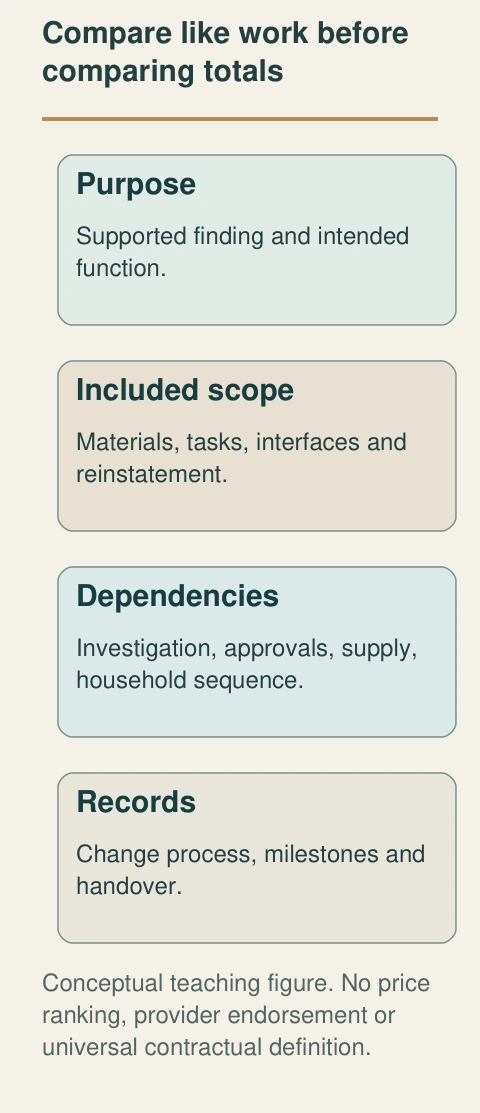
- Purpose
Supported finding and intended function.
- Included scope
Materials, tasks, interfaces and reinstatement.
- Dependencies
Investigation, approvals, supply, household sequence.
- Records
Change process, milestones and handover.
What does this illustration leave out?
No price ranking, provider endorsement or universal contractual definition. This illustration explains an idea. It is not an installation guide.
Which difference changes the commitment rather than just its total?
Explore this with HomeAI ↗Opens an editable question. Nothing is sent until you choose to send it.Compare the same proposal questions
- PurposeSupported finding and intended functional result.
- ScopeTasks, materials, connections, exclusions and assumptions.
- SequenceApprovals, supply, access and household needs.
- EvidenceChanges, milestones, completion and the actual records.
Price comparison does not settle technical disagreement or certify a provider.
Further reading: Government of Alberta · Hiring a contractor; Office of Consumer Affairs · Home renovations.
Read the complete figure
Compare like work before comparing totals
Original native teaching figure: Compare like work before comparing totals. Complete labels distinguish the conceptual functions; no actual property finding.
- Purpose
- Supported finding and intended function.
- Included scope
- Materials, tasks, interfaces and reinstatement.
- Dependencies
- Investigation, approvals, supply, household sequence.
- Records
- Change process, milestones and handover.
What remains unknown: No price ranking, provider endorsement or universal contractual definition.
A useful question: Which difference changes the commitment rather than just its total?
Identify approvals and connected professional responsibilities
Some work requires approvals, inspections or specialist involvement under actual local requirements. Identify those dependencies before work begins. Alberta’s and Canada’s consumer guidance both raise permit responsibilities, but this guide does not decide whether a particular repair is exempt or which party has a legal duty. Ask the relevant local authority and appropriate professional about the actual scope.
Write down who obtains the required approvals, provides supporting documents and coordinates relevant inspections. Keep the responsibility distinct from paying a fee or saying a permit is included. A submitted application, issued approval and completed inspection are different stages. The project record should state which stage has actually occurred and what remains outstanding.
Shared-property permissions can be another dependency. Work affecting a condominium, common service or managed property may need coordination beyond the contractor and owner. Confirm the actual arrangement with the relevant manager or adviser. This guide does not allocate ownership, interpret bylaws or grant permission from a general description of the project.
Specialist findings should keep their scope. An engineer’s review, trade assessment or municipal inspection may address a particular question rather than the entire repair. Ask what it establishes and which conditions remain. A collection of separate documents is most useful when the coordinator explains how they connect; their presence alone does not establish that every interface was covered.
Use the approval and professional requirements to inform the sequence. Work that must remain visible for a relevant review should not be scheduled as though immediate covering is inevitable. The responsible provider should define the actual process. This guide supplies no inspection procedure or concealment permission, and it does not broaden an authority’s acceptance into a guarantee of all workmanship.
Understand how and where the agreement is formed
The way a contract is offered and made can affect the applicable consumer rules. Consumer Protection BC’s current door-to-door-sales page distinguishes contracts before and on or after August 1, 2026 and discusses particular contract contexts. That is a reason to check current local advice for the actual transaction, not a basis for importing one province’s rules into every Canadian repair.
Ask for the complete written proposal and contract before relying on a sales summary. Identify the parties, work, materials, timing, price arrangement, changes, payment terms and completion requirements. The consumer sources support putting these matters in writing. This guide does not determine enforceability, mandatory clauses, cancellation rights or the legal effect of a signature for your circumstances.
Keep promises and attached documents connected. If the agreement refers to a drawing, report, product selection or schedule, identify the actual version. A conversation about one scope should not be mistaken for a written commitment to another. Ask the provider to resolve discrepancies before work proceeds and obtain legal advice where the wording or consequences remain unclear.
Sales urgency deserves a clear distinction from technical urgency. A time-limited offer does not itself establish that the home requires an immediate repair. If the building concern is urgent, use the appropriate emergency or technical response. If the pressure concerns signing, ask the relevant consumer adviser about the actual contract context rather than assuming an entitlement or inventing a cancellation deadline.
Retain the version actually agreed and subsequent authorized changes. An unsigned draft, accepted proposal and later amendment are different records. This guide does not sign, send or execute a contract. Its purpose is to help an owner identify the concrete terms and questions that need resolution before committing to work through the proper local process.
Connect payments to defined work and current advice
Payment terms need to be understandable before work begins. Identify what each requested payment relates to, when it is due and which records accompany it. A payment schedule can refer to materials, stages or completion, but the actual agreement and local legal requirements determine its effect. This guide supplies no universal deposit percentage, holdback, lien rule or payment method.
Ask how the proposed milestones relate to real work. “Halfway complete” can be ambiguous if the scope contains several systems and concealed tasks. A defined stage should identify the relevant work and evidence without making the owner perform a technical inspection. The responsible professionals should provide the findings or records appropriate to their scope.
Understand what a payment request does and does not establish. An invoice states a request; it is not independent evidence of technical completion. A delivered product is not necessarily installed, and an installed product may still need commissioning or related work. Keep those stages clear when reviewing the actual terms and seeking appropriate advice.
The primary consumer sources discuss written payment arrangements and legal protections in their respective contexts. Some wording is historical or broad, including Alberta’s legacy lien-act reference and Canada’s broad cash/no-recourse assertion. Those statements are deliberately not adopted here. Obtain current jurisdiction-specific legal or consumer advice where deposit, lien, holdback or dispute consequences matter.
Keep payment and work records together without treating them as interchangeable. Record the actual invoice, relevant agreed stage and any unresolved question. This guide does not tell an owner to withhold a legally due payment or sign a completion declaration. Where the parties disagree, use the actual agreement and appropriate advice rather than an improvised rule drawn from a general article.
Plan site access and the household’s continuing needs
Construction takes place in a household with routines, belongings and access needs. Agree how the contractor enters, which areas are included and how communication works when the owner is absent. A work scope that is technically clear can still cause avoidable disruption if those practical arrangements are undefined. The plan should reflect the actual people living there.
Identify essential facilities and routes that the work will affect. A bathroom, entrance or sleeping area may be unavailable at a particular stage. The renovation-occupancy guide owns the wider living-through-work plan, and the mobility and child-safety guides contribute their household needs. Bring those requirements into the contractor discussion before the relevant space is taken out of use.
The contractor should explain the actual work separation, services and site arrangements within their scope. This guide supplies no temporary barrier design, ventilation method, hazardous-material handling or occupancy clearance. Where a household member has specific needs, coordinate the relevant professional advice rather than expecting the contractor to infer them from a general request to be careful.
Agree how possessions, product deliveries and temporary storage are handled. Ask which tasks belong to the owner and which to the contractor, with the limits in writing where material. Do not assume that moving furniture includes reinstating its matching anchoring arrangement, or that removing a fixture includes every connected service. Clarify the interface rather than discovering it at handover.
Keep changes to access and household arrangements current. A shifted work date can affect a caregiver, temporary bathroom or building-management booking. Name who updates the relevant people through authorized communication. A schedule revision is not only a contractor logistics issue when it changes how the household can use the home.
Manage discoveries and substitutions before they spread
A repair can reveal information that was not available when the proposal was made. A concealed condition, unavailable product or altered requirement may change the work. The important question is how that change is assessed, priced, authorized and recorded. A discovery should not silently become a broader project whose purpose and consequences nobody has agreed.
Ask the provider to describe the new information and its source. Distinguish an observed condition, a specialist finding and a proposed solution. The owner needs enough explanation to understand why the original scope may no longer be adequate. If the technical conclusion lies outside the contractor’s scope, obtain the appropriate professional input rather than relying on an urgent site opinion alone.
A proposed change should identify effects on work, materials, interfaces, price arrangement and sequence. A substitute that looks similar can have different installation, maintenance or functional requirements. Have the relevant designer or specialist review it where their scope is affected. This guide does not decide product equivalence from a photograph or authorize an unreviewed technical substitution.
Use the agreed change process before the altered work proceeds, subject to the actual contract and any immediate safety needs. Document the version and who accepted it. This guide gives no legal rule about oral changes or emergency authority. Where the parties disagree about what is authorized, obtain appropriate advice on the actual agreement rather than inventing consent from silence.
Update household arrangements and completion evidence with the change. Additional work may affect access, temporary facilities or the records required at handover. Keep the old scope as history and make the current one easy to identify. A change log should explain what actually changed, not merely list an added charge without its technical or functional purpose.
A changed scope needs a decision and a record
Blank sheets and a closed sample box sit outside a plain closed door beside a separate unfinished-room cutaway.
Numbers identify the parts explained below.

- Papers
Actual current scope/change record.
- Sample box
Selection alone is not technical equivalence.
- Separate room
Household/work dependencies require coordination.
What does this illustration leave out?
No authorized change, approved barrier, safe occupancy, selected material or executed contract. This illustration explains an idea. It is not an installation guide.
What new finding and consequences need agreement before altered work?
Explore this with HomeAI ↗Opens an editable question. Nothing is sent until you choose to send it.A changed finding needs a coordinated decision
Original native teaching figure: A changed finding needs a coordinated decision. Complete labels distinguish the conceptual functions; no actual property finding.
Numbers identify the parts explained below.
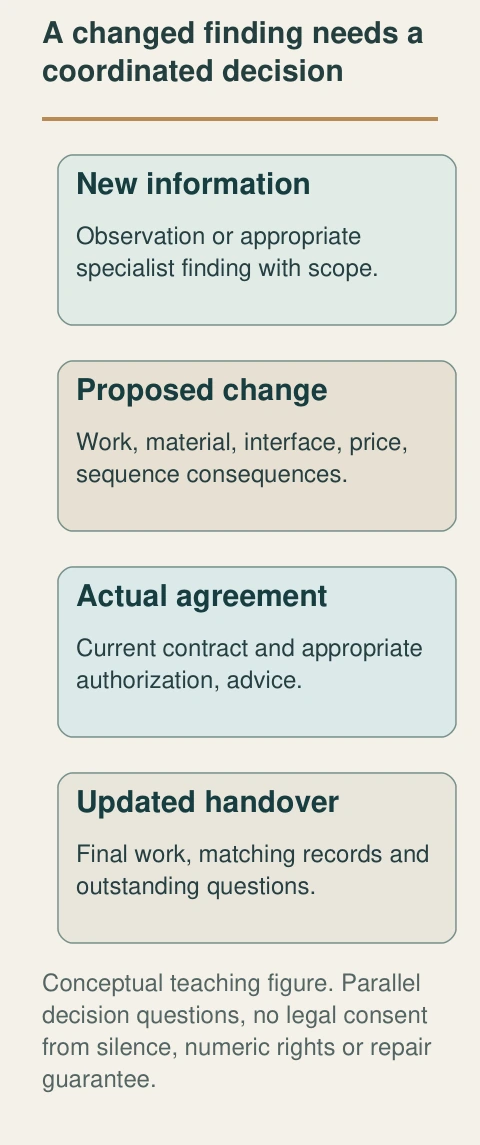
- New information
Observation or appropriate specialist finding with scope.
- Proposed change
Work, material, interface, price, sequence consequences.
- Actual agreement
Current contract and appropriate authorization, advice.
- Updated handover
Final work, matching records and outstanding questions.
What does this illustration leave out?
Parallel decision questions, no legal consent from silence, numeric rights or repair guarantee. This illustration explains an idea. It is not an installation guide.
Who reviews each affected scope before the changed work proceeds?
Explore this with HomeAI ↗Opens an editable question. Nothing is sent until you choose to send it.Read the complete figure
A changed finding needs a coordinated decision
Original native teaching figure: A changed finding needs a coordinated decision. Complete labels distinguish the conceptual functions; no actual property finding.
- New information
- Observation or appropriate specialist finding with scope.
- Proposed change
- Work, material, interface, price, sequence consequences.
- Actual agreement
- Current contract and appropriate authorization, advice.
- Updated handover
- Final work, matching records and outstanding questions.
What remains unknown: Parallel decision questions, no legal consent from silence, numeric rights or repair guarantee.
A useful question: Who reviews each affected scope before the changed work proceeds?
Use milestones to resolve questions while work is visible
A milestone is useful when it connects a stage of work to a defined question or decision. It should not simply divide the calendar into equal parts. Ask which work will be visible, which relevant provider reviews it and what record is expected. That helps the owner understand how the project progresses without taking on an unqualified technical inspection role.
Concealed work deserves particular coordination where the agreed scope calls for evidence or review before covering. The appropriate contractor, designer or authority should define the actual process. A photograph can preserve context but cannot establish every connection or hidden property. Keep provider findings and inspection scope distinct from a visual record of an open wall.
Discuss emerging concerns promptly through the agreed contact. Describe what was already noticed and which scope item it relates to. Do not touch, operate or reproduce a questionable condition to strengthen the report. The relevant provider should determine the assessment and explain the response. Clear communication helps prevent an unresolved question from being carried into the next stage.
A milestone record should identify the actual work completed, relevant findings and remaining tasks. Avoid treating “ready for the next stage” as a whole-project approval. Several trades may each complete their part while an interface remains open. The coordinator should explain how the separate scopes connect and who addresses the remaining question.
If a milestone or schedule changes, update the consequences honestly. A delayed product, unresolved approval or new finding may affect both the work and the household’s temporary arrangements. Record the current dependency instead of preserving an obsolete completion promise. This guide does not guarantee schedule performance or assign contractual liability for a delay.
Define completion and retain the actual handover
Completion should return to the agreed scope and functional purpose. Identify which work is finished, what relevant verification occurred and what remains outstanding. A clean site and an attractive surface are useful observations, but they do not independently establish concealed technical work or equipment performance. The relevant provider should supply the evidence within their scope.
Keep the actual installed product identities, matching instructions, relevant approvals and professional records together. Include agreed drawings and changes where they explain the final arrangement. A future repair provider should be able to distinguish what was built from an earlier option. The handover should not rely on the owner remembering an informal site conversation months later.
Equipment may need commissioning or an explanation of intended use separate from physical installation. Ask who provides it and what the actual record establishes. This guide supplies no owner test, operating shortcut or universal commissioning procedure. A provider’s limited verification should retain its limit rather than being described as proof that every connected system is sound.
Outstanding items need a clear description and agreed next step under the actual contract. Distinguish a cosmetic item, missing record, unresolved technical question and incomplete work. Their consequences can differ. Obtain appropriate advice before signing a declaration or treating a payment as an acceptance where its legal effect is unclear; this guide does not determine that effect.
Warranty and future service questions also need exact scope. Identify the actual provider, supplied terms and contact route, while retaining product and workmanship distinctions where relevant. No generic article establishes an entitlement or duration. The useful handover explains what was done, which evidence supports it and where the owner takes a later concern.
Visible completion and records answer different questions
A finished-looking kitchen/living cutaway includes plain binders and blank-cover booklets on the worktop.
Numbers identify the parts explained below.

- Room
Appearance is one observation.
- Binders
Actual final scope and changes.
- Booklets
Matching product instructions need identity.
What does this illustration leave out?
No completed actual project, commissioning result, approval, warranty entitlement or whole-system guarantee. This illustration explains an idea. It is not an installation guide.
Which actual work and verification scope does each handover record establish?
Explore this with HomeAI ↗Opens an editable question. Nothing is sent until you choose to send it.Completion keeps separate records
- BuiltActual final work/products and agreed changes.
- VerifiedRelevant provider/authority findings within scope.
- ExplainedMatching instructions and intended-use/service contacts.
- OutstandingSpecific unresolved work/record/question and next step.
No universal legal acceptance, warranty entitlement, payment withholding rule or whole-project guarantee.
Further reading: Government of Alberta · Hiring a contractor; Office of Consumer Affairs · Home renovations.
A fictional owner compares a repair with an assumption
David is a fictional owner with staining near an interior opening. One proposal prices preparing and repainting that surface, excluding the source and concealed work. Another prices investigating the stated concern and supplying findings, with the repair to be quoted afterward. He does not compare the totals as two prices for a complete repair.
For this invented example, the subsequent plumber’s report identifies a water-connection leak within the investigated opening and expressly excludes the roof and other concealed routes. David uses that limited finding to request a connection-repair scope. He does not expand it into proof that the roof or every nearby pipe was assessed.
He then compares the revised connection work, access and reinstatement on the same basis. The finish work remains separately described. The agreement identifies how a new concealed finding would change the work, who reviews it and which records belong at handover; this example supplies no repair method or universal contract term.
After the fictional work, the file contains a plumbing completion note for the named task and a separate finish invoice. A requested document still outstanding stays on the list, and the roof remains outside the earlier assessment. David has a reviewable account of the specific work instead of “all repaired.” These stipulated fictional records establish no actual defect, successful repair, legal entitlement or safety approval.
Handle a concern with a precise record and current advice
A later concern should begin with a clear account of what was noticed and the relevant agreed work. Keep the actual proposal, contract, changes, invoices and handover records available. These documents help the appropriate provider or adviser understand the issue. They do not automatically determine fault, coverage or entitlement, and this guide does not make that judgement.
Separate an urgent hazardous condition from a routine disagreement. Obtain appropriate emergency or technical help where needed before pursuing the normal complaint process. Do not reproduce a leak, operate uncertain equipment or open work to create evidence. Preserve already known information when safe and let the relevant professional determine the investigation.
For a routine concern, identify the specific scope item, reported result and question requiring a response. Follow the actual contract and relevant current local consumer or legal advice. This guide does not contact the contractor, file a complaint or send a demand. An owner’s authorized communication should accurately distinguish observation, professional finding and requested resolution.
The reviewed BC page’s current contract-date distinctions and Alberta’s historical wording show why legal steps require fresh local context. This guide deliberately withholds numerical deadlines, deposit limits, court thresholds and lien procedures. Do not use an old blog or another province’s summary as a substitute for advice on the actual agreement and dates.
Retain the outcome with its limits. A provider’s response, agreed correction, completed work and professional verification are different stages. Record what actually happened and what remains unresolved without claiming a successful repair from a promise alone. The same discipline used at the beginning—supported findings, defined scope and clear responsibilities—remains useful when the project needs further attention.
Keep learning about the connected parts
- Water leaks explained: find the right question before the repair
- Renovation records: what was proposed, approved and built?
- Electrical renovation records: what was actually checked?
- Build a home-care record that the next person can understand
- Adapting your home for changing mobility: connect activities, routes and phases
- Child safety throughout the home: understand access and the actual protection
Canadian context and authorities · Visual atlas · Learning labs
Practice the distinction.
Two different proposals become one clear work decision
David is a fictional owner with staining near an interior opening. One proposal prices preparing and repainting that surface, excluding the source and concealed work. Another prices investigating the stated concern and supplying findings, with the repair to be quoted afterward. He does not compare the totals as two prices for a complete repair.
Reported observations
- For this invented example, the subsequent plumber’s report identifies a water-connection leak within the investigated opening and expressly excludes the roof and other concealed routes. David uses that limited finding to request a connection-repair scope. He does not expand it into proof that the roof or every nearby pipe was assessed.
- He then compares the revised connection work, access and reinstatement on the same basis. The finish work remains separately described. The agreement identifies how a new concealed finding would change the work, who reviews it and which records belong at handover; this example supplies no repair method or universal contract term.
A useful next question
After the fictional work, the file contains a plumbing completion note for the named task and a separate finish invoice. A requested document still outstanding stays on the list, and the roof remains outside the earlier assessment. David has a reviewable account of the specific work instead of “all repaired.” These stipulated fictional records establish no actual defect, successful repair, legal entitlement or safety approval.
Clearly fictional teaching record; no actual property, safety, legal or insurance approval.
Know what the words mean.
- Investigation scope
- The question and evidence a provider is engaged to establish before a repair decision.
- Work scope
- The actual tasks, materials, interfaces, assumptions and exclusions of a proposal.
- Change process
- The agreed way to assess, authorize and record altered work under the actual contract.
- Milestone
- A defined stage tied to relevant work and evidence, not an owner technical test.
- Handover
- Actual completed-work, product, instruction and scoped verification records with outstanding items.
Questions to bring
to the conversation.
- Which actual finding supports each proposed repair task?
- Are investigation, affected materials, access and reinstatement included or excluded?
- Who confirms relevant provider status, specialist findings, approvals and shared-property permissions?
- What change process applies if the finding, material or household sequence changes?
- Which milestone records and final outstanding-item list will make completion reviewable?
Separate a showing observation, an existing record and a new professional assessment. Unknown means a question remains; it does not automatically mean a defect.
Use the evidence planner ↗Go to the source.
Original HomeAI explanation informed by these public references. Sources support the underlying guidance; they have not reviewed or endorsed HomeAI. Diagrams are conceptual, and calculator outputs depend on your inputs.
The full bodies of three primary sources were read. The British Columbia source distinguishes contracts made before and on or after August 1, 2026. Historical wording in the Alberta Act and the broad Canadian assertion about cash were not adopted. Numerical rules about legal rights, deposits, cancellation, liens and courts were not adopted. No contract was signed, provider contacted or provider status assessed. No technical diagnosis or actual outcome is claimed. David is fictional. Related destinations were checked against the current guides that cover those subjects.
Publication & source review
First published .
Sources reviewed .
Have a question about your home?
Start with the symptom, timing and what you have observed.
Ask HomeAI