- Capture at the cooking source, discharge outdoors and replacement air are three different functions.
- Identify the installed hood configuration and route before interpreting a fan rating or buying a larger unit.
- Use an ordinary cooking record to explain the concern; let qualified professionals assess the air path and connected equipment.
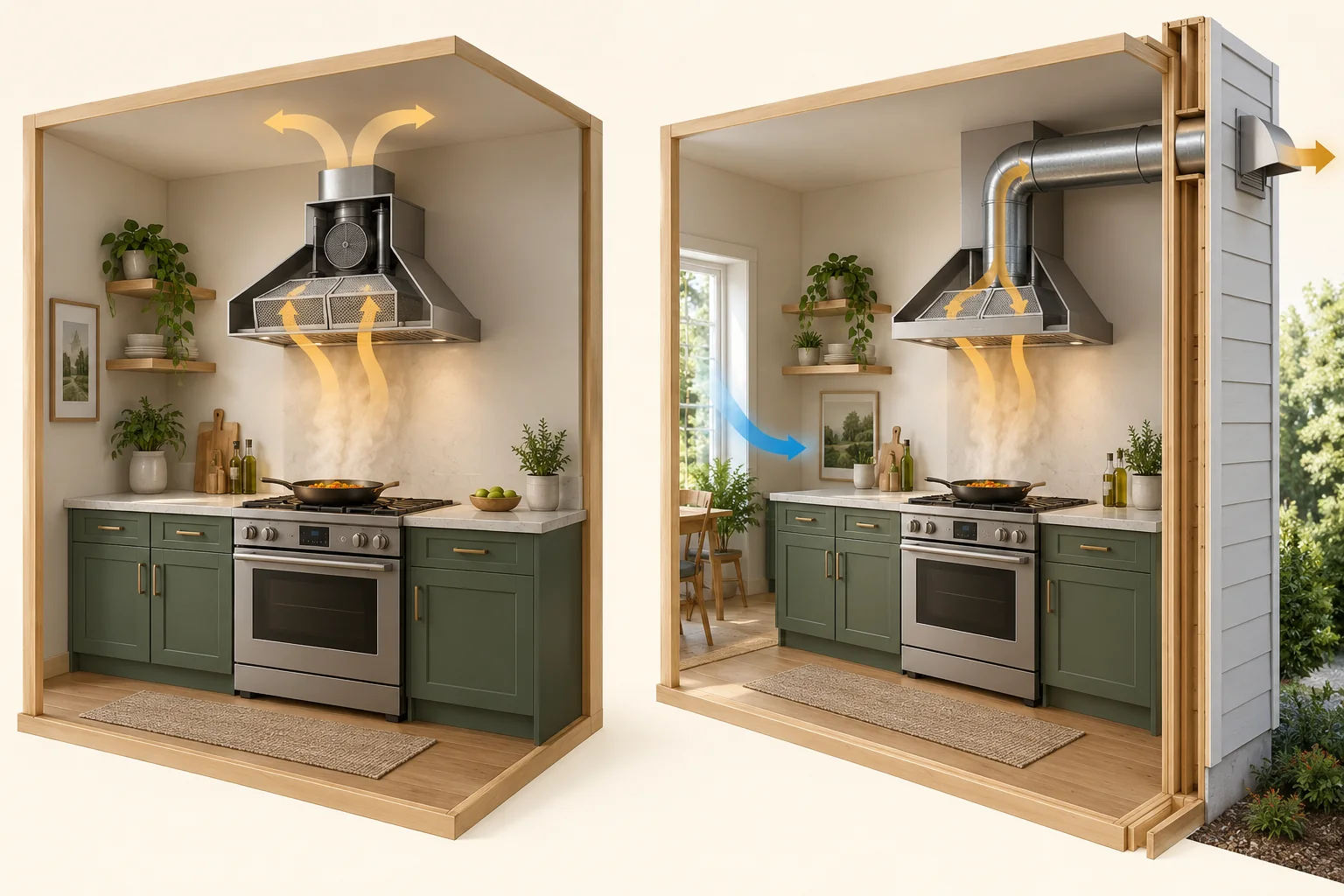
Separate kitchen models show cooking plumes, hood coverage, a return-to-room outlet on the left and an outdoor duct on the right. A blue arrow appears beside glazing.
About this illustration
The alternatives identify no actual product, filter performance, capture fraction, installed flow, approved duct, replacement-air design or healthy-air finding. The blue arrow does not prescribe opening a window or establish combustion safety. This is a conceptual teaching model, not an assessment of your home.
4 picture lessons appear beside the questions in this guide. Use them to understand the explanation, then consider what it means for your home.
What does the hood need to manage above an electric or gas cooktop?
Cooking creates a source close to the person using the stove. Heating food, oil and fat can release airborne particles; boiling and steaming add water vapour. These processes happen on electric appliances too. Gas cooking adds combustion by-products. Changing the fuel therefore changes part of the source question, while cooking-source removal remains relevant.
Start with the actual concern: lingering cooking odour, visible vapour escaping the hood, recurring grease deposits, noise that discourages use, or a planned kitchen change. Note the appliance and usual cooking activity. Each concern suggests a different service question. Grease on a cabinet is a useful observation, but its amount does not measure inhaled particles. Neither a pleasant smell nor a quiet kitchen establishes air quality. The useful first decision is which function you want assessed: local capture, the discharge route, ordinary use or the wider building-air relationship.
Why is capture different from clearing the room afterwards?
Capture means collecting the source-bearing air near cooking before much of it spreads through the kitchen. Warm cooking air can rise towards an overhead intake, while ordinary room air movement can change the relationship. The hood’s position and coverage relative to the burners matter. A shallow canopy that leaves a front burner beyond its coverage presents a different capture question from a hood extending over the cooking area.
Room ventilation works farther downstream: it exchanges or dilutes air after pollutants have entered the space. A whole-home ventilator and a portable air cleaner perform other functions; they are not automatically substitutes for source capture. Health Canada identifies burner coverage as an effectiveness consideration. Use that principle to ask about your actual hood and cooktop together, not to invent a mounting distance from a picture. Where cooking vapour visibly escapes during ordinary use, describe its location and the operating state rather than deliberately creating a larger plume.
Start where cooking emissions are generated
Separate kitchen models show cooking plumes, hood coverage, a return-to-room outlet on the left and an outdoor duct on the right. A blue arrow appears beside glazing.
Numbers identify the parts explained below.
- Cooking source
The plume is a concept, not a measured pollutant concentration. Describe ordinary cooking and the reported concern.
- Canopy relationship
Coverage and source capture deserve a question separate from the fan’s advertised airflow.
- Separate alternatives
The same-looking hood can return air or discharge outside; identify the actual installation.
What does this illustration leave out?
The alternatives identify no actual product, filter performance, capture fraction, installed flow, approved duct, replacement-air design or healthy-air finding. The blue arrow does not prescribe opening a window or establish combustion safety. This illustration explains an idea. It is not an installation guide.
What source, canopy coverage and installed configuration should my kitchen assessment address?
Explore this with HomeAI ↗Opens an editable question. Nothing is sent until you choose to send it.Does this installation return air to the kitchen or discharge it outdoors?
An outdoor-exhaust installation moves collected kitchen air through a connected route to outside. A recirculating arrangement returns air to the room after passing through its particular treatment components. The returning flow may feel impressive while no equivalent kitchen air is discharged outdoors. Health Canada’s kitchen-exhaust table distinguishes non-vented circulation from removing moisture and odours outside; NRCan also treats outdoor exhaust and recirculation differently.
Find the installed model, owner manual and installation record. Some products permit more than one configuration, so a manual showing an outdoor duct option does not establish which option was installed. Ask the provider to identify the actual configuration, filter arrangement and discharge destination. A decorative cover can conceal a route; an outdoor wall hood may belong to something else. Preserve an unverified destination as a question. This is an identification task for existing documents and safe observations, not permission to open cabinets, dismantle the hood or trace ducts through an attic.
Returning air and exhausting air are different arrangements
Separate kitchen models show cooking plumes, hood coverage, a return-to-room outlet on the left and an outdoor duct on the right. A blue arrow appears beside glazing.
Numbers identify the parts explained below.
- Return outlet
The left model returns air to its room. Actual treatment components and limitations are model-specific.
- Exterior duct
The right model illustrates a dedicated route; it does not prove my hood reaches outdoors.
- Blue concept arrow
Replacement air needs coordinated review; this arrow does not prescribe a window opening.
What does this illustration leave out?
The alternatives identify no actual product, filter performance, capture fraction, installed flow, approved duct, replacement-air design or healthy-air finding. The blue arrow does not prescribe opening a window or establish combustion safety. This illustration explains an idea. It is not an installation guide.
Does my actual hood recirculate or exhaust outdoors, and how is the incoming-air question addressed?
Explore this with HomeAI ↗Opens an editable question. Nothing is sent until you choose to send it.What should I expect from the filters in a recirculating arrangement?
A filter or treatment stage has a particular purpose. Different components may be intended for grease, selected particles or odours, with model-specific conditions and care. Ask the manufacturer’s documentation what each installed component is designed to address. Do not turn the generic word filter into a promise that every cooking gas, particle and moisture load is removed.
Recirculation returns air to the room instead of providing an outdoor exhaust path. Filtering does not make water vapour vanish simply because the fan is running. NRCan specifically cautions that recirculating hoods do not remove combustion products. A kitchen using one therefore needs a separate, correctly scoped ventilation discussion. Record the exact hood and filter identity, any missing component information and the present cooking appliance. An owner deciding whether to retain this arrangement should ask what the complete existing system can do and which practical, authorized alternatives the qualified provider can assess.
Which number describes the product, and which describes the installation?
A stated fan airflow is evidence under the product’s rating conditions. Installed airflow depends on the connected system and operating mode. In the NRC-hosted Ottawa experiment, researchers separately measured installed flow rather than relying only on manufacturer-stated values. That distinction is useful even though the controlled study does not predict performance in your kitchen.
Duct resistance, fittings, terminations and the supply of replacement air form part of the installed question. A contractor should identify the conditions behind a measurement and the appropriate comparison for the actual project. Capture performance is another question: air moving through a fan is not itself a measured fraction of cooking emissions captured. Ask which claim the proposed assessment will answer. Comparing advertisements becomes more useful when you separate rated capacity, measured installed airflow, sound and cooking-area coverage. A large advertised number should lead to an installation discussion, not an automatic upgrade decision.
Where does the air replacing outdoor exhaust come from?
When a hood exhausts air outside, other air must enter the building or suite. The incoming route may be designed, or air may travel through available leakage paths. Exhaust can change pressure relationships and influence which paths carry air. A cold draft felt elsewhere can therefore be relevant context for the specialist without identifying the route by itself.
Replacement air and makeup air describe related air-supply questions; a dedicated system may be part of the actual design. Ask how the arrangement serves the hood in its intended modes, where incoming air is obtained and how Canadian winter conditions are addressed. The answer may involve controls, conditioning and other equipment, which need coordinated design rather than a generic opening size. Do not block an intake because it feels cold or assume that opening a window is the permanent solution. The qualified provider should explain the installed arrangement and the evidence supporting any proposed change.
Why should the hood conversation include dryers and fuel-burning equipment?
The kitchen is part of a larger air system. Other exhaust equipment can also remove air, while naturally drafted fuel-burning appliances rely on venting relationships influenced by pressure. NRCan explains this competition and recommends expert air-supply advice when a powerful kitchen exhaust is added. The actual appliance type, venting arrangement and building configuration decide what assessment is relevant.
Tell the provider about the dryer, other exhaust equipment, fireplaces, fuel-burning water heaters and recent air-sealing work using the information you already have. Ask who will assess any connected combustion or pressure question; a hood installer’s scope and an appliance service visit may differ. Do not run combinations of fans and appliances to create a household challenge test, use smoke to trace draft, or change dampers. If a CO alarm sounds, leave immediately for fresh air and call emergency services from outside. Do not stay to locate the source or wait for ventilation to silence the alarm.
Exhaust belongs to the wider building-air question
The hood has a visible illustrative duct reaching an upper exterior outlet. A bathroom grille, closed exterior door, closed gray cabinet and separate incomplete vent-like shape provide wider-house landmarks.
Numbers identify the parts explained below.
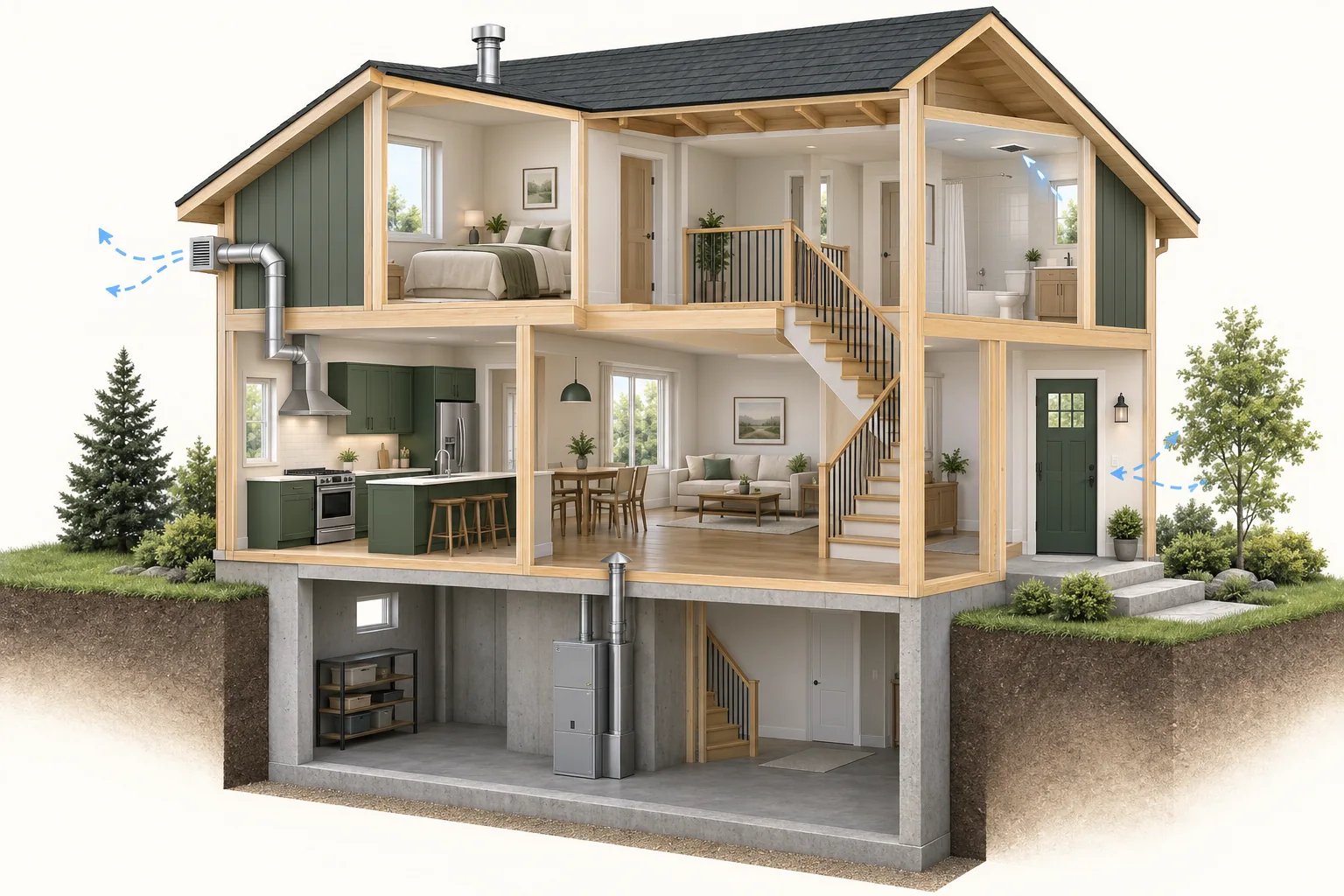
- Hood and duct
A kitchen discharge can change the building-air question. The model supplies no airflow or pressure.
- Closed utility cabinet
Identify actual equipment and its qualified service scope. Appearance supplies no fuel or connected flue.
- Closed exterior door
A dashed air concept identifies an unresolved route, not an approved makeup-air solution.
What does this illustration leave out?
No appliance fuel, connected flue, roof termination, bathroom duct route, pressure, replacement-air route or safe operating combination is established. Dashed arrows are concepts. This is not a pressure experiment or an installation design. This illustration explains an idea. It is not an installation guide.
Who will review replacement air and relevant connected equipment before a kitchen exhaust upgrade?
Explore this with HomeAI ↗Opens an editable question. Nothing is sent until you choose to send it.What can I record during ordinary cooking without performing an experiment?
For a few normal meals, note the cooking start and finish, the appliance used, the usual burner positions, the hood’s existing mode and when the reported concern appeared. Describe where vapour or odour was noticed and whether the fan noise affected normal use. Add ordinary door/window conditions and relevant outdoor weather. Keep the record short enough that someone can compare events.
Follow the actual owner instructions and any established building operating guidance. Do not burn food, overheat oil, generate smoke or intentionally change pressure conditions for a demonstration. An accessible photograph showing the cooktop and canopy together can explain coverage better than a close-up of the control alone. If a consumer air monitor is already present, keep its channel, location and time context with the observation; its display does not measure hood capture efficiency. The record’s job is to show the professional what needs explaining and when it occurs.
Which route questions belong in a service visit?
Ask the service provider to connect the intake, fan, inspected duct extent and identified discharge in one description. Concealed sections, connections and termination condition can affect the scope. A neatly boxed route may still need records or suitable authorized access before its destination and condition are understood.
From ordinary ground-level or room access, you can share existing photographs, visible exterior context and dated changes. Leave roof access, equipment opening and concealed-route investigation to the appropriate service team. In shared buildings, an individual hood may connect to a building arrangement that also requires management involvement. Ask the manager which provider can assess it without disturbing other services. A useful service scope states the route questions and the operating concern together; replacing the motor alone may answer only one of them. If the provider recommends a change, ask how the retained route and termination will be assessed.
How should maintenance support the system rather than become a guessed schedule?
Keep the exact owner manual and component references. Grease-related care, filter replacement and outdoor-route service may be different tasks performed by different people. Product instructions determine which components an owner can safely maintain and how; shared or inaccessible equipment needs the authorized team. A generic internet calendar cannot identify the right component or procedure.
Record completed care with the date, component and provider, together with changed noise, damage or performance concerns. Request clarification when the manual belongs to another version or the filter reference is missing. The existing HRV maintenance guide explains a fuller equipment/manual record without turning every ventilation appliance into the same system. After hood service, compare the original ordinary-use concern with the provider’s findings and recommended follow-up. A reminder being marked complete records a task; it does not replace the separate route or performance assessment when one is needed.
What should a renovation or new-home handover settle before I rely on the hood?
Before selecting an upgrade, give the qualified designer or installer the actual cooking appliance, hood coverage question, intended use, available duct route and building-air information. Ask what can be retained, what needs investigation and how replacement air or connected equipment affects the proposal. The relevant authority and provider should identify current requirements for the project and location; this guide supplies no national airflow or pressure trigger.
At new-home handover, request the installed model/configuration, route information, appropriate completion or commissioning records and an explanation of ordinary controls. Where a shared building is involved, coordinate common-system questions through management. A seller can retain the same material and accurately distinguish a local hood replacement from a wider ventilation change. Compare proposals by the problem they address and the evidence they will deliver, including any unresolved access. Appearance, a running motor and a new-appliance invoice are useful parts of the file, rather than interchangeable completion findings.
A handover connects the appliance with the completed house
The hood has a visible illustrative duct reaching an upper exterior outlet. A bathroom grille, closed exterior door, closed gray cabinet and separate incomplete vent-like shape provide wider-house landmarks.
Numbers identify the parts explained below.
- Visible kitchen route
Keep product identity, installed route and completion evidence together.
- Bathroom landmark
Other equipment can matter, but this picture verifies no bathroom duct or operating interaction.
- Utility location
Ask what the provider assessed and what remained outside the completed-work scope.
What does this illustration leave out?
No appliance fuel, connected flue, roof termination, bathroom duct route, pressure, replacement-air route or safe operating combination is established. Dashed arrows are concepts. This is not a pressure experiment or an installation design. This illustration explains an idea. It is not an installation guide.
Which route, replacement-air and completion records should accompany my new-home hood?
Explore this with HomeAI ↗Opens an editable question. Nothing is sent until you choose to send it.How do I turn the findings into a clear next decision?
Group the response under capture, discharge and replacement air. For each, note what was identified, what was assessed under stated conditions, what work is proposed and which question remains. If a route concern was resolved but vapour still escapes at a particular ordinary cooking position, return to the capture question. If installation evidence is incomplete, resolve that scope before comparing larger fans.
Where targeted indoor-air assessment is proposed, ask what contaminant or decision it addresses and how the result will be used. Health Canada’s professional guidance treats sampling as one tool within an investigation, rather than an automatic first purchase. Keep completed-work and follow-up records with the manual so the next owner can understand the configuration. The aim is a hood arrangement that has been appropriately assessed for this kitchen and building, supported by interpretable findings and instructions. It is not a removal percentage, health guarantee or whole-home air score inferred from the fan switch.
Keep learning about the connected parts
Practice the distinction.
A stylish hood and an uncertain route
Fictional learning example: an owner considers a larger hood because cooking odour lingers after a renovation.
Reported observations
- The present motor runs, but its installed exhaust/recirculation configuration is undocumented.
- The canopy does not appear to cover the usual front cooking position.
- A renovation invoice names the hood but omits the retained route and air-supply arrangement.
Compare the explanations
Expand each possibility to see the evidence needed to distinguish it. Similar symptoms can have different mechanisms.
A capture or use question
Coverage and ordinary operating context may affect what reaches the intake.
Identified product, cooktop relationship and scoped capture assessment.
A separate route or building-air question
The installation and replacement-air arrangement may need clarification before an upgrade.
Qualified route findings and coordinated air-supply/connected-equipment review.
A useful next question
Identify the configuration and ask for a proposal addressing capture, discharge and replacement air separately.
No actual fault, airflow, removal percentage, approved design or safe-air finding is supplied.
Know what the words mean.
- Source capture
- Collecting cooking-source air near where it is generated before it spreads widely through the room.
- Recirculating hood
- An arrangement returning air to the room through its particular treatment components rather than discharging that flow outdoors.
- Outdoor exhaust
- A connected path carrying collected room air to an identified outdoor discharge.
- Replacement air
- Air entering to replace air exhausted from the building or suite; its route and suitability need assessment.
- Installed airflow
- Flow assessed in the actual connected configuration and recorded operating conditions, distinct from a product rating.
- Capture performance
- How effectively the arrangement collects source-bearing air, a different question from fan airflow alone.
Questions to bring
to the conversation.
- What actual cooking-source or use concern should the assessment answer?
- Which model and installed recirculation/outdoor-exhaust configuration are documented?
- What coverage relationship and discharge route have actually been assessed?
- Is a quoted number a product rating, installed measurement or capture claim?
- How will replacement-air and relevant connected equipment be addressed?
- What completed work, conditions and follow-up belong in the handover?
Separate a showing observation, an existing record and a new professional assessment. Unknown means a question remains; it does not automatically mean a defect.
Use the evidence planner ↗Go to the source.
Original HomeAI explanation informed by these public references. Sources support the underlying guidance; they have not reviewed or endorsed HomeAI. Diagrams are conceptual, and calculator outputs depend on your inputs.
Publication & source review
First published .
Sources reviewed .
- Health Canada · Factsheet: Cooking and indoor air quality (2018)
Where this reference applies
Jurisdiction: Canada; general cooking-source education
Publisher publication date: 2018
Publisher modification date: 2021-01-12
Source reviewed: 2026-10-03 · UTC
Gas and electric cooking can generate particles and moisture; gas adds combustion by-products. Exhaust use and burner coverage are relevant. Its historical numerical flow/removal comparison is excluded from targets, predictions and current-code claims. Window/furnace operating suggestions are not generalized here.
- Sun and coauthors · Venting range-hood particle study, NRC Publications Archive (2018)
Where this reference applies
Jurisdiction: Canadian Ottawa research houses; bounded experiment, not a current installation rule
Publisher publication date: 2018-11-05
Source reviewed: 2026-10-03 · UTC
The paper distinguishes source capture, burner/hood context and measured installed flow from manufacturer-stated flow. Cover citation is November 5, 2018; PDF creation in April 2019 is not publication. No study apparatus, gas-cooking experiment, removal percentage, model comparison or design recipe is reproduced.
- Health Canada · Ventilation and the indoor environment (March 2018)
Where this reference applies
Jurisdiction: Explicit scope: detached houses, duplexes and row houses with individual heating/ventilation equipment
Publisher publication date: 2018-03
Publisher modification date: 2018-04-19
Source reviewed: 2026-10-03 · UTC
Exhaust, replacement air, enclosure leakage and connected combustion venting interact; non-vented kitchen fans return moisture/odours to the room. Numerical historical pressure/flow triggers, code-edition statements, fixed maintenance intervals and unrestricted window/furnace instructions are excluded.
- Natural Resources Canada · Keeping the Heat In, section 9: operating your house
Where this reference applies
Jurisdiction: Canada; general household-operation context
Publisher modification date: 2025-09-29
Source reviewed: 2026-10-03 · UTC
Kitchen/bathroom source use, exhaust outdoors, recirculation distinction and replacement-air relationship. Issued/modified page dates do not individually date every passage. No window humidity table, prescriptive duct retrofit, interlock procedure, universal savings or maintenance calendar.
- Natural Resources Canada · Combustion gases in your home: combustion spillage
Where this reference applies
Jurisdiction: Canada; building-air and combustion mechanism education
Publisher modification date: 2025-01-16
Source reviewed: 2026-10-03 · UTC
Exhaust and naturally drafted appliances can interact; an added hood merits qualified air-supply advice; recirculation is not combustion-product exhaust. The document’s smoke-indicator/all-fans-on test, equipment alterations, current alarm-standard assertion and fireplace operating instructions are expressly excluded.
- Health Canada · Guidance for indoor air quality professionals (September 2025)
Where this reference applies
Jurisdiction: Canada; professional indoor-air assessment guidance
Publisher publication date: 2025-09-19
Publisher modification date: 2025-09-23
Source reviewed: 2026-10-03 · UTC
Walkthroughs, operational logs and source questions can inform whether targeted sampling is useful. Methods, location, timing, actual objective and professional interpretation matter. No universal sampling duration, exposure number, contaminant protocol or DIY test is adopted.
- Health Canada · Carbon monoxide: preventing exposure
Where this reference applies
Jurisdiction: Canada; immediate CO-alarm response
Publisher modification date: 2024-11-12
Source reviewed: 2026-10-03 · UTC
Leave immediately for fresh air if a CO alarm sounds, call emergency services from outside, do not locate the source and return only after professional resolution. No universal provincial placement rule, alarm maintenance calendar or owner combustion test.
Have a question about your home?
Start with the symptom, timing and what you have observed.
Ask HomeAI