Jump to a question in this guide
- What jobs does a microwave oven combine?
- How does radiofrequency energy become heat in food?
- What does the cavity do, and what should remain intact?
- Why are the door and interlocks a separate safety question?
- What do power, programme and timer selections mean?
- Why can food need standing and temperature checks after cooking?
- Why must containers and care match the instructions?
- Which fan is cooling the appliance, and which handles cooking air?
- What can a changed result or sound establish safely?
- What should service and replacement records establish?
- How would a fictional owner separate food and fan questions?
- What should the microwave handover make clear?
- The microwave supplies cooking energy; heat can remain and redistribute in food after that energy stops.
- A countdown, turning tray or warm portion does not establish the condition of the whole meal.
- Door interlocks, an electronic control lock and the food result are different questions.
- Appliance cooling and an over-range kitchen vent fan have different jobs and routes.
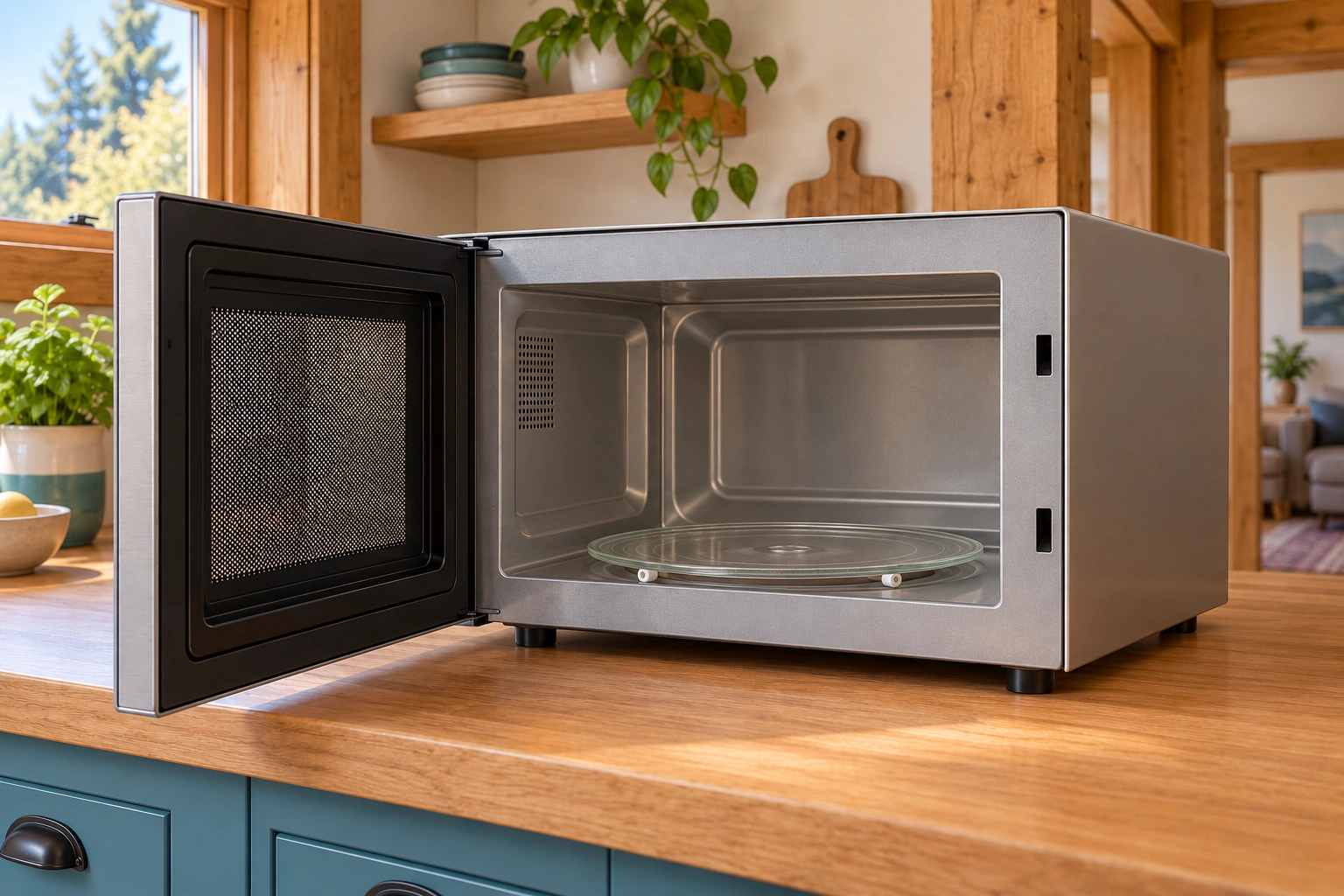
The intact countertop appliance has its door open to an empty cavity and glass tray with roller support. Every outer machinery compartment remains closed; the image identifies user-space landmarks without showing a repair view.
About this illustration
Generic countertop concept, not the named over-range manual model, actual interlock inspection or an operating test. This is a conceptual teaching model, not an assessment of your home.
6 picture lessons appear beside the questions in this guide. Use them to understand the explanation, then consider what it means for your home.
What jobs does a microwave oven combine?
A microwave oven supplies radiofrequency energy to food inside a cooking cavity. Controls request a cooking function, while the door and interlocks have a separate safety role. The appliance also manages heat and moisture, and an over-the-range unit may combine a kitchen vent fan with the cooking equipment. Those are connected functions, but a display, sound or warm dish does not assess them all.
Begin by naming the actual appliance and its installation type. A countertop model, a model installed with its matching built-in arrangement and an over-the-range unit have different surrounding relationships. Similar door shapes do not establish the same ventilation or installation requirements. Use existing model records and exact instructions; do not move or dismantle equipment to find a hidden label.
This guide uses Health Canada’s microwave and food-safety explanations for Canadian context. Its detailed control and fan example is the Panasonic Canadian NN-ST27HB/NN-ST27HW over-the-range manual, printed copyright 2017. The manufacturer hosts it under a 2023 web path, which is not a new technical edition. Its features and old installation statements are not universal current Canadian rules.
The original pictures show a generic countertop appliance with an intact exterior and user cavity. They do not depict the historical over-the-range model or hidden electrical machinery. The range guide owns radiant, induction and conventional oven functions; the kitchen-exhaust guide owns room-air routes. This guide explains the microwave’s distinct cooking, enclosure and service questions without replacing the actual manufacturer’s instructions.
How does radiofrequency energy become heat in food?
Health Canada describes microwaves as radiofrequency electromagnetic energy and explains their interaction with water molecules in food. The resulting energy transfer raises the food’s temperature. This is a different heating relationship from an oven cavity surrounding food with heated air. The useful homeowner distinction is between the cooking energy supplied by the appliance and the temperature actually reached throughout the food.
A magnetron is an internal microwave-energy source in the common design described here. Panasonic’s North American component explanation identifies its conversion from electrical energy into microwave radiofrequency energy. That energy is different from the electrical supply entering the appliance and from the heat that eventually reaches the meal. This is a functional chain, not a drawing of internal electrical parts.
The US Food and Drug Administration explains the next handoff: microwaves generated inside the oven are reflected within its metal cooking space and absorbed by food. Absorbed energy becomes heat. The cavity therefore provides the cooking space; the turntable, where fitted, moves the dish rather than producing the microwaves. A turning tray and an effective heating result remain different observations.
Thick food is not simply cooked from its centre outward. The FDA describes microwave heating in the outer layers and heat conduction toward the inside. Conduction means heat moving from a hotter region to a cooler one through the food. This helps explain why a hot outside is not a complete food check.
These North American manufacturer and US public-education sources support the physical explanation only. Their regulations, numerical values, broad efficiency or cookware claims and procedures are not adopted as Canadian rules. No internal cover, electrical compartment or energy path should be opened or tested by the reader.
The energy does not make the food or appliance radioactive. Health Canada explains that the microwaves cease when the oven is switched off; they do not remain stored in the food. Heat already present is another matter. The food, vessel and steam can remain hot after cooking energy stops, so an ended programme is not permission to touch or open a container carelessly.
Food can heat unevenly. Its quantity, shape, starting condition and arrangement affect the result, and a hot exterior or steaming portion does not establish the condition everywhere. Health Canada’s food-safety page calls for a digital food thermometer to check internal temperature under the applicable food instructions. This guide gives no general cooking time, recipe, temperature table or guarantee from appearance.
The native cooking figure separates requested programme, energy delivered during operation, uneven food heating and the food-specific check. It is not a diagram of a hidden machine or an owner experiment. A poor result may require reviewing food and instruction context as well as appropriate appliance service. It does not independently identify a failed component or establish that the enclosure is leaking.
Compare energy and heat across time. During the requested cooking function, the appliance supplies energy under its actual control. After that function ends, heat already held in the food can continue moving within it. This explains why the food instructions can include a later milestone without implying that microwaves remain trapped inside. It also explains why an immediate result at one point is not a complete description of the whole meal.
Cooking energy and retained food heat differ
Original native teaching figure: Cooking energy and retained food heat differ. The complete labelled relationships distinguish the functions below; they describe conceptual questions rather than an actual property finding.
Numbers identify the parts explained below.
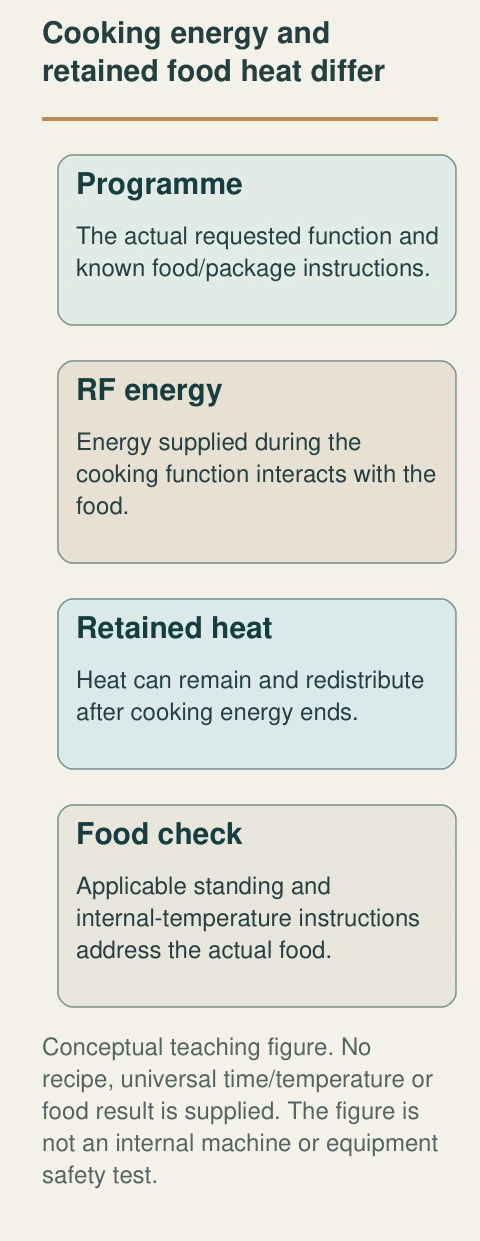
- Programme
The actual requested function and known food/package instructions.
- RF energy
Energy supplied during the cooking function interacts with the food.
- Retained heat
Heat can remain and redistribute after cooking energy ends.
- Food check
Applicable standing and internal-temperature instructions address the actual food.
What does this illustration leave out?
No recipe, universal time/temperature or food result is supplied. The figure is not an internal machine or equipment safety test. This illustration explains an idea. It is not an installation guide.
Which milestone does the actual instruction or observation describe?
Explore this with HomeAI ↗Opens an editable question. Nothing is sent until you choose to send it.Different stages of the food question
- ProgrammeThe requested actual cooking function.
- Cooking energyRF energy supplied while the function operates.
- Retained heatFood/container heat can remain and redistribute afterward.
- Food checkApplicable food instructions and internal condition.
No recipe, universal time, temperature table or equipment safety test.
Further reading: Health Canada · Microwave ovens; Health Canada · Food safety tips for microwaves.
Read the complete figure
Cooking energy and retained food heat differ
Original native teaching figure: Cooking energy and retained food heat differ. The complete labelled relationships distinguish the functions below; they describe conceptual questions rather than an actual property finding.
- Programme
- The actual requested function and known food/package instructions.
- RF energy
- Energy supplied during the cooking function interacts with the food.
- Retained heat
- Heat can remain and redistribute after cooking energy ends.
- Food check
- Applicable standing and internal-temperature instructions address the actual food.
What remains unknown: No recipe, universal time/temperature or food result is supplied. The figure is not an internal machine or equipment safety test.
A useful question: Which milestone does the actual instruction or observation describe?
What does the cavity do, and what should remain intact?
The cavity is the space in which the food is placed for the appliance’s intended cooking function. The named Panasonic manual identifies the glass tray, roller ring and surrounding user-accessible surfaces separately from the exterior casing and controls. The cavity picture helps locate these familiar parts while leaving every electrical compartment closed. It provides no approved arrangement for an actual unidentified model.
In the Panasonic example, the tray and ring support movement of the dish as part of the stated cooking arrangement. That function differs from the door’s safety role. A turning tray does not independently demonstrate food temperature, the condition of the door or every cooking function. Likewise, a stopped tray is not a diagnosis without the exact model, selected programme and observed context.
A cavity includes surfaces and openings that belong to the appliance design. Do not remove a cover, film, grille or other part because it looks like packaging or a place to investigate. Follow the exact model’s user-care instructions and obtain qualified advice for an uncertain or damaged component. The guide does not supply a replacement part, disassembly step or permission to operate with any part missing.
Keep an existing account of a damaged surface, unusual noise or changed tray movement separate from its possible explanation. Do not run the oven empty, stage a container test, reach into openings or reproduce an event for evidence. An appropriate service provider identifies the actual component and assessment needed. A normal-looking cavity photograph cannot clear the concealed machine or authorize continued use after a safety concern.
The user cavity is separate from closed machinery
The intact countertop appliance has its door open to an empty cavity and glass tray with roller support. Every outer machinery compartment remains closed; the image identifies user-space landmarks without showing a repair view.
Numbers identify the parts explained below.
- Cavity
Intended food space, not electrical access.
- Tray and ring
Visible user-space parts with model-specific instructions.
- Opaque outer casing
Hidden machinery remains closed and unassessed.
What does this illustration leave out?
Generic countertop concept, not the named over-range manual model, actual interlock inspection or an operating test. This illustration explains an idea. It is not an installation guide.
Which actual user part and matched instruction does the record identify?
Explore this with HomeAI ↗Opens an editable question. Nothing is sent until you choose to send it.Why are the door and interlocks a separate safety question?
The door closes the cooking enclosure, and the interlocks are safety devices associated with its operation. Health Canada explicitly says not to disable or tamper with them. A control lock that prevents electronic commands is a different function: in the named Panasonic example it does not physically lock the door. Do not treat either a padlock symbol or a closed-looking door as an independent assessment of the actual safety system.
Health Canada advises against using an oven whose door does not close or is bent, warped or damaged. It also identifies hinges, latches, seals and the screen as relevant inspection concerns. Stop using damaged equipment and contact the manufacturer, distributor or qualified service provider. The article gives no permitted gap, bend tolerance or repair technique, and no photograph can establish acceptable leakage.
Never insert an object around the door or through an opening to check a latch or energy path. Do not defeat a switch, hold a door in position, force it or try an improvised leakage instrument. A domestic symptom record is not a safety-interlock test. Keep people clear of the concern and let the responsible qualified provider define the necessary professional inspection.
The door picture shows an intact closed appliance for identifying the exterior parts only. The native safety figure distinguishes visible condition, the stop-use/service response and professional findings. It does not teach a test sequence. A service report should state the exact unit and what was actually inspected or verified, leaving unassessed questions visible rather than declaring safety from an ordinary cooking result.
An intact door view locates the safety question
The generic countertop appliance keeps its door closed, with visible frame, mesh window, hinges and handle beside a blank control fascia. Its opaque casing encloses all machinery; no live test or leakage path is illustrated.
Numbers identify the parts explained below.
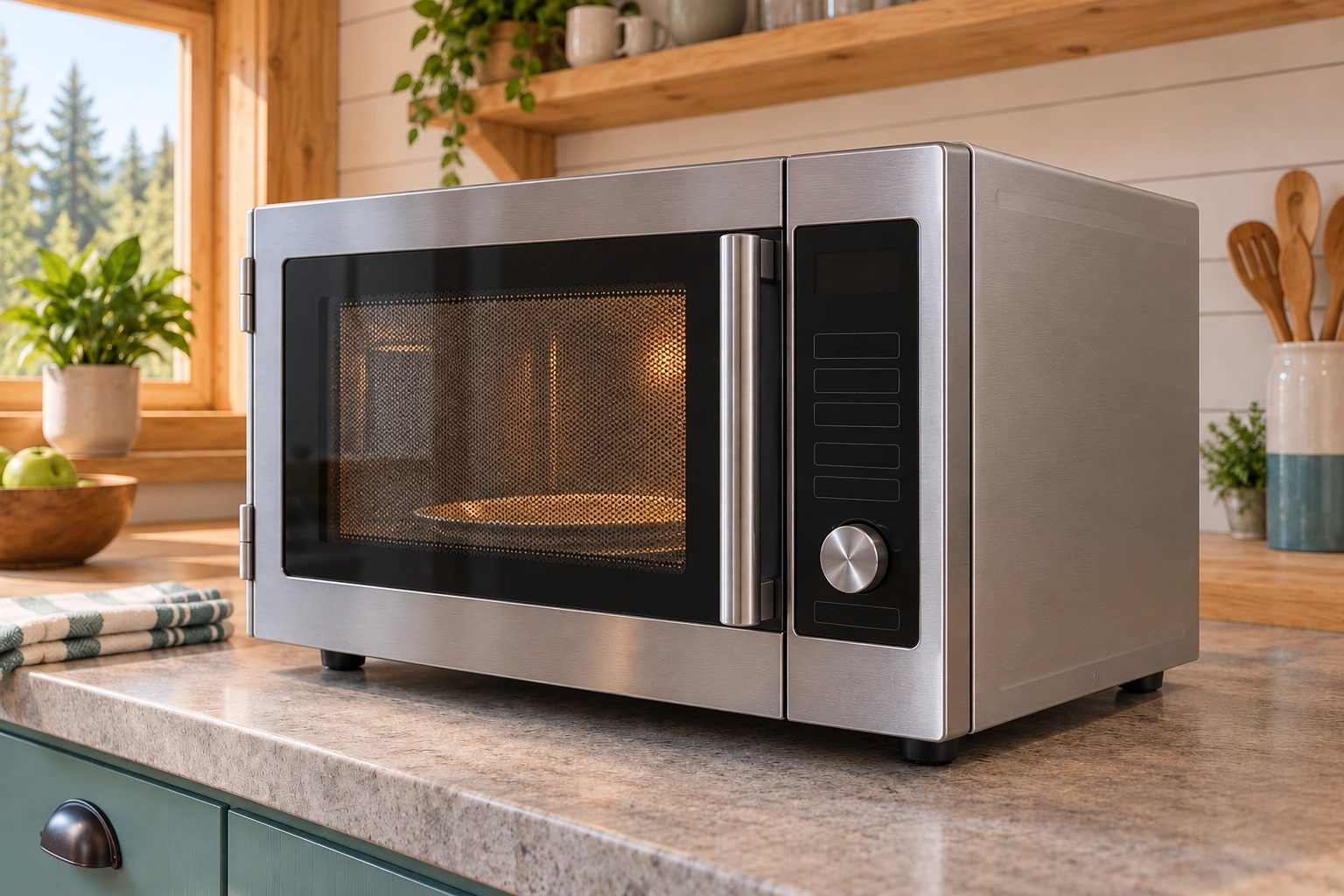
- Door frame and window
Visible landmarks, not a clearance finding.
- Hinges and handle
Condition concerns need appropriate service.
- Controls
Control lock and door safety have distinct roles.
What does this illustration leave out?
Appearance cannot establish leakage, interlock function, safe use, actual model or suitability of installation. This illustration explains an idea. It is not an installation guide.
What does the qualified actual door and safety-system assessment establish?
Explore this with HomeAI ↗Opens an editable question. Nothing is sent until you choose to send it.Door safety, control lock and food result are different
Original native teaching figure: Door safety, control lock and food result are different. The complete labelled relationships distinguish the functions below; they describe conceptual questions rather than an actual property finding.
Numbers identify the parts explained below.
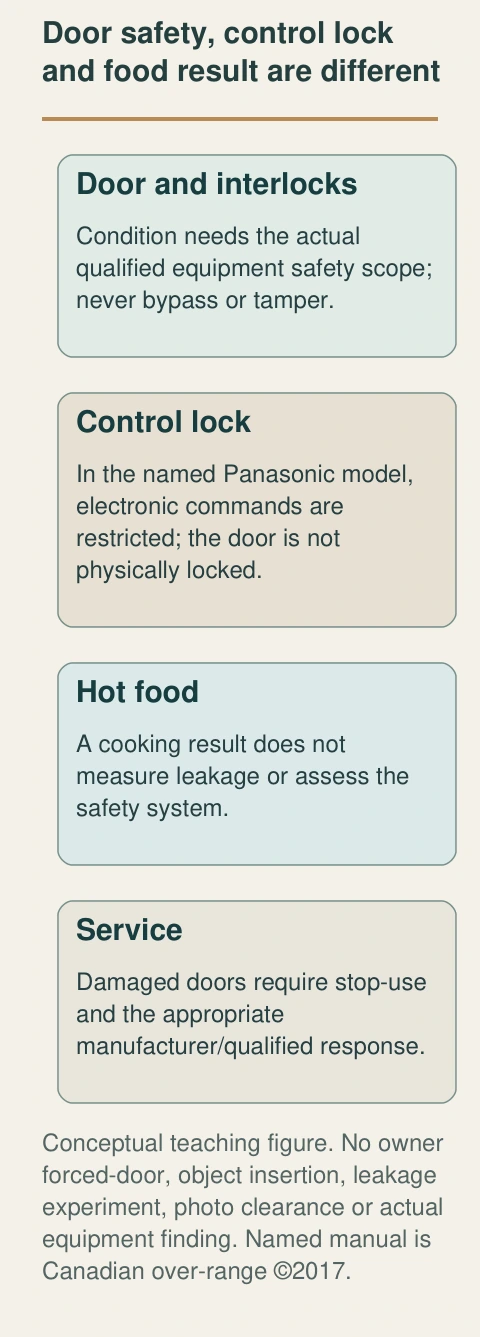
- Door and interlocks
Condition needs the actual qualified equipment safety scope; never bypass or tamper.
- Control lock
In the named Panasonic model, electronic commands are restricted; the door is not physically locked.
- Hot food
A cooking result does not measure leakage or assess the safety system.
- Service
Damaged doors require stop-use and the appropriate manufacturer/qualified response.
What does this illustration leave out?
No owner forced-door, object insertion, leakage experiment, photo clearance or actual equipment finding. Named manual is Canadian over-range ©2017. This illustration explains an idea. It is not an installation guide.
What did the actual professional door/system assessment establish?
Explore this with HomeAI ↗Opens an editable question. Nothing is sent until you choose to send it.Door, control and food evidence differ
- Door/interlockCondition and qualified equipment safety scope.
- Control lockNamed-model electronic-command feature, not a physical door lock.
- Hot foodCooking result, not a leakage or interlock assessment.
No owner bypass, forced door, object insertion or leakage experiment.
Further reading: Health Canada · Microwave ovens; Panasonic Canada · NN-ST27HB / NN-ST27HW operating instructions.
Read the complete figure
Door safety, control lock and food result are different
Original native teaching figure: Door safety, control lock and food result are different. The complete labelled relationships distinguish the functions below; they describe conceptual questions rather than an actual property finding.
- Door and interlocks
- Condition needs the actual qualified equipment safety scope; never bypass or tamper.
- Control lock
- In the named Panasonic model, electronic commands are restricted; the door is not physically locked.
- Hot food
- A cooking result does not measure leakage or assess the safety system.
- Service
- Damaged doors require stop-use and the appropriate manufacturer/qualified response.
What remains unknown: No owner forced-door, object insertion, leakage experiment, photo clearance or actual equipment finding. Named manual is Canadian over-range ©2017.
A useful question: What did the actual professional door/system assessment establish?
What do power, programme and timer selections mean?
A cooking programme requests a function under the actual appliance’s control design. A power selection and a time selection describe different parts of that request. The display may also show a clock, kitchen timer, lock, demonstration mode or status message. Its meaning must come from the matched instructions and known operating context, not from the mere presence of digits on the panel.
The Panasonic example distinguishes its kitchen timer from cooking and describes a demonstration mode for retail display. Its control lock prevents electronic operation without locking the door. These examples explain why a lit display or countdown does not independently establish cooking energy. They are not instructions to alter settings, reset the appliance or repeat a heating event to identify a fault.
The same manual describes sensor programmes that use detected steam in their operation. That is not a direct measurement of every part of the food or a substitute for appropriate food-safety instructions. A convenient programme still has a named purpose, conditions and limits. Keep those with the actual model instead of assuming that a button marked reheat guarantees a safe result for any quantity or food.
For a service account, preserve the already-known programme, displayed message, selected time and event sequence separately. If a detail was not recorded, leave it unknown. The provider can interpret the controls and decide whether a qualified assessment is needed. This guide supplies no button sequence, wattage conversion, calibration method or universal explanation for a programme that appears to finish without the expected result.
Why can food need standing and temperature checks after cooking?
Heat can continue redistributing within food after cooking energy stops. Health Canada explains that standing time helps complete cooking and improve heat distribution. That function is different from an appliance cooling fan running afterward. A timer ending, a fan stopping and food reaching the applicable safe internal condition are separate milestones, with the actual instructions governing each.
Health Canada’s current food-safety page describes uneven microwave cooking and the need to check internal food temperature. It also directs readers to food and package instructions and recognises that different appliance power affects timing. This article does not reproduce a recipe or assign one time to an unidentified meal. A hot plate, steam or browned-looking portion cannot replace the appropriate check.
Defrosting, cooking and reheating have different purposes. A defrost programme does not establish that the food is cooked, and a warm-holding label is not an unlimited food-storage assurance. Follow current applicable food-safety and package directions alongside the exact appliance manual. The 2017 manual’s recipes, visual doneness suggestions and US temperature table are deliberately not adopted as current Canadian general guidance.
Keep food questions distinct from equipment damage. A food result may need instruction and handling review; a damaged door needs the service response even if a dish became hot. Neither conclusion cancels the other. The fictional case later in this guide keeps those responsibilities separate, without using a cooking trial as an equipment safety test or promising that a programme setting alone resolves a food concern.
Why must containers and care match the instructions?
A vessel and its lid or wrap form part of the cooking arrangement. Health Canada’s food-safety page calls for microwave-safe containers and packaging and warns that some packaging is unsuitable for heating. Compatibility is not established by shape, colour or having survived a previous use. Use the actual container, food and appliance instructions rather than a generic material guess.
Steam and retained heat need their own caution. A covered food can release hot vapour, while the container and contents can have different temperatures. Follow the applicable instructions for handling and venting; this guide supplies no cover arrangement or opening technique. Do not seal a container or deliberately overheat liquid to observe how the microwave works.
The full Panasonic manual contains detailed cookware and care directions, including model-specific exceptions. Those are not reduced here to a universal foil, metal, plastic or container-test rule. The historical manual and Health Canada page serve different scopes. If advice seems inconsistent for the actual item or model, resolve it with the appropriate current manufacturer and food guidance before use.
Care also needs matching directions. Health Canada identifies the importance of door and seal condition and advises against abrasive cleaners. This guide offers no chemical recipe or internal cleaning procedure. Do not spray into openings, remove a cover or improvise a repair. A damaged or uncertain part belongs with qualified service, while ordinary user care remains within the exact instructions and the appliance’s actual safe condition.
Which fan is cooling the appliance, and which handles cooking air?
An appliance can move air to manage its own heat, while an over-the-range unit can also have a vent fan serving the cooking surface below. The Panasonic NN-ST27 instructions distinguish these functions and describe automatic fan behaviour under certain conditions. A fan-like sound therefore needs an identified component and context before it can be called an exhaust problem or a failed control.
The current manufacturer fan-help page and the 2017 manual describe named-model status messages and automatic cooling behaviour. Their detailed times and button sequences are not universal normality rules and are not reproduced here. A different sound, odour, damaged part or changed behaviour still needs appropriate advice. Do not block a vent, force a fan off or repeatedly operate equipment to compare sounds.
A countertop appliance’s exterior slots serve its own design; they do not turn it into a kitchen hood. The generic vent picture shows intact exterior openings and surrounding context, with no airflow arrows or installation clearances. Its function is to help the reader name an appliance vent, not prove that the actual placement provides suitable ventilation.
For an over-the-range unit, the actual kitchen-air route is another question. The Panasonic manual distinguishes ducted and recirculating arrangements, but the separate installation document has not been read here. Ask the responsible installer which arrangement actually exists and use the kitchen-exhaust guide for that system. A running fan alone establishes neither exterior discharge nor effective room-air capture, and this guide gives no duct, filter or installation design.
Air movement has a purpose and a route. A fan managing the appliance’s temperature does not independently establish where cooking vapours from the range go. A vent fan serving the range still needs its actual ducted or recirculating arrangement identified. Preserve the named component, the operating context and the supported route as separate facts. Sound can support an account of activity without proving capacity, capture or the condition of concealed connections.
Identify the air-moving function and actual route
Original native teaching figure: Identify the air-moving function and actual route. The complete labelled relationships distinguish the functions below; they describe conceptual questions rather than an actual property finding.
Numbers identify the parts explained below.
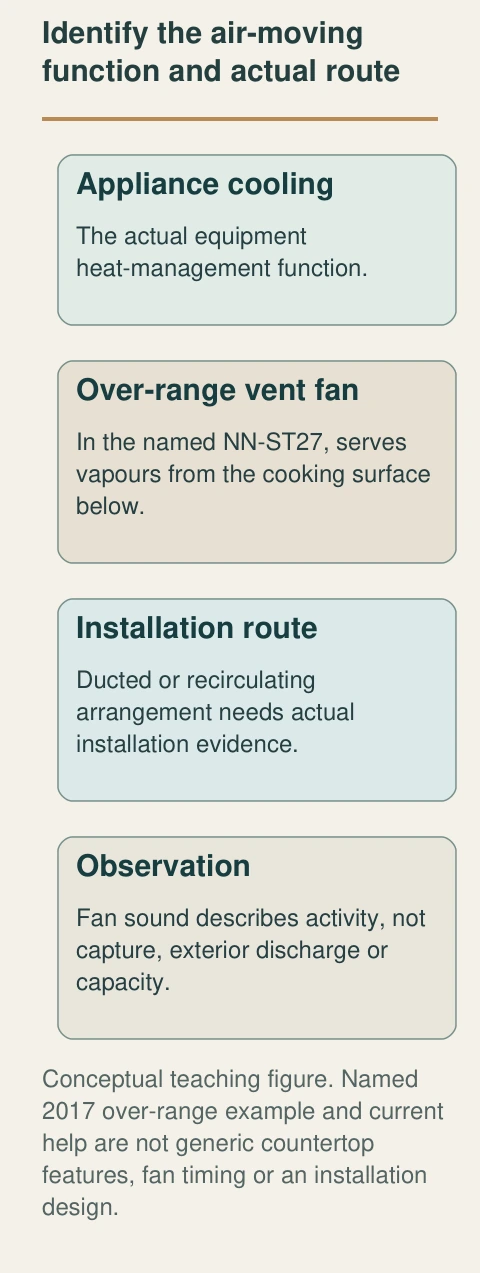
- Appliance cooling
The actual equipment heat-management function.
- Over-range vent fan
In the named NN-ST27, serves vapours from the cooking surface below.
- Installation route
Ducted or recirculating arrangement needs actual installation evidence.
- Observation
Fan sound describes activity, not capture, exterior discharge or capacity.
What does this illustration leave out?
Named 2017 over-range example and current help are not generic countertop features, fan timing or an installation design. This illustration explains an idea. It is not an installation guide.
Which fan and which supported route does the service record identify?
Explore this with HomeAI ↗Opens an editable question. Nothing is sent until you choose to send it.Exterior appliance slots are not a kitchen hood
The intact countertop microwave sits on a worktop within the skeletal kitchen model, with exterior slots visible on its opaque casing. It identifies appliance ventilation context without exposing a fan or drawing airflow.
Numbers identify the parts explained below.

- Exterior slots
Actual model instructions govern their role.
- Intact casing
No internal machine or owner access.
- Kitchen context
Countertop equipment is not the named over-range example.
What does this illustration leave out?
No clearance, route/capacity, hidden connection, approved placement or over-range extraction function is established. This illustration explains an idea. It is not an installation guide.
Which actual cooling or kitchen-air function does the service record identify?
Explore this with HomeAI ↗Opens an editable question. Nothing is sent until you choose to send it.Name the air-moving function
- Appliance coolingThe actual equipment heat-management function.
- Over-range vent fanCooking-surface air function in the named model.
- Ducted/recirculating routeActual installation evidence, separate from fan sound.
No universal fan timing, clearance, capture result or installation design.
Further reading: Panasonic Canada · NN-ST27HB / NN-ST27HW operating instructions; Panasonic · How to turn the fan On and Off: NN-ST27.
Read the complete figure
Identify the air-moving function and actual route
Original native teaching figure: Identify the air-moving function and actual route. The complete labelled relationships distinguish the functions below; they describe conceptual questions rather than an actual property finding.
- Appliance cooling
- The actual equipment heat-management function.
- Over-range vent fan
- In the named NN-ST27, serves vapours from the cooking surface below.
- Installation route
- Ducted or recirculating arrangement needs actual installation evidence.
- Observation
- Fan sound describes activity, not capture, exterior discharge or capacity.
What remains unknown: Named 2017 over-range example and current help are not generic countertop features, fan timing or an installation design.
A useful question: Which fan and which supported route does the service record identify?
What can a changed result or sound establish safely?
A useful account separates observations: a dish heated differently, the tray sounded different, a display showed a message or a fan continued after a programme. None independently names a cause. Preserve the actual sequence, approximate timing and existing model information. Record known food and programme context without claiming controlled conditions that were never observed.
Use existing records and ordinary safe views. Do not move an installed appliance, remove trim, open the casing, reset a breaker, test an outlet or reproduce a heating event for evidence. The historical manual’s before-service table includes user troubleshooting steps, but this guide does not adopt them as an owner investigation. A qualified provider decides the appropriate assessment and any related electrical or installation scope.
Smoke, sparks, burning smells, damaged equipment or another immediate danger require the appropriate urgent response. Keep clear and use emergency services when danger is present; evidence gathering can wait. A description of possible normal steam or automatic cooling in one manual is not a reason to dismiss a safety concern or continue using damaged equipment.
The native symptom figure keeps observed result, actual function question and responsible assessment distinct. It gives no cause score or leakage inference. A household can still make a precise service request with missing fields: which unit, what was already observed and what remains unknown. The provider’s finding, not an improvised demonstration, should connect the account to any actual defect and next work.
What should service and replacement records establish?
A service record should connect the exact unit and date with the reported concern, assessed functions, findings, completed work and verification limits. A replacement part or successful cooking demonstration does not automatically assess the door system, installation, every programme or kitchen-air route. Ask the provider which question was answered and what remains outside its scope.
Health Canada directs adjustments and repairs to qualified service technicians. The exact manufacturer can identify the relevant service route and matching instructions. An electrical, mounting, cabinetry or kitchen-air issue may require another appropriate provider and local requirements. This guide does not invent a nationwide credential, code acceptance or warranty entitlement from the appliance category.
Replacement needs its own arrangement review. Similar external dimensions do not establish a compatible built-in kit, mounting, support or ventilation design. Give the actual installer the intended equipment and existing records before work is planned. Do not cut cabinetry, reuse an unidentified trim kit or change a duct to make a unit fit on the basis of this guide.
Retain current care and use instructions, actual installation and service records and unresolved concerns with the equipment identity. A historical warranty page is evidence of what that document says, not a current entitlement. The 2017 Panasonic warranty and old electrical statements remain held. The useful handover explains actual work and limits without declaring whole-appliance safety from age, appearance or a recent invoice.
How would a fictional owner separate food and fan questions?
Dev is a fictional owner who recalls unevenly warm leftovers and a fan continuing after the programme. He did not record the programme. In this example, a technician’s written note identifies only the appliance-cooling fan for his model; the note excludes the earlier meal, the door system and the kitchen-air installation.
Dev can close the narrow question “which fan was described?” in his example file. He cannot rewrite the note as a food or whole-appliance approval. He keeps the earlier meal result unestablished, uses current applicable food and package directions for ordinary future use, and does not repeat the meal as an equipment test.
His handover separates the fan explanation, the unknown earlier food result and the unassessed kitchen-air route. A separate damaged-door concern would still call for the stated stop-use and service response. One limited answer has made the next questions clearer without cancelling them. No actual meal temperature, leakage result, safe-use clearance or repair is represented.
What should the microwave handover make clear?
Keep the exact model and installation type, matching manual, known ordinary-use account, care and service history and unresolved questions together. Identify which record concerns food instructions, equipment service or kitchen-air installation. A later owner should not need to infer the actual model from a similar photograph or mistake an old web upload for a current technical revision.
Ask the responsible provider to state the assessed functions and work with their conditions and limits. Preserve any remaining door, component, electrical, mounting or exhaust question separately. The kitchen-exhaust, cooking-range and cabinetry guides can deepen their own functions, while actual professionals and authorities govern the equipment and building work. A household summary should point to those records without becoming a certification.
The reader should finish able to explain cooking energy versus retained heat, cavity versus concealed machinery, control lock versus door interlocks, and cooling versus room-air extraction. They should know why food needs its applicable instructions and why a damaged door belongs with qualified service. That practical understanding supports a precise handover while keeping actual condition, cause and completion open until suitable evidence supports them.
Keep learning about the connected parts
- Ranges and ovens: understand heat, modes and changed results
- Kitchen hoods: follow capture, exhaust and replacement air
- Cabinets and worktops: understand support, seams and everyday use
- Build a home-care record that the next person can understand
Canadian context and authorities · Visual atlas · Learning labs
Practice the distinction.
A fan explanation leaves the meal and door questions separate
Dev is a fictional owner who recalls unevenly warm leftovers and a fan continuing after the programme. He did not record the programme. In this example, a technician’s written note identifies only the appliance-cooling fan for his model; the note excludes the earlier meal, the door system and the kitchen-air installation.
Reported observations
- Dev can close the narrow question “which fan was described?” in his example file. He cannot rewrite the note as a food or whole-appliance approval. He keeps the earlier meal result unestablished, uses current applicable food and package directions for ordinary future use, and does not repeat the meal as an equipment test.
A useful next question
His handover separates the fan explanation, the unknown earlier food result and the unassessed kitchen-air route. A separate damaged-door concern would still call for the stated stop-use and service response. One limited answer has made the next questions clearer without cancelling them. No actual meal temperature, leakage result, safe-use clearance or repair is represented.
Clearly fictional teaching record; no actual property, safety, legal or insurance approval.
Know what the words mean.
- Radiofrequency energy
- The form of electromagnetic cooking energy described by Health Canada; distinct from retained food heat.
- Cavity
- The intended food space, distinct from closed electrical compartments.
- Door interlocks
- Safety devices associated with the door; never an owner test or bypass.
- Control lock
- A model-specific electronic-operation feature, distinct from physically locking the door.
- Vent fan
- In the named over-range example, a fan serving cooking vapours from the surface below.
- Standing time
- The applicable food instruction for heat distribution/completion after cooking energy ends.
- Magnetron
- An internal component that produces microwave radiofrequency energy in the common design explained here.
- Heat conduction
- Heat moving through food from a hotter region toward a cooler one, distinct from generating microwaves.
Questions to bring
to the conversation.
- Which exact model and installation type do the records identify?
- Was the reported event a food result, tray movement, door concern, display message or fan sound?
- Which current food/package and matching appliance instructions apply?
- Does the service finding identify the actual fan without extending to food, door or kitchen-air conclusions?
- For replacement, who checks mounting, matching trim, ventilation and surrounding cabinetry?
Separate a showing observation, an existing record and a new professional assessment. Unknown means a question remains; it does not automatically mean a defect.
Use the evidence planner ↗Go to the source.
Original HomeAI explanation informed by these public references. Sources support the underlying guidance; they have not reviewed or endorsed HomeAI. Diagrams are conceptual, and calculator outputs depend on your inputs.
Full current Health Canada bodies, manufacturer fan help and all 28 pages of the historical Canadian over-range operating manual personally read October 14. Old recipes, US food table, electrical rules, installation, disassembly or troubleshooting steps, intervals and warranty held. Generic countertop art is not the named over-range unit. No owner live test, leakage experiment, internal machine or actual food/equipment clearance. Fictional Dev case gives no outcome.
Publication & source review
First published .
Sources reviewed .
- Health Canada · Microwave ovens
- Health Canada · Food safety tips for microwaves
- Panasonic Canada · NN-ST27HB / NN-ST27HW operating instructions
- Panasonic · How to turn the fan On and Off: NN-ST27
- Panasonic Industrial Devices North America · Microwave Sources
- US Food and Drug Administration · Microwave Ovens
Have a question about your home?
Start with the symptom, timing and what you have observed.
Ask HomeAI